


Boston Dynamics unveils a hand built for mass manufacturing and sim-to-real learning
 13 October 2026 05:24 PM
Summary: Boston Dynamics has unveiled a new four-fingered humanoid hand engineered for mass manufacturing and simulation-driven reinforcement learning, prioritizing reliability and transparency over raw strength.
Last week, Boston Dynamics offered its first look at a new humanoid robot hand. The four-fingered design packs 13 degrees of freedom (DoF) with direct actuation, and the company says it was built for mass manufacturing. Notably, the hand drops the pinky, reduces the size of the end effector, and was designed for high-fidelity simulation to enable sim-to-real reinforcement learning (RL).
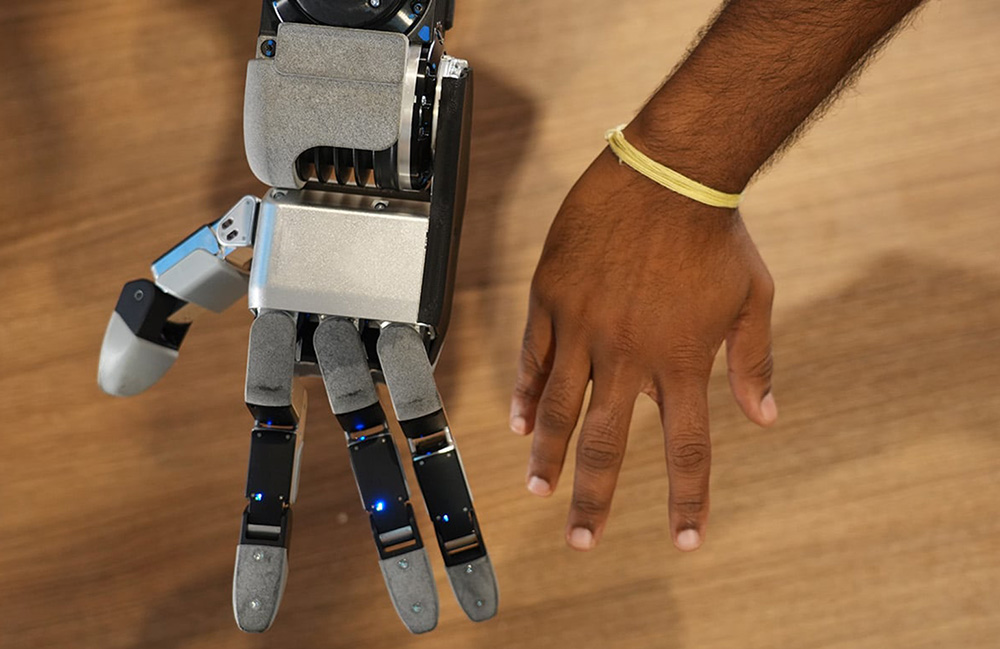
Lessons from the Atlas body shaped the design. "Simplicity, modularity, and actuator maturity make sense in theory, but over time you start appreciating their impact on the velocity you can move," said Alberto Rodriguez, director of robot behavior for Atlas. The hand uses 13 identical, fully encapsulated actuators with no fragile cables crossing joints. Because earlier hands could already lift loads over 100 lb, the team did not need to increase strength and even considered lowering it slightly to improve actuation transparency.
Durability follows the company's established path: early prototypes are placed with the systems, controls, and behavior teams to surface "unknown unknowns," then pass rigorous validation and verification tests before deployment. Testing spans representative industrial tasks — handheld power tools, cable handling, fishing for screws — alongside less mission-oriented experiments such as juggling and speed hand games.
The finger count was a pragmatic decision. One concept with strong early support featured two thumbs, which would allow a single assembly line to produce identical left and right hands. Boston Dynamics ultimately rejected it because the extra actuation complexity incurred additional degrees of freedom, cost, and volume.
For simulation, the team designed the actuation and transmission with backdrivability and transparency in mind, while controller techniques compensate for residual non-idealities such as friction. Accurate dynamic simulation enables reinforcement learning to train proprioceptive policies that transfer directly to hardware — the same recipe behind recent agile humanoid behavior. Rodriguez believes simulation-based RL will be a key enabler for manipulation beyond pick-and-place.
The new hands have been used extensively at headquarters but not yet deployed across the fleet, including RMAC. "That is a process that requires coordination and time to make sure it does not disrupt regular operations like data collection or applications," said Rodriguez.