


Microsoft Unveils Maia 300 AI Chip With 7x Rack-Scale Inference Throughput
 14 October 2026 05:32 PM
Summary: Microsoft has unveiled Maia 300, its third-generation custom AI accelerator designed to improve inference performance and energy efficiency. Scheduled for deployment in 2027, the chip targets up to 40% more tokens per megawatt than leading GPU-based systems, as Microsoft scales its in-house AI infrastructure.
Microsoft is accelerating its investment in custom AI chips with Maia 300, a new accelerator designed to power large-scale AI inference across its cloud and productivity services. The announcement also marks a new stage in the company's silicon strategy, as its predecessor, Maia 200, enters full production across Microsoft's global data centers.

An Architecture Built for AI Inference
Unlike chips designed primarily to train AI models, Maia 300 focuses on inference — the process of running trained models to generate responses, analyze information and execute tasks. This workload is becoming increasingly important as AI assistants and autonomous agents handle longer conversations and more complex, multi-step requests.
Microsoft says Maia 300 is optimized for long-context processing, memory-intensive operations and token generation. These workloads place significant demands on memory bandwidth, data movement and power consumption.
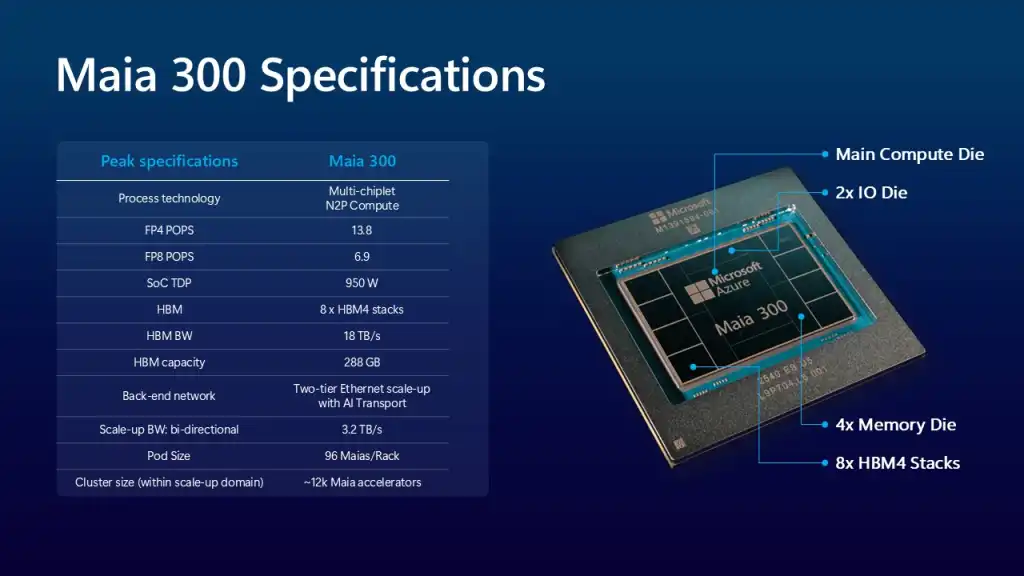
The company expects Maia 300 to deliver approximately 40% more tokens per megawatt than leading GPU-based systems. In a rack containing 96 accelerators, it also claims up to seven times the rack-scale token throughput of Maia 200. These figures are Microsoft's stated performance targets, rather than independently verified benchmark results.
Scaling Custom Silicon Across Azure
Microsoft plans to deploy Maia 300 in production in 2027, with its Maia processor family targeted for expansion to multi-gigawatt scale. The chips are intended to support internal workloads, including Copilot and other Azure-based AI services.
The strategy does not mean Microsoft is abandoning GPUs from suppliers such as Nvidia and AMD. Instead, custom accelerators give the company greater control over inference costs, power efficiency and data-center infrastructure while maintaining access to external hardware.
Why Maia 300 Matters
As AI adoption grows, the cost of generating each token and the number of requests a data center can handle are becoming critical measures of infrastructure efficiency. Improving both could help cloud providers deliver AI services at lower operating costs and greater scale.
However, real-world performance will depend on software optimization, workload characteristics and deployment efficiency. Maia 300's significance will ultimately be determined by how its claimed advantages translate into production workloads, making its planned 2027 rollout an important milestone in Microsoft's custom AI silicon strategy.