


Voltage-controlled lithium niobate chip boosts laser scanning displays for smart glasses
 21 October 2026 05:31 PM
Summary: TDK researchers demonstrated a thin-film lithium niobate photonic integrated circuit that uses voltage to modulate RGB laser light, delivering faster color switching and far lower power for compact laser beam scanning smart-glass displays.
Laser beam scanning is a promising display technology for lightweight smart glasses, drawing images by steering lasers pixel by pixel. Traditional designs tune laser brightness by adjusting diode current, which limits color-switching speed, caps resolution and raises power use.
Published in Advanced Photonics Nexus, the work from Yasuhiro Takagi and the TDK team replaces direct laser-current modulation with an external photonic chip built on thin-film lithium niobate. The chip integrates three Mach–Zehnder interferometers for red, green and blue channels. Applied voltage adjusts light intensity in each channel before a waveguide multiplexer combines them into one full-color laser beam.
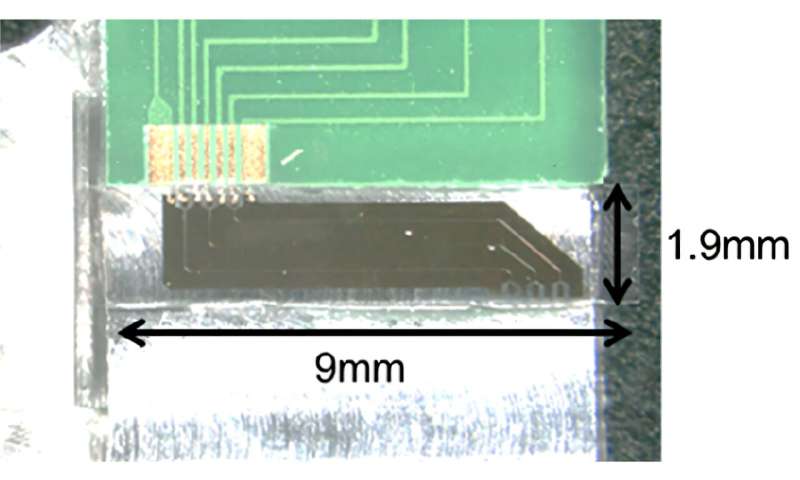
A photonic integrated circuit device designed with a thin film of lithium niobate enables control of laser light with variable electrical voltage.
The device reaches a 10 GHz modulation bandwidth, enough to support 4K and higher resolutions. Compared with conventional current-driven systems, it cuts power consumption by more than 75% and removes the need for power-wasting neutral-density filters. The team paired the circuit with a fast micro-scanning mirror to prove full-color image generation.
The design addresses key barriers for wearable hardware: switching speed, energy demand and component count. The researchers note the main remaining challenge is reducing optical loss in waveguides and combiners. Lower losses would further improve efficiency and help bring this photonic circuit into production-ready compact smart-glass displays.