Product Description

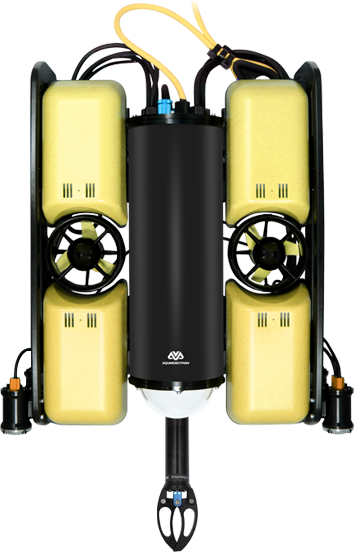
SY4 Professional-Grade Underwater Robot
500-meter Deep Pressure Operation | 1080° Full Attitude Control | Modular Expansion System
● 8-Thruster Vector Layout
● High-Density Corrosion-Resistant Alloy Body
● Supports Heavy-Duty Robotic Arm Mounting
The SY4 underwater robot is a high-performance operating platform. It utilizes a high-density corrosion-resistant alloy body and is capable of operating at depths of 500 meters. Equipped with 8 thrusters and a 1080° full-attitude control system, it can hover stably and maneuver flexibly even in complex water currents. The robot supports modular expansion such as 4K high-definition camera, various sonar systems, and a high-load robotic arm. It is widely used in professional scenarios such as dam inspection, underwater rescue, archaeological exploration, and operations in confined spaces, providing a reliable intelligent underwater solution.
Product Features

Deep-water robust hull
500-meter pressure-resistant depth,
high-density corrosion-resistant alloy body;
Frame structure, weighing only 26kg in air;

Omnidirectional precise control
8-thruster vector layout, 1080° all-attitude control;
Center of gravity and buoyancy coincide, stable hovering in any posture;

Modular expansion
Can be equipped with robotic arms, various types of sonar,
underwater lasers, etc.;
Supports customization of high-load accessories;

High-definition vision system
1080P camera, 4x optical zoom;
±90° pitch, Intellisight HD image enhancement;

Professional operation support
Zero-buoyancy cable, standard 100 meters (300 meters optional);
External power supply, long-lasting operation.
Structure Diagram

Propulsion device Scanning sonar Hanging ring
Camera
Robotic arm Searchlight
Product parameters
Main Unit | |
Dimensions (L*W*H) | 630mm*470mm*300mm |
Weight in Air (without peripherals) | ≤26kg |
Structure | Frame-style |
Pressure Depth | ≥500m |
Thrusters | 8 Thrusters (4 horizontal, 4 vertical) |
Corrosion Resistance | Main body uses corrosion-resistant materials, suitable for both seawater and freshwater |
Front Camera & Lights | |
Pixels | 1080 |
Zoom | 4x Optical Zoom |
Focus | Auto Focus |
Focal Length | 1.6mm |
Pitch angle | ±90° |
Yaw angle | ±60° |
Lighting | Main Lights: 2 * 3500LM (can be enhanced) |
Cable | |
Length | Standard 100m, optional 300m |
Diameter | ≤12mm |
Cable Type | Zero-buoyancy Cable |
Sensors | |
Supported Devices | Single-beam sonar, Multi-beam sonar, Side-scan sonar, Forward-looking sonar, Multi-degree-of-freedom manipulator, Underwater 3D laser |
Applications
The SY4 underwater robot is suitable for deep-water narrow space exploration, dam inspection, underwater rescue, archaeological photography, underwater surveying, and underwater ship inspection. With its 500m pressure resistance, high-definition imaging, and equipment expansion capabilities, it can meet the needs of various complex underwater operations.

FAQ
1.Q: Is it difficult to insert the plug that connects the robot cable to the robot?
A: Pay attention to the red dot marks at both ends of the plug; insert it after aligning them.
2.Q: How to solve the stuttering of the camera image?
A: Just restart the UUVGS software.
3.Q: Is it difficult to insert the 400V DC power supply line and 220V AC power supply line into the control box?
A: Pay attention to the groove on the plug, align it with the protrusion on the socket, insert it and then rotate.
4.Q: The handle controls the headlight and small light switches, but the lights have no response?
A: Check whether the connection between the handle and the host is normal; press the handle buttons corresponding to the headlight and small light a bit harder.
Precautions
1.When connecting the cable to the underwater robot body, apply a small amount of silicone grease to the threaded part to improve the connection performance.
2.After the underwater robot is powered on, please wait for 3 minutes before starting the thruster, which helps to extend the service life of the robot.
3.Before the underwater robot enters the water, be sure to use an air cylinder/air pump to inflate the robot's cabin to check its airtightness (you can observe the change of the cabin pressure value through the upper computer; it is usually better if the pressure does not drop rapidly). After inflating, be sure to tighten the air hole cover before using it underwater.
4.When inserting the 220V AC power supply line and 400V DC power supply line of the underwater robot into the control box, be sure to check the hole positions clearly before inserting to avoid damage.
5.If the upper computer of the underwater robot control box reports water leakage information, be sure to turn off the power supply of the underwater robot immediately.