


Summary: Morgan Stanley forecasts that AI-powered robots moving beyond factories will drive explosive demand for edge computing, reshaping global robotics and infrastructure.
Morgan Stanley’s latest report, The Robotics Almanac, Volume 2, highlights a historic transformation in the global robotics industry: robots are moving from structured factory floors into unstructured environments—homes, cities, farms, and even space—while training focus shifts from AI “brain” models to the “body” of physical motion control.
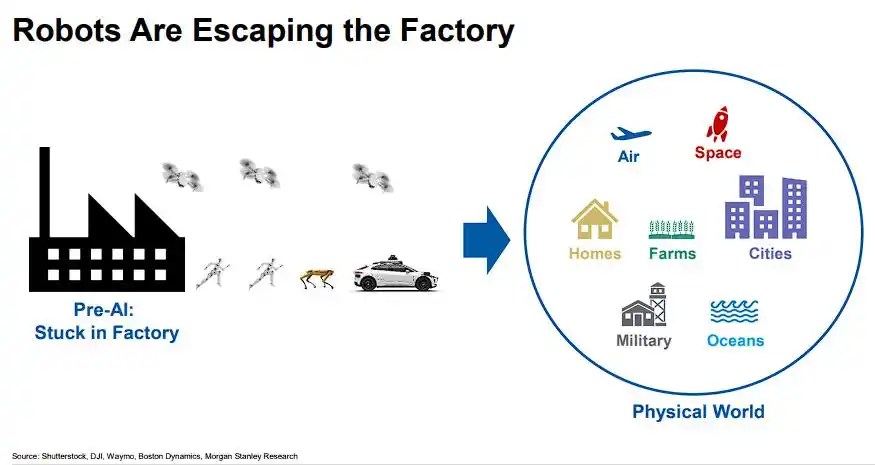
Traditional industrial robots operate in controlled settings, performing repetitive tasks without real-time perception or learning. In contrast, the new generation of AI-enabled robots must navigate complex, dynamic environments. Even simple tasks, such as picking a bottle from a refrigerator, involve precise finger positioning, balance adjustment, grip modulation, and adaptation to environmental factors like humidity. These requirements demand advanced real-time perception, dynamic decision-making, and fine motion control.
| Teleoperation | Simulation | Videos |
|  |  |
|
|
|
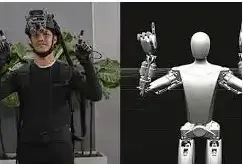
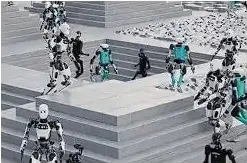
This shift highlights a fundamental bottleneck: physical skill acquisition is far more complex than cognitive training for AI, a phenomenon aligned with the Moravec Paradox. Unlike large language models trained on vast text and image datasets, robot models require extensive real-world physical operation data. Morgan Stanley notes that tech giants—including Tesla, NVIDIA, and Google—are collecting such data through teleoperation, simulation training, and video learning. Teleoperation mimics human actions via motion capture but has limited scalability. Simulation training reproduces complex scenarios in virtual environments, leveraging digital twins and reinforcement learning. Video-based learning extracts motion patterns from human activities, enabling prediction of object trajectories and interactions.
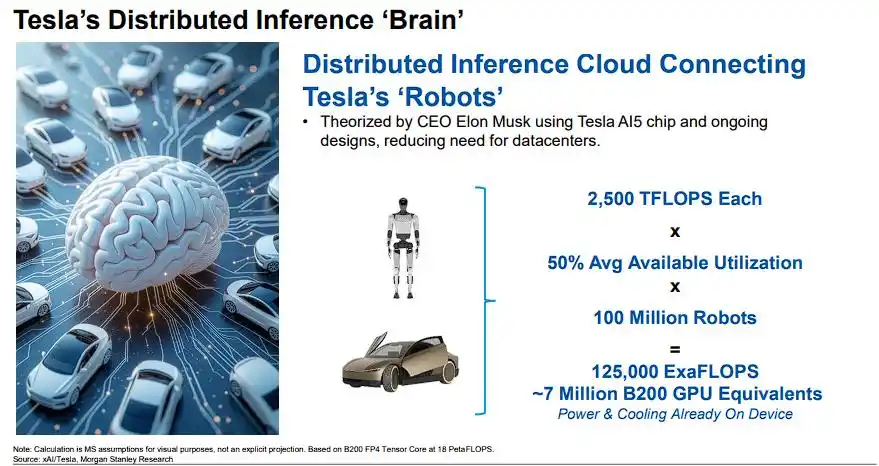
As robots “escape the factory,” cloud-centric computing faces latency challenges, particularly for applications like autonomous driving that require millisecond-level responses. Morgan Stanley forecasts a surge in edge computing demand, driven by two trends. First, specialized edge chips such as NVIDIA Jetson Thor provide high-performance, low-latency computation for real-time robotic tasks. Second, distributed inference networks, where robots themselves act as computing nodes, could cumulatively deliver exascale-level processing. Tesla’s proposal suggests that 100 million globally deployed robots, each with 2,500 TFLOPS, could collectively achieve 125,000 ExaFLOPS—equivalent to seven million high-end GPUs—while reducing reliance on centralized data centers.
Morgan Stanley predicts that by 2030, edge computing demand from humanoid robots, autonomous vehicles, and drones will rise sharply, with global robot sales reaching 1.4 billion by 2050. This unprecedented growth will not only redefine robotics applications but also reshape the global computing infrastructure, creating investment opportunities in real-time inference chips, simulation platforms, and advanced sensors.
The report underscores a paradigm shift: future robots will combine sophisticated AI cognition with precise physical execution, operating seamlessly in the real world while driving an edge-computing revolution

