


Abstract:No blood needed, just a simple, band-aid-like skin patch, and you can determine the effectiveness of your flu or COVID-19 vaccine within ten minutes. Researchers at the University of Pittsburgh have recently developed a technology that makes this seemingly science fiction a reality.
Recently, a research team at the University of Pittsburgh announced the development of a painless, blood-free microneedle array sensor patch. This device can rapidly detect antibodies associated with COVID-19 and influenza virus infections, providing a painless alternative for monitoring vaccine effectiveness.

This research, published in the journal *Analytical Chemistry*, shows that the sensor requires only 0.5 volts of power and can produce results within 10 minutes, with a sensitivity several orders of magnitude higher than existing antibody detection methods.
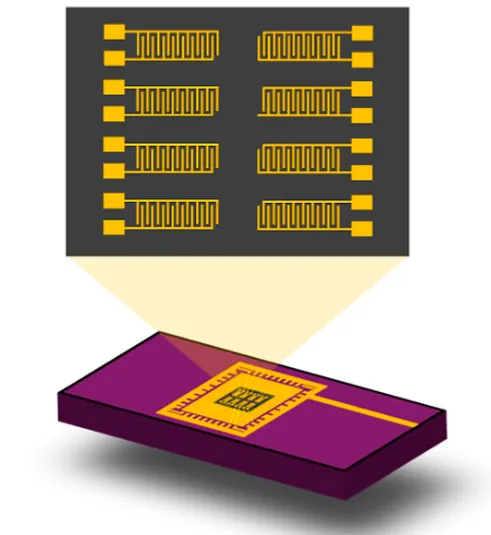
Top: magnification of the sensor chip with eight gold interdigitated devices. Bottom: the wire-bonded sensor chip on a package for field-effect transistor (FET) measurements.
"It doesn't go in too deep, so it doesn't hurt," explained Alexander Starr, a professor of chemistry at the University of Pittsburgh's Kenneth P. Dietrich College of Arts and Sciences, in a press release. "It doesn't touch any nerves, you don't lose blood, but you get the same results as traditional tests." Carbon nanotube technology enables precise detection.
The core technology of this sensor lies in a virus-specific antigen attached to a carbon nanotube 100,000 times thinner than a human hair. The device is painlessly attached to the skin via an array of microneedles, sampling the tissue fluid between skin cells.
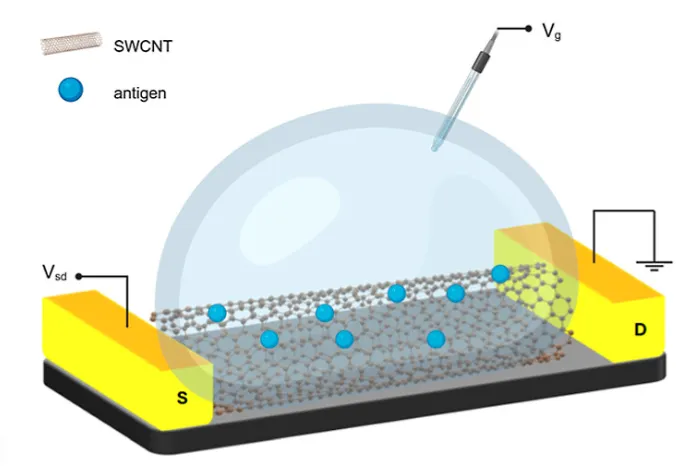
Schematic illustration of a liquid-gated antigen-functionalized single-walled carbon nanotube FET biosensor for detection of antibodies.
When the corresponding antibody binds to the antigen, the electrical properties of the carbon nanotube change, indicating the presence of the specific antibody. This detection method can determine whether a vaccine has successfully "trained" the body's immune system to fight a specific virus.
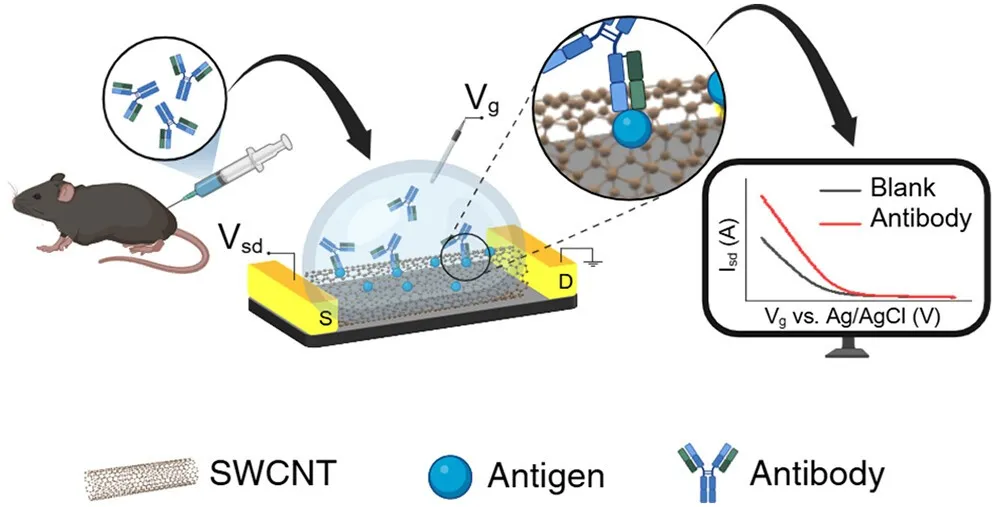
This technology will help clinicians assess vaccine effectiveness and determine whether patients with a strong natural immune response need booster shots.
With broad application prospects, this platform, in addition to detecting antibodies against SARS-CoV-2 (the virus that causes COVID-19) and H1N1 (the influenza virus), can also be configured to identify antibodies associated with a variety of conditions, including autoimmune diseases that are often triggered by viral infections in their acute phase. It is understood that Professor Starr has previously used a similar carbon nanotube platform to develop sensors for detecting substances such as cannabis and fentanyl.
Source: Online Public Resources

