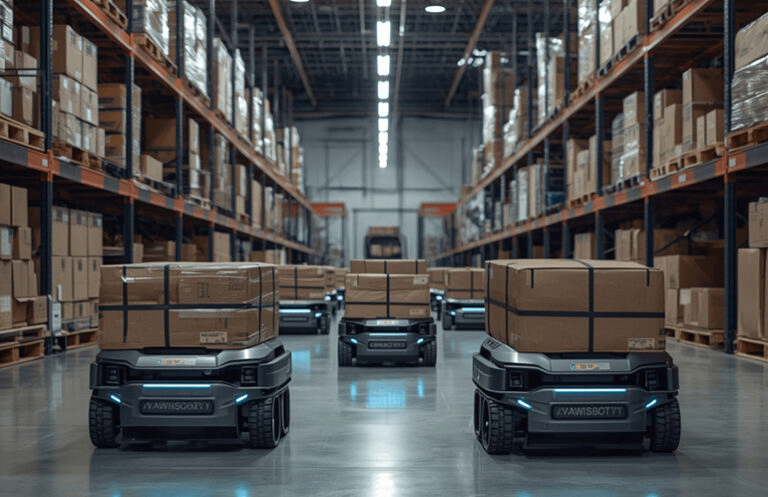
Summary:Next-generation FMCW LiDAR integrated with silicon photonics is enabling more precise, affordable, and scalable 3D sensing for autonomous robots, forklifts, and warehouse automation systems.
As warehouses, factories, and logistics centers accelerate automation, demand is growing for sensing technologies that allow machines to navigate and interact with complex environments safely and efficiently. Industry experts increasingly point to Frequency Modulated Continuous Wave (FMCW) LiDAR combined with silicon photonics as a key technology for the next generation of industrial robotics.
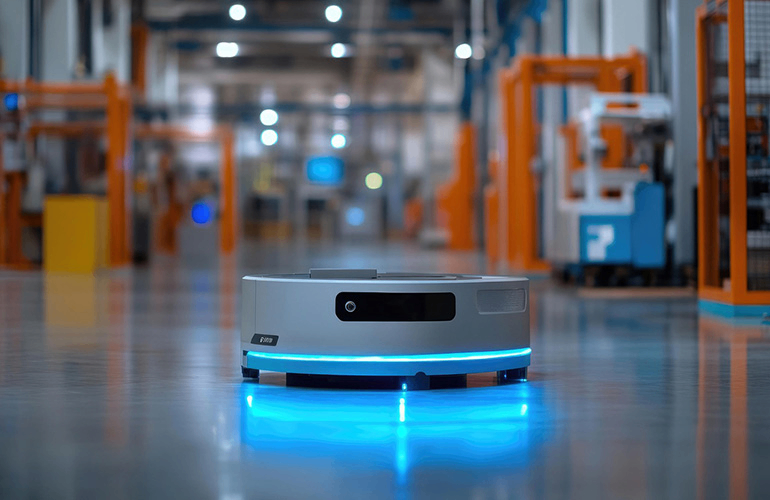
Traditional sensing solutions, including cameras, Time-of-Flight (ToF) sensors, and conventional LiDAR, often struggle in challenging industrial environments where glare, dust, reflective surfaces, and changing lighting conditions can reduce accuracy. As autonomous mobile robots (AMRs), robotic arms, and automated forklifts become more common, reliable perception has become a critical requirement.
FMCW LiDAR offers a different approach. Instead of measuring the return time of laser pulses, it continuously emits a frequency-modulated laser signal and analyzes the reflected light. This enables the system to simultaneously measure an object's distance and velocity in real time. The technology also provides strong resistance to ambient light interference, sensor cross-talk, and adverse environmental conditions.
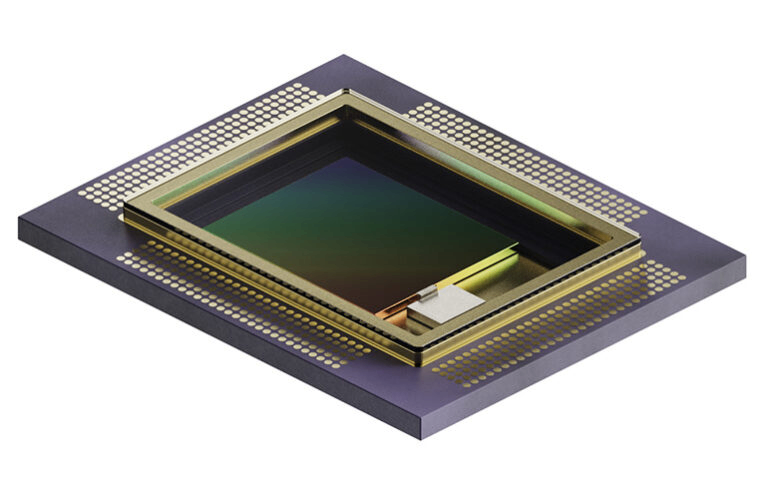
The scalability challenge has been addressed by advances in silicon photonics. By integrating light generation, beam steering, and signal detection onto a single photonic chip, manufacturers can dramatically reduce sensor size, complexity, and cost. This "LiDAR-on-a-chip" architecture enables wafer-scale production similar to semiconductor manufacturing, paving the way for large-scale deployment across industrial applications.
Potential use cases include autonomous forklift guidance, robotic picking and sorting, mobile robot navigation, human-machine safety monitoring, and outdoor logistics operations. The combination of high-resolution 3D perception, sub-centimeter accuracy, and real-time velocity sensing allows autonomous systems to operate more efficiently while reducing errors and improving workplace safety.
As Physical AI continues to evolve, advanced perception is becoming as important as computing power. FMCW LiDAR and silicon photonics represent a significant step toward scalable machine perception, providing the foundation for autonomous systems that can better understand and respond to the physical world.
With industrial automation expanding rapidly worldwide, compact and cost-effective sensing technologies may play a defining role in enabling the next generation of intelligent robots and autonomous logistics platforms.