


Summary: The D5 wheel-leg hybrid quadruped robot demonstrates a new approach to autonomous mobility by combining high-speed wheeled travel with agile legged stair climbing. Designed for industrial automation and large-scale outdoor environments, the platform integrates AI computing, 360-degree perception, and autonomous navigation to efficiently handle complex terrain transitions.
The D5 wheel-leg hybrid quadruped robot is showcasing how next-generation industrial robots can combine speed, efficiency, and terrain adaptability within a single platform. In a recent demonstration, the D5 smoothly transitioned between wheeled driving and legged locomotion while climbing multiple staircases at speeds of up to 1.5 meters per second, highlighting the practical potential of hybrid mobility systems.
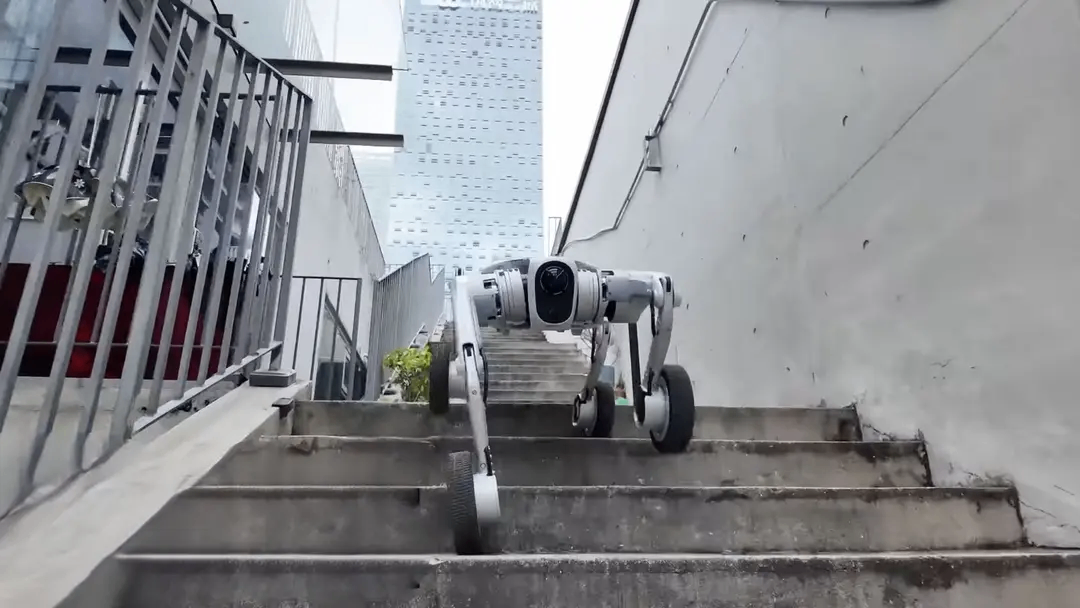
Unlike conventional quadruped robots that rely entirely on legged movement, the D5 uses wheels for rapid travel across flat surfaces and automatically switches to a canine-inspired climbing posture when encountering stairs, ramps, or uneven terrain. This seamless mobility transition enables greater operational efficiency in mixed indoor-outdoor environments.
The platform is powered by a dual-processor architecture combining NVIDIA Orin and RK3588, delivering up to 275 TOPS of AI computing performance. This supports advanced capabilities including real-time SLAM mapping, autonomous navigation, obstacle avoidance, path planning, and 3D environmental reconstruction.
To enhance situational awareness, the D5 integrates a 360-degree perception system featuring fisheye cameras and high-resolution LiDAR sensors. The system generates dense 3D point-cloud maps for autonomous operation across large facilities such as airports, industrial parks, logistics hubs, and transportation infrastructure.
Performance specifications further position the D5 as a capable industrial mobility platform. The robot can reach 5 meters per second on flat terrain, climb 30-degree slopes, overcome stairs and obstacles, and carry payloads of up to 30 kilograms.
As demand grows for industrial quadruped robots, AI-powered autonomous inspection systems, and wheel-leg hybrid robotic platforms, the D5 demonstrates how combining wheeled speed with legged adaptability could accelerate the deployment of robotics in complex real-world environments where traditional automation solutions remain limited.

