


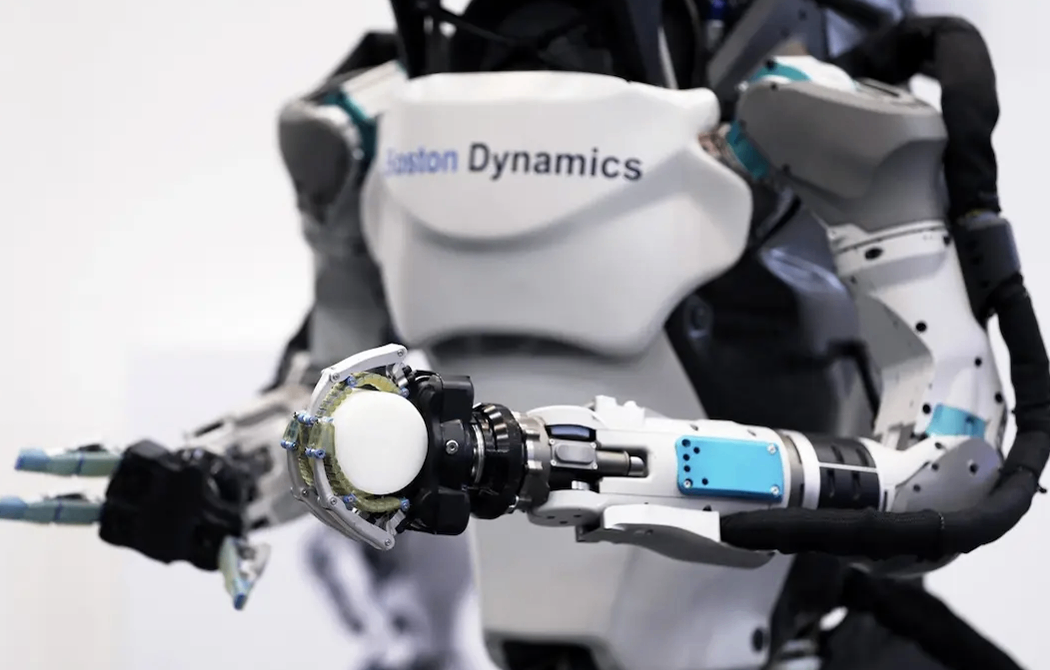
At the Consumer Electronics Show (CES) in Las Vegas, Boston Dynamics, a subsidiary of Hyundai Motor, unveiled its humanoid robot Atlas for the first time on Monday, officially launching its direct competition with companies like Tesla in the humanoid work robot market. This highly agile humanoid robot not only completed a smooth live demonstration, but its production version also has a confirmed timeline for deployment.
"Please welcome Atlas for its first public appearance!" With Zachary Jakowski, General Manager of Boston Dynamics' Humanoid Robotics Division, the life-size robot, equipped with arms and legs, smoothly rose from the ground and walked smoothly on the stage for several minutes. During the demonstration, Atlas waved to the audience from time to time, and its head could turn flexibly like an owl, demonstrating excellent motion control capabilities. Jakowski revealed that this demonstration used a remote control mode, while in real-world applications, Atlas will achieve fully autonomous movement.
Notably, Boston Dynamics has begun production of the Atlas robot, specifically designed for automotive assembly, which will be officially deployed at Hyundai's electric vehicle manufacturing plant near Savannah, Georgia, by 2028. As a company with decades of experience in robotics, Boston Dynamics previously made its name with its quadruped robot Spot. At CES, four Spot robots opened the Hyundai booth with a synchronized performance of a K-pop song, attracting considerable attention.
On the technology front, Hyundai also announced a key collaboration: a deep partnership with Google's DeepMind, with the latter providing AI technology support for Boston Dynamics' robots. This collaboration carries a strong sense of "reunion"—Google acquired Boston Dynamics in 2013, sold it to Japan's SoftBank a few years later, and finally acquired it in 2021, becoming its controlling shareholder.
For leading robotics companies, publicly showcasing humanoid robots is uncommon. The core reason is that any mishap during a live demonstration can easily trigger negative public opinion. For example, last November, Russia's first humanoid robot fell over during a demonstration. Therefore, most robotics startups prefer to release prototype videos on social media, showcasing the robot's best performance and allowing for editing to avoid showing malfunctions. Atlas's live demonstration, however, was flawless throughout, culminating in an exaggerated arm-waving motion that revealed a slightly modified, all-blue static model of the production version.
Currently, the surge in commercial AI and technological breakthroughs have injected massive amounts of capital into the robotics R&D field. However, industry experts generally believe that truly versatile and highly realistic humanoid robots still have a long way to go before they can fully enter the workplace and home.
“I think the question comes back to what are the use cases and where is the applicability of the technology,” said Alex Panas, a partner at consultancy McKinsey who helped lead a CES robotics panel that attracted hundreds of people earlier in the day. “In some cases, it may look more humanoid. In some cases, it may not.”
Parnas further pointed out that technologies in software algorithms, chip modules, and communication technologies are rapidly converging, which will inevitably give rise to more entirely new application scenarios in the future. From the current technological standpoint, humanoid robots are not yet capable of threatening large-scale human employment. However, as their skills continue to improve, the debate surrounding their employment impact is likely to intensify. It's worth noting that Hyundai's Georgia plant, where it plans to deploy Atlas robots, was raided by U.S. Immigration and Customs Enforcement last year, resulting in the arrest of hundreds of workers, including over 300 South Korean nationals.

