


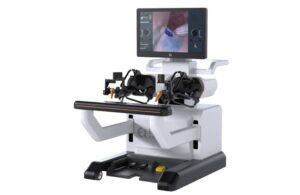
The ELS physician console
Endoquist Robotics today announced a series of new collaborative initiatives with NVIDIA in the field of endoscopic surgical robotics.
Houston-based Endoquist Robotics previously announced in October 2025 its plan to integrate NVIDIA's IGX Thor platform into its next-generation surgical robot system.
Compared to its predecessor, NVIDIA has enhanced the IGX Thor platform with increased computing power, improved energy efficiency, and enhanced system awareness. The cloud computing giant has already partnered with numerous companies in the surgical robotics field, including CMR Surgery, Johnson & Johnson Medical Technology, Karl Storz's Athens Surgery, Lunar Surgery, Virtual Incision Surgery, Neptune Surgery, and Stereotactic Surgery.
This collaboration between Endoquist Robotics and NVIDIA focuses on three core areas: visualization systems, robot control technology, and secure cloud services. The goal is to achieve the integrated application of real-time image processing, precise robot control, and cloud intelligence within a unified architecture.
The company plans to develop its next-generation platform into an image-based real-time solution system, facilitating intraoperative tissue identification, tissue perfusion visualization, and supporting autonomous execution of certain surgical tasks. Simultaneously, the company will equip the platform with advanced functions such as remote robot operation, remote surgical guidance and supervision, and collaborative surgical workflow management, creating complementary functionalities.
As a crucial part of this collaboration, Endoquist Robotics will fully leverage NVIDIA's AI infrastructure, utilizing its low-latency sensor processing, 3D visualization, precise time-synchronized motion control technology, and secure cloud connectivity. These technological capabilities will support device cluster management, data services, remote surgical supervision, and the future deployment of AI technologies.
This collaboration is progressing concurrently with Endoquist Robotics' ongoing PARADIGM clinical trial, which aims to validate the clinical efficacy of its endoscopic surgical robot system, focusing on its performance in lower gastrointestinal surgery.
More information about Endoquist's endoscopic surgical robot:
Endoquist Robotics has independently developed its endoscopic surgical system (ELS). This surgical robot platform was initially developed to address unmet clinical needs in gastroenterology and other endoscopic surgical fields. The system combines operational precision and flexibility, helping to improve patient outcomes.
According to the company, this system enables endoscopic surgery to combine the visualization, operational precision, and core technological advantages of traditional surgery, achieving surgical procedures and movements that are currently impossible with advanced therapeutic endoscopy techniques. Its independently developed core technology supports robot navigation and surgical operations within the body's luminaries, facilitating minimally invasive interventional treatments and allowing gastrointestinal endoscopists and surgeons to perform surgery via the mouth or anus.
In December 2024, the system received Investigational Device Exemption (IDE) designation from the U.S. Food and Drug Administration (FDA). In May 2025, the company announced the completion of the first colorectal surgeries in the clinical trial; in October of the same year, it announced the first surgery performed independently by a gastroenterologist.

