


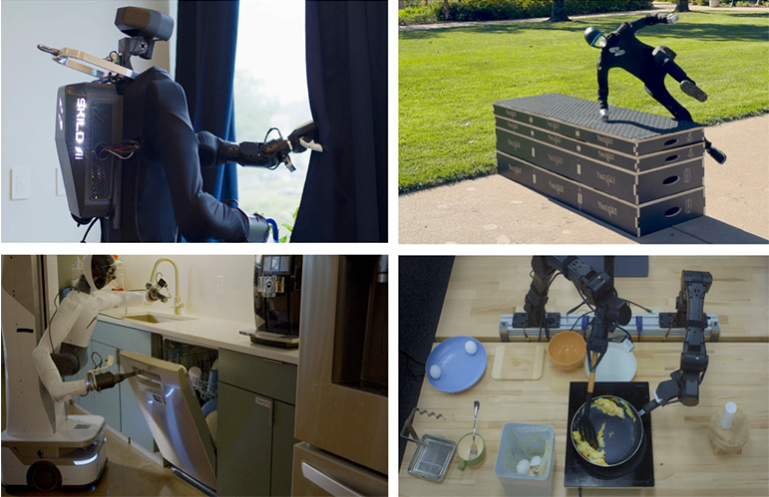
In a global industry context where the focus of competition in embodied intelligence is shifting from "limbs" to "brains," Skild AI, a company specializing in the development of fundamental robot models, has achieved a major breakthrough. The company recently announced the completion of a nearly $1.4 billion funding round, pushing its valuation above $14 billion. Simultaneously, it launched Skild Brain, touted as the "industry's first unified robot fundamental model," laying a core foundation for the development and large-scale application of general-purpose robots.
Core Breakthrough: A Shared Brain Adaptable to All Robot Models
Skild AI explicitly states that a unified robot fundamental model is a key prerequisite for building general-purpose robots. Unlike traditional AI models tailored to specific robots, Skild Brain's core advantage lies in its "universal compatibility"—it can achieve precise control of multiple robot types, including quadruped robots, humanoid robots, desktop robotic arms, and mobile manipulation robots, without requiring prior knowledge of the robot's specific morphological parameters.
This "shared brain" empowers robots to cover all task requirements across various scenarios: capable of performing everyday chores such as cleaning, loading dishwashers, and frying eggs, as well as tackling complex challenges that demand high performance from the robot, such as navigating slippery terrain. Founded in 2023 by two pioneers in self-supervised learning and adaptive robotics, Skild AI currently has offices in Pittsburgh, the San Francisco Bay Area, and Bangalore, India, continuously advancing the research and iteration of its foundational models.
Technical Breakthrough: Diverse Data and Dynamic Adaptation
Skild AI points out that the core challenge in developing basic robot models lies in the lack of a readily available "internet-level data ecosystem," a fundamental difference from language or video models. To overcome this challenge, the company employs diverse alternative data sources for pre-training Skild Brain. Key methods include learning by watching online videos of human operation and repeated hands-on training in physical simulation environments.
Thanks to its cross-model compatibility, Skild Brain's training dataset has been significantly expanded, resulting in powerful dynamic adaptive capabilities. Even when the robot encounters unexpected situations such as limb damage, wheel jamming, increased load, or even a completely new body shape, the model can quickly adapt to these unforeseen scenarios without retraining or fine-tuning.
“The Skild Brain can control robots it has never trained on, adapting in real time to extreme changes in form or environments. The model is forced to adapt rather than memorize – much like intelligence in nature,” stated Deepak Pathak, co-founder and CEO of Skild AI. “We believe that a unified, omni-bodied brain is the fastest way to establish a continuous data flywheel where the model gets better with every single deployment, no matter what the hardware or task.”
Currently, besides Skild AI, companies such as Qualcomm, Sanctuary AI, and X Square Robot are also actively developing general artificial intelligence technologies for robots. Industry competition focuses on the ability to build fundamental models and data loops.
Key Support: Contextual Learning Drives Intelligent Upgrades
Over the past year, Skild AI has continuously disclosed technological advancements, demonstrating Skild Brain's core ability to flexibly adjust robot movements based on visual information from the surrounding environment. Behind this generalization ability lies the support of contextual learning technology.
According to reports, Skild Brain can dynamically adjust its behavior patterns based on real-time contextual learning experience when applied to new robot bodies, deployed in unknown environments, or when initial action plans fail. The relevant research results have been officially published, providing important reference for the industry's technological development.
“We believe this omni-bodied learning is essential for building AGI [artificial general intelligence] that works reliably in the physical world, paving the way for robots that can safely help humans in everyday environments,” said Abhinav Gupta, co-founder and president of Skild AI. “This enables robots to operate dynamically in complex environments, without requiring preprogrammed instructions for each scenario.”
Commercialization: Multi-Scenario Applications and Market Goals
While achieving technological breakthroughs, Skild AI's commercialization process is accelerating. Data shows that in just a few months in 2025, the company's revenue jumped from $0 to $30 million. Currently, its technology has been applied in various scenarios such as security inspection, last-mile delivery and point-to-point transportation, warehouse management, smart manufacturing, data center operation and maintenance, and construction, validating its practicality and commercial value.
This $1.4 billion funding round was led by SoftBank Group, with participation from NVIDIA Ventures, Macquarie Capital, Bezos Expeditions, Disruptive Ventures, 1789 Capital, and other institutions. Existing investors including Lightspeed Venture Partners, Felicis, Coatue, and Sequoia Capital also increased their investments. Notably, Samsung, LG, Schneider Electric, CommonSpirit, and Salesforce Ventures participated as strategic investors, along with other investors including TF Capital and Andra Capital.
“Skild AI is building foundational technology for physical AI across robots, tasks, and environments,” said Dennis Chang, managing partner at SoftBank Investment Advisers. “We’re proud to partner with Deepak, Abhinav, and the Skild AI team to bring that shared vision into real-world applications worldwide.”
“Solving intelligence for the physical world unlocks enormous commercial value and long-term strategic national importance,” said Rita Waite, a partner at IQT. “Skild AI is uniquely positioned to do both, and we’re excited to be working with this team as they build.”
Skild AI stated that the newly raised funds will primarily be used to expand model training and accelerate the deployment of its technology in more scenarios. The company will use enterprise-level scenarios as its first entry point for technology implementation, with the ultimate goal of bringing robotics technology to the consumer home market. It also emphasized that “Skild AI is poised to be a critical force behind re-inventing American manufacturing with automation,.”

