


Summary:Next-generation robots achieve human-like, fluid motion through core technologies like pneumatic muscles, harmonic reducers, central pattern generators, electroactive polymers, and shape memory alloys, enabling flexibility, precision, and real-world adaptability.
The era of clunky, rigid robots is over. Modern collaborative and soft robots, like the UR5 cobot, rely on advanced motion technologies that make their movements smooth, flexible, and remarkably human-like. These innovations enable robots to operate in tight spaces, handle delicate tasks, and improve collaboration with humans.
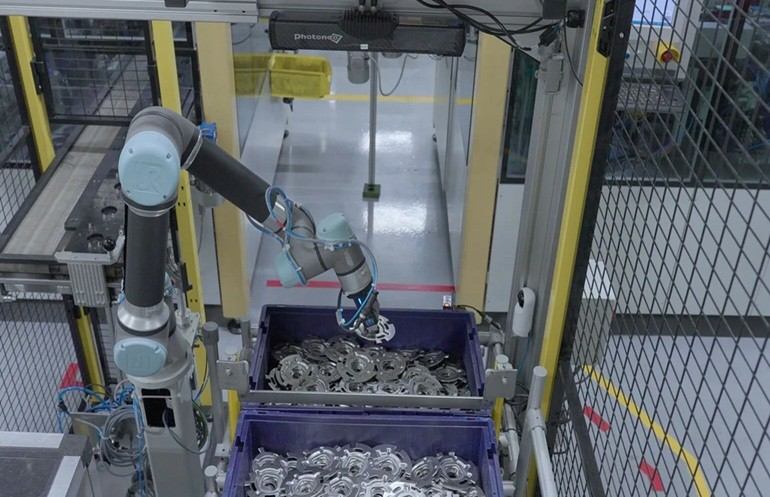
A UR5 cobot uses strain wave gearing for smooth motions in material handling.
At the heart of this evolution are five core technologies:
1、Pneumatic Artificial Muscles (PAMs) – Using air pressure to expand and contract, PAMs allow robots to mimic natural muscle movement. Festo’s E-Trunk robot demonstrates how bending and twisting become seamless without rigid joints.
2、Harmonic Reducers – These strain-wave gears reduce backlash and jitter, enabling fluid, precise joint movement. Universal Robots’ UR5 series uses them to achieve consistent, smooth motion in industrial and collaborative tasks.
3、Central Pattern Generators (CPGs) – Inspired by biological spinal cords, CPGs automatically generate natural motion patterns. The amphibious Salamandra Robotica II switches effortlessly between swimming and crawling thanks to these neural-like control systems.
4、Electroactive Polymers (EAPs) – These smart materials contract and change shape in response to electrical signals, replacing stiff mechanical transmissions and frequent lubrication, as seen in NASA’s early robotic grasping devices.
5、Shape Memory Alloys (SMAs) – By changing shape when heated or electrified, SMAs allow robots to adapt tasks in real time with fewer moving parts. Harvard researchers are exploring their use in wearable robots for smoother elbow and forearm motion.
Together, these technologies underpin the new generation of high-performance, flexible robots that can handle precision tasks, reduce energy consumption, and adapt dynamically to real-world conditions. Understanding these components is crucial for designers and engineers aiming to optimize robot performance, improve safety, and expand industrial applications.
Smooth robotic motion isn’t just a feature—it’s a transformative leap for industries ranging from manufacturing to rescue operations, signaling a future where machines move as intuitively and efficiently as living beings.

