


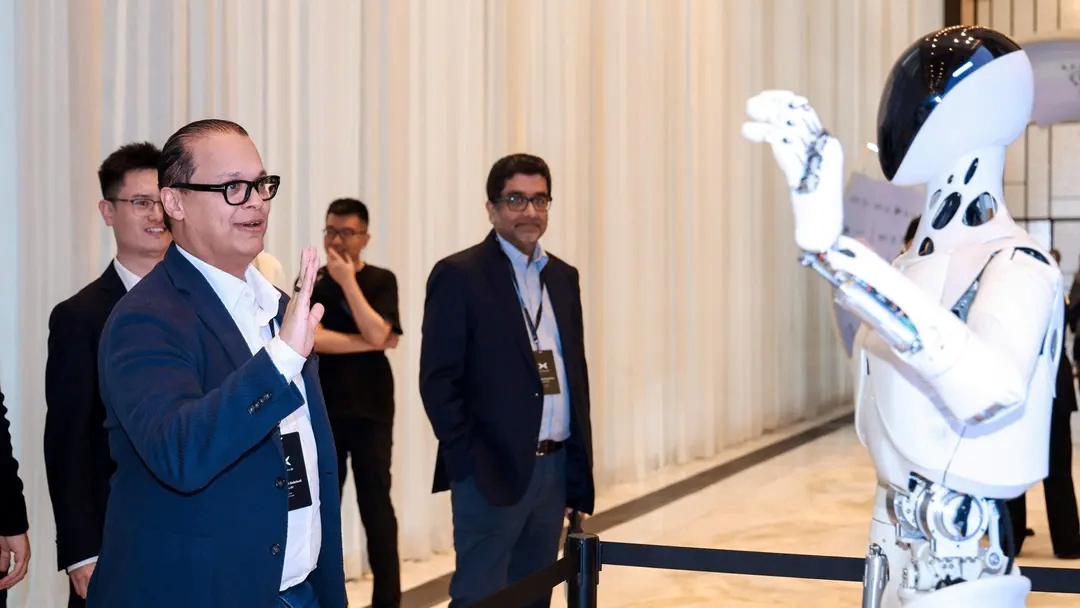
XPeng said it aims to begin mass production of humanoid robots by the end of 2026. (Representational image)
XPeng has completed the development of its first ET1 humanoid robot prototype, marking a significant step forward in the company's progress towards mass production of humanoid robots.
XPeng founder and CEO He Xiaopeng announced this milestone via social media, stating that the robot was developed and built strictly according to automotive-grade standards and has officially rolled off the production line.
"Today, our first ET1 robot, built to automotive-grade standards, successfully rolled off the production line," He Xiaopeng wrote on Weibo, mentioning that he and his team "observed and discussed the various technical details behind it" that day.
"This marks another crucial step towards achieving mass production of high-end humanoid robots this year," the CEO emphasized.
XPeng stated that the company plans to achieve mass production of humanoid robots by the end of 2026, a goal that will be announced as early as the XPeng AI DAY Technology Day event in November 2025.
Back in 2024, at its AI DAY event, XPeng first publicly disclosed its humanoid robot development plan and unveiled its first product—the IRON robot. This robot's motion design and form exhibited a high degree of human-likeness.
A Year-Long Robot Development Journey
At the 2024 XPeng AI DAY event, the first-generation IRON humanoid robot, developed based on years of technological accumulation, officially debuted. This model is equipped with over 60 joints and 200 degrees of freedom, enabling highly flexible motion output.
XPeng stated that its humanoid robot shares core technologies with its electric vehicles. "Currently, the robot has been integrated into XPeng's daily operations system, and is primarily used in internal scenarios such as factories and stores," the company pointed out at the launch event.
A year later, XPeng launched its second-generation humanoid robot product. This new product is equipped with a self-developed VLA 2.0 power architecture and multiple self-developed AI chips, achieving a computing power level of quadrillion calculations per second.
Leveraging core technologies such as anthropomorphic spine, bionic muscles, and flexible skin, the robot achieves highly realistic and fluid movements. During the demonstration, many audience members and online viewers initially mistook it for being controlled by a human.
To demonstrate its purely mechanical operation, XPeng staff showcased parts of the robot's mechanical structure via video during the demonstration.
XPeng revealed that its next-generation humanoid robot will prioritize the commercial service sector, with initial applications targeting service positions in industries such as retail and hospitality, and will not initially enter the personal consumer market.
AI and Robotics Strategic Layout
The humanoid robot R&D project is a crucial component of XPeng's overall "Physical Intelligence" strategy. This strategy encompasses autonomous driving, robotaxi, and other embodied intelligent systems.
XPeng's full-stack AI technology system, including large-scale models and customized chips, aims to connect the technological links between robots, autonomous driving, and other future mobility platforms, achieving technological integration and synergistic development.
Although XPeng's humanoid robots are still in the ongoing research and development stage, the successful rollout of the first ET1 prototype marks another solid step forward for the company in its journey to industrialize high-end humanoid robots.

