


Abstract: Microsoft introduces Rho-alpha, a robot vision-language-action (VLA) model based on the Phi series, which has tactile perception and natural language control capabilities, and can improve the robot's autonomous operation and adaptability in dynamic environments.
Microsoft Corp. has introduced Rho-alpha (ρα), the first robotics model derived from its Phi series of vision-language models, designed to enable robots—including humanoids—to operate autonomously in dynamic, unstructured environments.
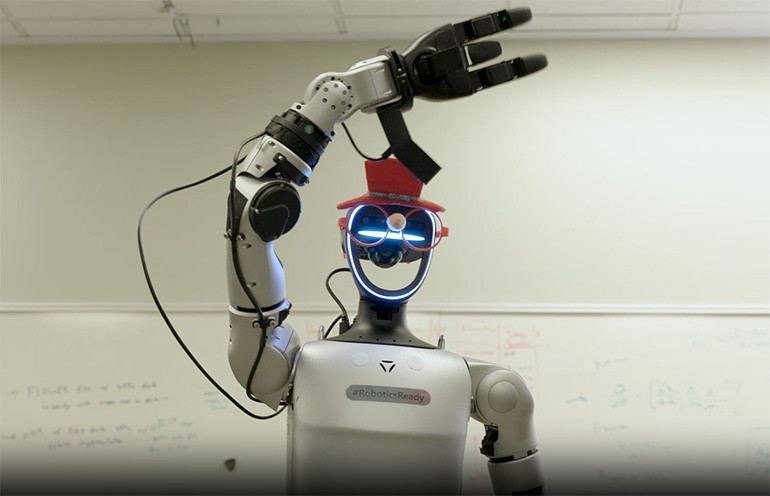
Rho-alpha is designed to help robots including humanoids become more autonomous. Source: Microsoft
Built as a vision-language-action (VLA) model, Rho-alpha translates natural language commands into control signals for robotic systems performing complex bimanual manipulation tasks. Unlike traditional VLA models, Rho-alpha incorporates tactile sensing and is designed to continuously improve through human feedback. Demonstrations have shown the model interacting with Microsoft’s BusyBox benchmark using natural language cues to guide actions.
Rho-alpha co-trains across multiple modalities, combining physical demonstration trajectories, simulated tasks, and web-scale visual question-answering datasets, expanding the model’s perceptual and learning capabilities. Microsoft leverages NVIDIA Isaac Sim to generate physically accurate synthetic data, addressing the scarcity of large-scale tactile datasets, particularly where teleoperation is impractical.
“Training foundation models capable of reasoning and acting in the real world requires overcoming limited diverse datasets,” said Deepu Talla, NVIDIA’s VP of Robotics and Edge AI. “By combining simulation with reinforcement learning, Microsoft accelerates the development of versatile models like Rho-alpha, capable of mastering complex manipulation tasks.”
Human feedback remains central to training: operators using teleoperation devices such as 3D mice correct mistakes in real time. Microsoft has demonstrated Rho-alpha controlling dual UR5e cobot arms with tactile sensors, with guided operations such as plug insertion showing improved reliability and precision.
Looking forward, Microsoft is optimizing Rho-alpha’s end-to-end training pipeline and data corpus for performance and efficiency on bimanual tasks, while expanding evaluation to humanoid platforms. The company plans to release a technical paper detailing the model’s architecture and capabilities.

