


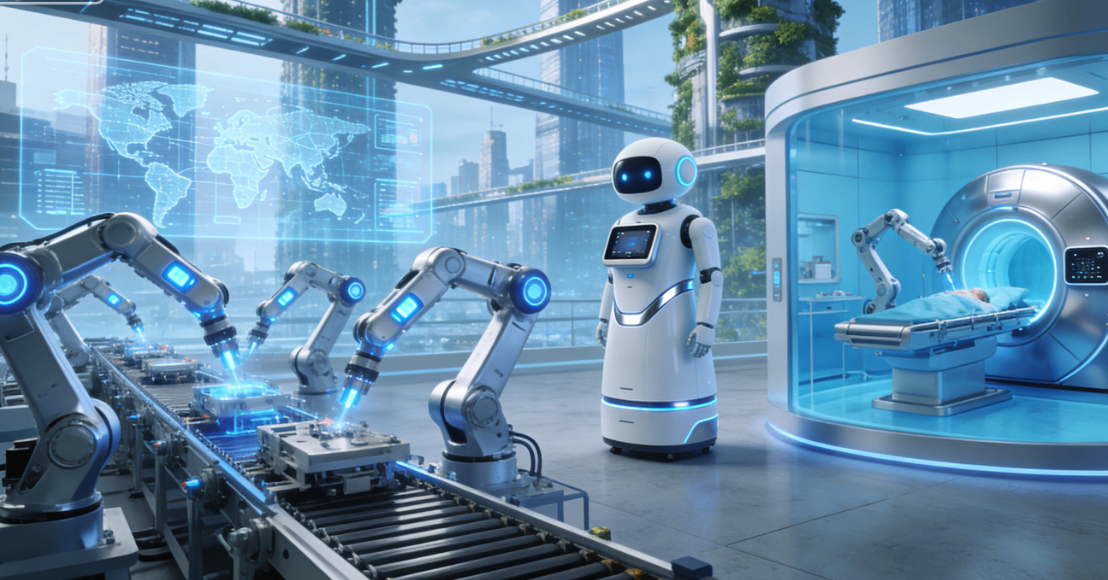
As the robotics industry enters 2026, it is undergoing a structural transition that marks a departure from speculative innovation toward empirically grounded performance. After more than a decade characterized by rapid prototyping, ambitious demonstrations, and optimistic projections, the central question has shifted: not what robots could achieve under ideal conditions, but what they can reliably execute in complex, real-world environments.
This analysis synthesizes findings from The Robot Report’s State of Robotics Industry Report 2026, integrating industry data, expert interviews, and cross-sector observations to evaluate the current state of robotic systems and their near-term evolution. The focus spans industrial automation, mobile robotics, humanoid platforms, autonomous vehicles, and enabling technologies, with particular attention to deployment outcomes rather than laboratory benchmarks.
Technological Drivers of the Current Transition
Recent advances in artificial intelligence, particularly in foundation models and vision-language-action (VLA) architectures, are reshaping how robots perceive, reason, and act. Improvements in sensor fusion, real-time perception, and simulation-first development workflows have reduced the gap between training environments and operational settings. At the same time, increased access to edge compute and more efficient software stacks has enabled greater autonomy under constrained latency and power conditions.
However, these advances are accompanied by new engineering trade-offs. Model generalization, data efficiency, system interpretability, and failure recovery remain limiting factors, especially in unstructured environments. As a result, progress in 2026 is less defined by dramatic capability leaps and more by incremental gains in robustness, repeatability, and maintainability.
Constraints on Deployment and Scaling
Despite technical progress, widespread adoption continues to be shaped by non-technical constraints. Safety certification, regulatory uncertainty, integration costs, and deployment timelines impose practical limits on commercialization. For end users, return on investment is increasingly tied to system uptime, ease of integration with existing workflows, and long-term operational support rather than raw performance metrics.
Developers and integrators face growing pressure to align product roadmaps with these realities. Simulation and digital twins are increasingly used not only for training but also for validation and lifecycle management. Meanwhile, humanoid robots—while advancing in mechanical design and control—remain constrained by cost, energy efficiency, and task specificity, suggesting a slower path to broad industrial impact than some early forecasts implied.
External Influences on Industry Direction
The trajectory of robotics in 2026 is also shaped by broader systemic forces. Geopolitical tensions and supply-chain localization are influencing component availability and manufacturing strategies. Labor shortages in logistics, manufacturing, and healthcare continue to drive demand for automation, while shifting investor expectations place greater emphasis on sustainable revenue models and measurable deployment success.
These pressures collectively favor application-specific solutions over generalized platforms, and they reward companies capable of demonstrating operational reliability at scale.
Outlook: Adoption, Saturation, and Measured Progress
Looking ahead 12 to 24 months, adoption is expected to accelerate in domains where task constraints are well-defined and operational environments are semi-structured, such as warehousing, intralogistics, and certain manufacturing processes. Conversely, segments driven primarily by speculative narratives are likely to experience a cooling of expectations as empirical performance data accumulates.
Overall, the robotics industry in 2026 is characterized less by hype cycles and more by convergence: between AI and physical systems, between simulation and deployment, and between technological possibility and economic viability. Understanding this transition requires moving beyond demonstrations to systematic analysis of what works, under what conditions, and at what cost.
This scientific perspective provides a durable framework for evaluating progress in robotics—not only in 2026, but as the industry continues its shift from experimentation to infrastructure.

