


Content Summary:
A new type of vision sensor integrates sensing, memory, and computation at the device level, enabling energy-efficient, low-latency intelligent perception. Optical synapse technology could transform edge AI applications by processing visual data directly on the sensor.

Recent advances in sensor technology are shifting the focus from passive data capture to intelligent perception. Traditional CMOS image sensors rely on separate components for sensing, memory, and computation, which can limit performance in real-time applications due to energy and latency constraints. Increasing image resolution and on-device processing demands further exacerbate these limitations, particularly in edge platforms where power and speed are critical.
Emerging research introduces optical synapses—photoelectric memristors that integrate sensing, memory, and neuromorphic processing in a single device. These components use semiconductor heterostructures to modulate conductance directly in response to light, eliminating the need for separate photodetectors and memory. The devices exhibit synaptic behaviors such as persistent and transient conductance changes, temporal integration of optical pulses, and learning-like responses, all while consuming energy at picojoule to femtojoule levels.
By performing computation at the sensor itself, optical synapses enable vision sensors to output processed features or event-based data instead of raw pixels. This approach could revolutionize edge AI applications, including robotics, autonomous systems, wearable electronics, and medical imaging, where efficiency and low latency are essential.
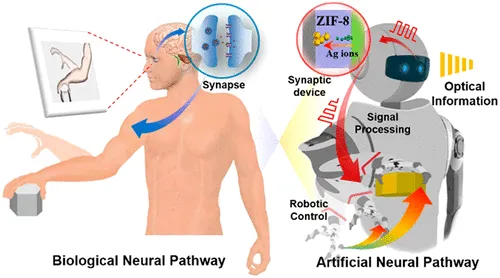
Schematic diagram, image sourced from the internet
While challenges remain in device scaling, uniformity, and integration into larger systems, neuromorphic optical technology presents a promising pathway for redefining sensors as active computational elements. These advances blur the traditional line between sensing and processing, opening new possibilities for intelligent, energy-efficient vision systems.

