


Summary:Brain-inspired spiking neural networks running on neuromorphic hardware have enabled real-time control of a high-speed robotic arm, achieving up to 98% success in dynamic tasks like air hockey. The approach demonstrates energy-efficient, low-latency learning with minimal neurons, offering potential for robotics and edge AI applications.
Researchers have demonstrated that spiking neural networks (SNNs) running on neuromorphic hardware can control high-speed robots in real time, overcoming the long-standing challenge of balancing responsiveness with learning capability. Using only a small number of training trials, the networks successfully adapted during physical interactions, highlighting the practical potential of brain-inspired computing beyond simulations.
The team trained a network of silicon neurons to control a robotic arm playing air hockey, achieving success rates of 96–98% in intercepting fast-moving pucks. The system operates in a six-dimensional continuous state space, tracking both the puck and robot striker within a large workspace, and executes predictive control at a 50 Hz frequency, a critical feature for high-speed interactions.
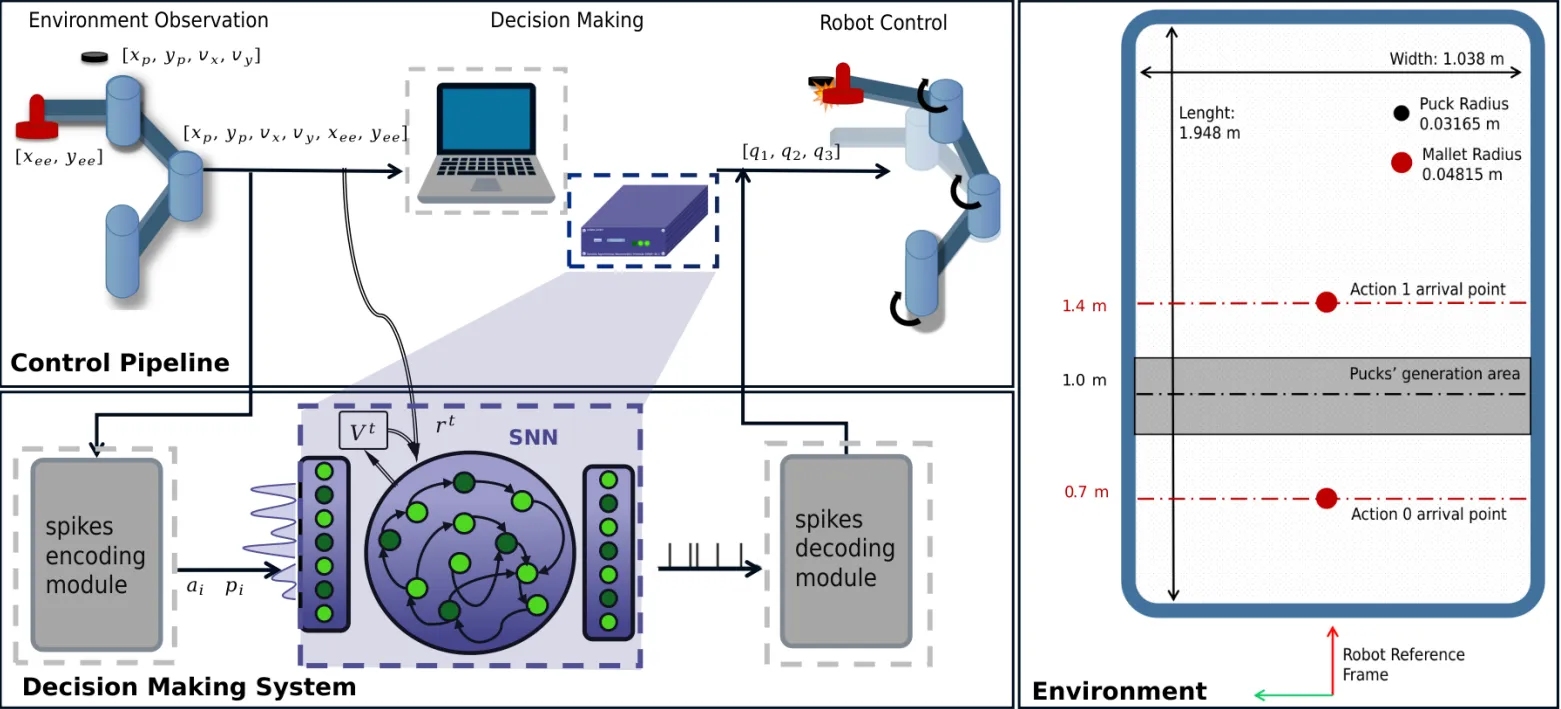
At the core of the system is a chip-in-the-loop architecture that tightly integrates a conventional computer with a neuromorphic processor. This setup allows online learning directly within the robot control loop, replacing static offline training with continuous adaptation through local synaptic plasticity rules.
The study represents the first hardware implementation of a biologically inspired “awake–dreaming” reinforcement learning paradigm on a real robot. Using only 1,020 silicon neurons, the robot maintained high performance across varying puck velocities, demonstrating energy-efficient, low-latency control with minimal neural resources.

Researchers say this breakthrough could transform robotics and edge AI applications where fast decision-making, low power consumption, and continuous learning are critical, including industrial sorting, human–robot collaboration, and autonomous systems. Future work aims to scale neuromorphic networks across multiple cores, integrate event-based vision, and validate performance on more complex robotic platforms.

