


As robotics moves rapidly toward humanoid systems and highly integrated automation, a quiet but fundamental shift is underway in how robots are powered. Axial flux frameless torque motors are emerging as a critical technology that could redefine the performance limits of robotic joints, enabling lighter, stronger, and more responsive machines.
Once confined to specialized engineering discussions, this motor architecture is now gaining momentum as robot developers seek higher torque density, improved efficiency, and tighter system integration—especially in space- and weight-constrained designs.
Why Traditional Motors Are Becoming a Bottleneck
Conventional radial flux motors were not designed with modern robots in mind. Their cylindrical housings, integrated bearings, and standardized interfaces impose constraints on mechanical layout, add unnecessary weight, and limit how closely motors can be integrated with robotic structures.
As robots evolve from rigid, task-specific machines into dynamic, force-controlled systems, these limitations become increasingly apparent. High-performance joints—particularly in legs, hips, and arms—require large torques, low gear ratios, fast response times, and precise force feedback. Traditional motor designs struggle to deliver all of these simultaneously.
Axial Flux and Frameless Design: A Structural Shift
Axial flux motors address these challenges by fundamentally rethinking motor geometry. Instead of directing magnetic flux radially, axial flux motors align the magnetic field parallel to the rotation axis using a disc-shaped layout. This configuration shortens magnetic paths and increases the effective torque-producing area.
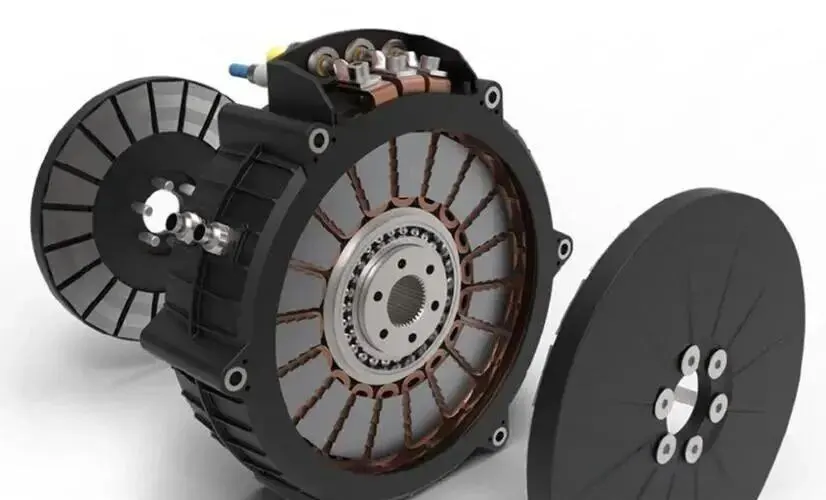
The frameless approach takes this a step further. By removing housings, shafts, and bearings, frameless motors allow robotic systems to use their own structural components for support. Motors become embedded elements of the joint itself, rather than standalone parts bolted onto the system.
This shift enables thinner joints, higher torque density, and far greater freedom in mechanical design—key advantages for next-generation robots.
Dual-Rotor Architectures Push Torque Density Higher
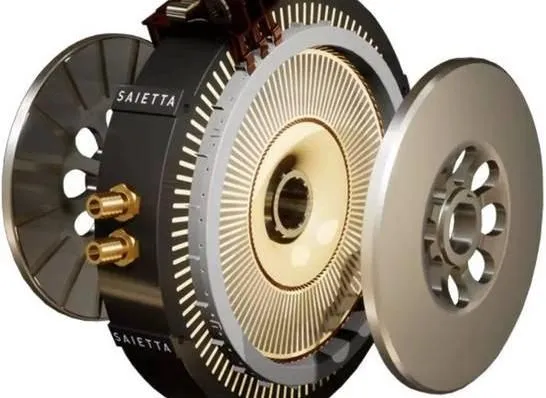
Recent developments in dual-rotor axial flux motors are accelerating adoption. By placing a stator between two rotors, engineers create a closed-loop magnetic circuit that improves magnetic utilization and boosts torque output without increasing size.
Separating stator teeth from the yoke—or eliminating the yoke entirely—further reduces mass and improves space efficiency. The result is a compact motor capable of delivering high torque in a flat, lightweight form factor, well suited for robotic joints with strict dimensional constraints.
Why This Matters for Humanoid Robots
Humanoid robots are one of the strongest drivers behind this technology shift. A typical humanoid requires dozens of actuators, many of which must support body weight, handle dynamic loads, and enable compliant motion.
Lower-limb joints, in particular, benefit from axial flux frameless motors. These joints demand high torque, low inertia, and precise force control to maintain balance and agility. By reducing motor weight while increasing torque output, axial flux designs directly improve energy efficiency, stability, and overall mobility.
Beyond Robotics: Broader Industrial Impact
The implications extend well beyond humanoids. In collaborative robots, frameless torque motors enable more compact joints and smoother interaction with humans. In industrial automation, they support high-precision motion in machine tools, laminating systems, and printing equipment.
Medical robotics is another growth area. Surgical robots and imaging systems rely on smooth, precise, and quiet motion—an ideal match for frameless torque motors. Meanwhile, aerospace and defense applications are adopting frameless designs for gimbals, inertial systems, and radar platforms where vibration resistance and compactness are critical.
Challenges Remain—but Momentum Is Building
Thermal management remains one of the main technical challenges. The compact geometry of axial flux motors limits heat dissipation, particularly in high-torque, continuous-duty applications. Manufacturers are addressing this through improved potting materials, forced cooling, and integrated liquid-cooling solutions.
Manufacturing complexity is another hurdle. Axial flux motors often rely on advanced soft magnetic materials and specialized production techniques. However, automation, improved material processing, and growing production volumes are steadily reducing these barriers.
A Key Enabler for the Next Generation of Machines
As robots become more capable, mobile, and human-like, the technologies powering their joints matter more than ever. Axial flux frameless torque motors represent more than an incremental improvement—they signal a structural shift in how robotic actuation is designed and integrated.
With continued advances in materials, manufacturing, and system-level integration, these motors are positioned to become a foundational technology for humanoid robots, high-performance automation, and intelligent machines operating at the edge.
In the race toward more capable robots, the revolution may not start with software—but with the motor hidden inside the joint.

