


Summary:A Japanese technology company has developed a spatial world model AI technology that enables robots to understand, predict, and respond to dynamic environments involving humans and objects. The innovation advances physical AI by improving human-robot collaboration, multi-robot coordination, and safety in real-world applications.
A Japanese tech company has developed a new AI technology aimed at improving collaboration between humans and robots. Known as the spatial world model, this technology enables AI to predict the future behaviors and states of people, robots, and objects within a space, enhancing the safety, efficiency, and intuitiveness of human-robot interactions. It also optimizes coordination among multiple robots working together.
The company plans to showcase the technology at CES 2026 in Las Vegas from January 6–9 and will hold technical demonstrations at its headquarters during fiscal year 2026.
Key Features of the Spatial World Model Technology
The spatial world model utilizes 3D scene graphs to create a hierarchical representation of physical spaces, focusing on interactions between humans, robots, and objects. Unlike traditional camera-based systems that often struggle with appearance variations and field-of-view limitations, this approach minimizes distortion and enables real-time understanding of dynamic environments.
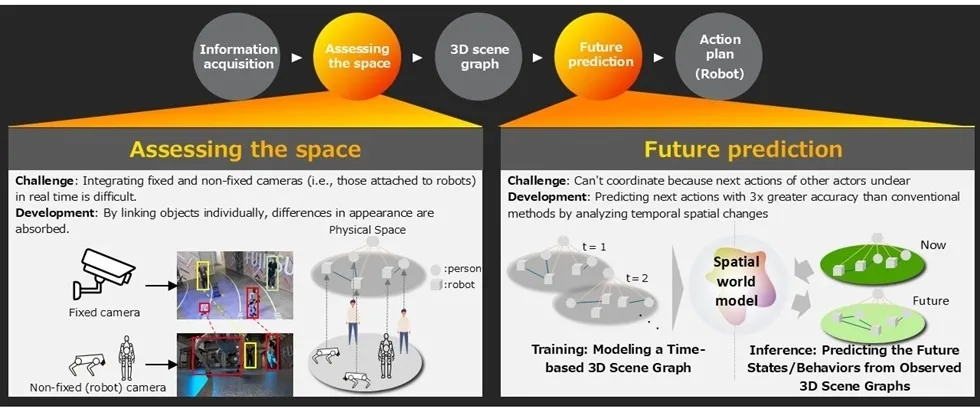
Figure: Diagram of the spatial world model technology.
By analyzing interactions, the system can predict behaviors, avoid collisions, and generate cooperative plans for multiple robots. Benchmark tests show a threefold improvement in estimating behavioral intentions compared to conventional methods.
Advancing Physical AI
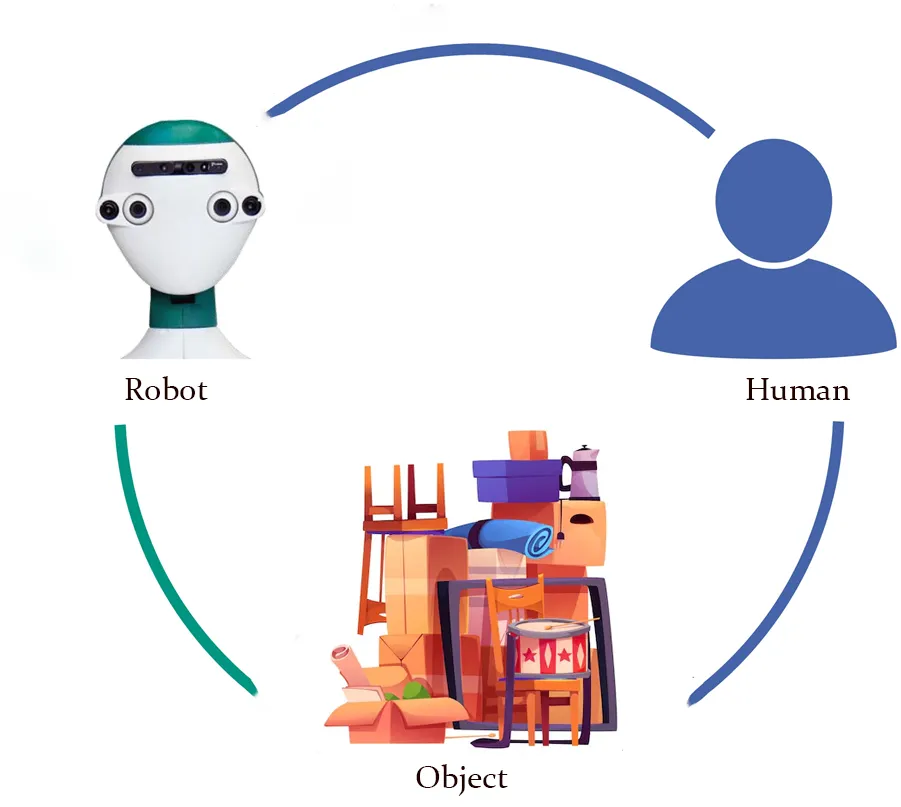
This technology is part of a broader initiative in physical AI, which seeks to enable AI systems to understand and act in real-world environments. While AI excels in digital spaces, its application in physical environments, like homes and public facilities, is challenging due to unpredictable human movement and dynamic objects. The spatial world model addresses these issues by providing a comprehensive understanding of spatial relationships between humans, robots, and objects.
Physical AI has significant potential in fields such as autonomous driving, smart factories, and labor-intensive industries facing workforce shortages. Current solutions are limited to structured environments, making them impractical in more dynamic spaces. This technology extends AI’s capabilities to unstructured environments, fostering safer and more efficient human-robot collaboration.

