


The industrial robotic arm market is one of the most dynamic sectors within global automation, reshaping advanced manufacturing and logistics. With systems ranging from articulated, SCARA, and Cartesian robots to collaborative designs, robotic arms are now integral to smart factories, driving enhanced efficiency, precision, and sustainability across various industries.
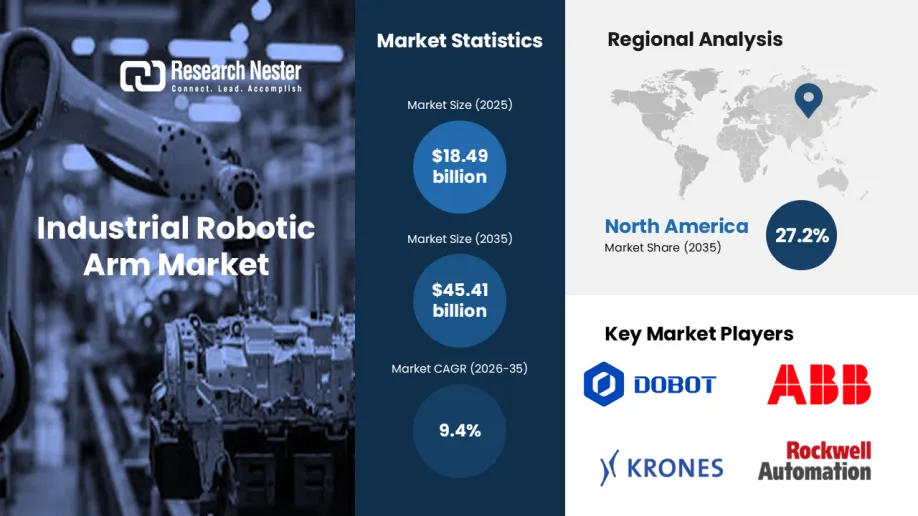
In 2025, the market value for industrial robotic arms stood at USD 18.49 billion, reflecting the accelerating adoption of these technologies in automotive, electronics, aerospace, and logistics sectors. This growth trend is expected to continue, with the market projected to reach USD 45.41 billion by 2035, fueled by a compound annual growth rate (CAGR) of 9.4% from 2026 to 2035. As Industry 4.0 strategies gain traction and the demand for flexible, automated manufacturing solutions rises, industrial robotic arms will remain at the forefront of transformation.
Regional Market Overview
North America: The U.S. and Canada are set to capture over 27.2% of the market revenue by 2035. Manufacturers in these countries are focusing on automation to boost supply chain resilience and support onshoring initiatives.
Europe: In Europe, robotics adoption is accelerating as manufacturers modernize aging infrastructure, particularly in automotive hubs like Germany, France, and Italy. Robotics applications are also expanding in pharmaceuticals, food processing, and heavy machinery sectors.
Asia Pacific: Asia Pacific, particularly China, Japan, South Korea, and Southeast Asia, is expected to experience rapid market growth. Robotics is central to national industrial policies, driven by strong manufacturing activity and labor-saving automation initiatives.
Market Segmentation
Articulated Robots: This segment is projected to capture approximately 48.5% of the market share by 2035. Their versatility in performing complex multi-axis movements makes them ideal for applications such as assembly, welding, painting, and material handling.
Payload Categories: The 5 kg payload category is expected to represent over 30.8% of the market share by 2035. Lightweight robotic arms in this range are particularly popular in electronics assembly, precision pick-and-place operations, and collaborative robot (cobot) applications, where space constraints and human-robot interaction safety are critical.
Key Market Trends
Smart Automation and AI Integration
AI, machine vision, and advanced analytics are becoming integral to industrial robotic arms, enabling real-time decision-making, adaptive control, and predictive maintenance in autonomous workflows. AI-powered robotic arms, used in tasks such as precision assembly and defect inspection, are boosting operational efficiency and reducing downtime. For instance, companies like Dexterity and HIWIN Technologies are launching AI-enabled dual-arm systems for warehouse automation, enhancing the flexibility and mobility of robotic solutions.
Human-Robot Collaboration (HRC)
Collaborative robots (cobots) are increasingly seen as valuable tools to augment human labor rather than replace it. Designed to work safely alongside humans, cobots are gaining popularity, particularly among small and medium-sized enterprises (SMEs). These robots are ideal for collaborative tasks like assembly and inspection that require repetitive manual labor. Advances in safety sensors, user-friendly programming interfaces, and rapid deployment kits are making these systems more accessible to a wider range of businesses.
Sustainability and Flexible Manufacturing
As manufacturers increasingly prioritize sustainability, robotic arm providers are optimizing designs for energy efficiency and modularity. Robots are becoming key enablers of circular manufacturing systems, which focus on reducing environmental impact and enabling rapid shifts in production lines. This flexibility is particularly important in sectors like renewable energy, electric vehicle manufacturing, and sustainable consumer goods production. By allowing for reconfiguration and repurposing, robotic arms contribute to a more circular economy while maximizing asset utilization.
Conclusion
The industrial robotic arm market is poised for significant growth, driven by technological advancements and increasing demand for flexible, efficient manufacturing solutions. With applications ranging from AI-powered automation and collaborative robotics to sustainable production practices, these systems are set to become foundational assets for industries worldwide. As adoption continues across regions and sectors, the role of industrial robotic arms in shaping the future of manufacturing and logistics will only intensify.

