


Researchers in Germany are developing a next-generation magnet-free electric motor designed to eliminate the use of rare-earth materials while maintaining high torque density and efficiency.
The project, known as NAFTech (Sustainable Axial-Flux Machines Considering Tolerance-Affected Manufacturing Technologies), aims to combine the benefits of axial-flux and radial-flux motor technologies into a single compact and cost-effective solution.
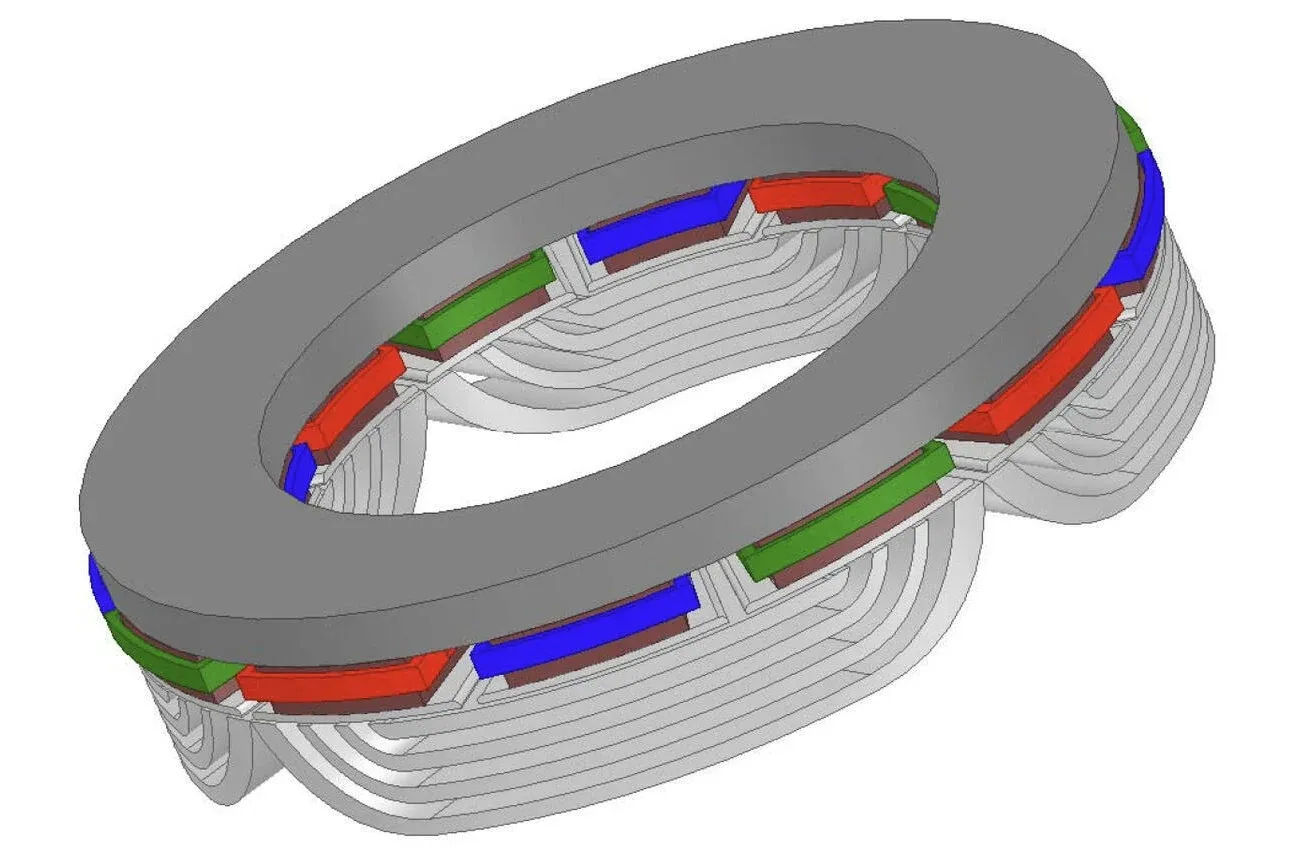
A Rare-Earth-Free Alternative for Electric Motors
Current axial-flux machines (AFM) are valued for their compact structure and high torque density. However, most rely heavily on rare-earth magnets, which are costly and subject to supply chain volatility.
To address this issue, the NAFTech consortium is working on an axial-flux synchronous reluctance machine (AF-SynRM) — a magnet-free motor architecture that removes dependence on rare-earth elements.
While radial-flux synchronous reluctance motors (RF-SynRM) have already eliminated magnets, they often require more installation space and offer lower torque density. The AF-SynRM concept aims to bridge that gap by delivering:
High torque density
Compact design
Improved efficiency
Reduced material costs
Collaboration Between Leading German Institutions
The two-year NAFTech initiative is funded by the German government and brings together several major research institutions:
Production Engineering of E-Mobility Components (PEM), RWTH Aachen
Institute for Electrical Energy Conversion (iew), University of Stuttgart
Chair of Manufacturing Automation and Production Systems (FAPS), FAU Erlangen
According to Professor Achim Kampker, Head of PEM, axial-flux machines currently face challenges such as limited production volume, immature manufacturing processes, and strict tolerance requirements.
To overcome these barriers, the project integrates:
Advanced topology development
Multi-domain machine design
Data-driven optimization of tolerance chains
Validation through partial demonstrator prototypes
Cost Reduction and SME Competitiveness
One of the key advantages of a magnet-free motor is economic stability. Eliminating rare-earth magnets can reduce material costs by up to 50%, according to the project team.
This cost reduction is particularly significant for small and medium-sized enterprises (SMEs), helping them mitigate exposure to volatile rare-earth prices and lower barriers to market entry.
Beyond cost savings, magnet-free motor technology also supports sustainability goals by reducing dependence on environmentally intensive materials and contributing to lower CO₂ emissions.
Timeline and Outlook
The NAFTech project officially began in early 2025 and is scheduled to run until the end of 2027.
If successful, the axial-flux synchronous reluctance motor could establish a new benchmark for sustainable, high-efficiency electric machines in e-mobility and industrial applications.

