


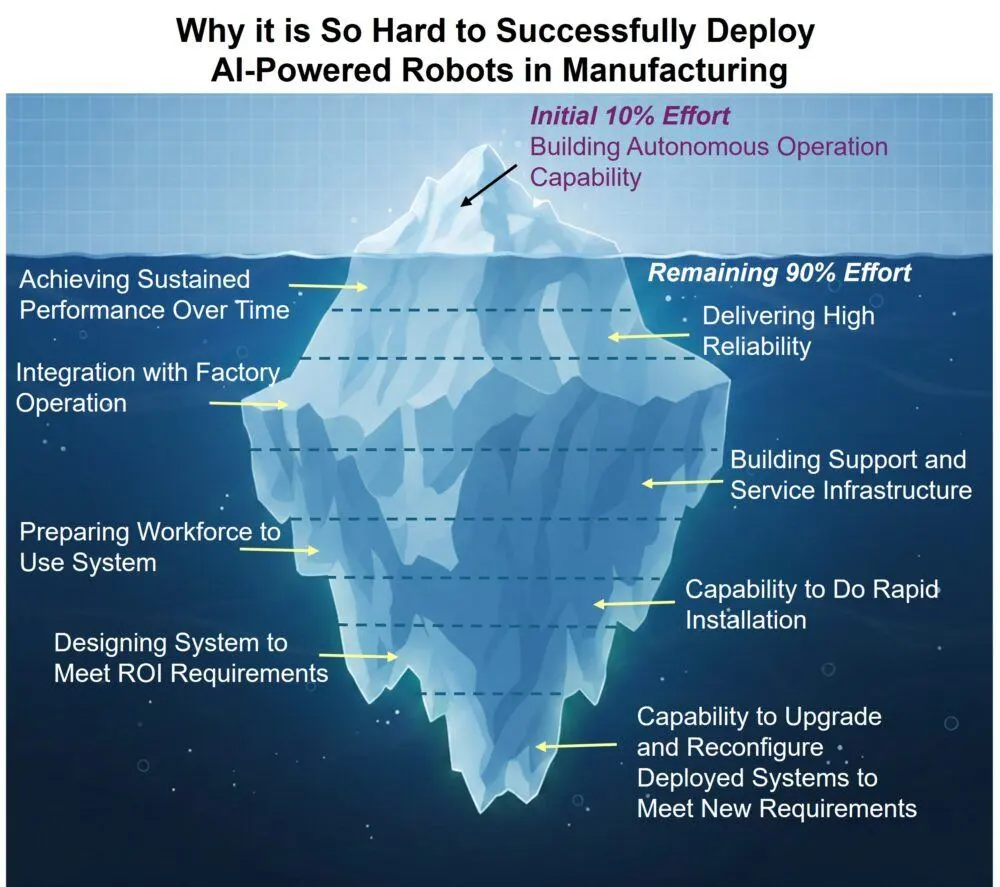
Robotic automation has demonstrated impressive potential in high-mix manufacturing environments, but the transition from technology demonstrations (TRL 5-6) to full-scale deployments has been slower than expected. Despite considerable interest and investment, many of the systems showcased in demonstrations fail to make it to production. In this article, we examine the main reasons behind this slow maturation and why overcoming these challenges is critical for successful high-mix manufacturing automation.
1. Data Scarcity for AI Systems
High-mix environments require sensors for part localization and quality assessment, and AI-based perception systems are often considered ideal to handle these tasks. However, the limited amount of data generated during pilot demonstrations is insufficient for training robust AI models, especially when real-world sensor noise significantly differs from controlled environments. Moreover, the lack of diverse part geometries further limits the ability to fully test and optimize AI-based systems. This results in the need for extensive retraining before deployment.
2. Limited Part Diversity and Algorithm Robustness
Demonstrations typically focus on a narrow range of part geometries, leading to underdeveloped planning and control algorithms. In practice, high-mix environments require algorithms that can adapt to a wide variety of parts. Validating these algorithms requires testing with a much broader set of part types, which is not feasible during initial demonstrations.
3. Process Innovation for Robots
Many manual processes are designed for human capabilities, but robots offer different strengths, such as applying higher forces or using tools more efficiently. Demonstration projects often fail to explore process innovations that could leverage these robotic advantages, such as reducing material costs or improving cycle times. Realizing the full value of robotic automation requires significant investment in rethinking and optimizing existing processes.
4. Human-Robot Interaction Challenges
In most high-mix applications, full automation isn’t feasible, and humans still play a vital role. Many demonstration projects overlook the integration of human workers into automated systems. Effective collaboration between humans and robots is crucial to ensure high worker utilization and avoid idle time. Optimizing human-robot interaction is a critical factor in justifying the cost of automation.
5. Workforce Readiness and Training
Successful automation depends on workers who can effectively interact with robotic systems. This requires intuitive user interfaces, proper training, and ongoing maintenance support. Without addressing workforce readiness and skill development, automation systems may fail to deliver value.
6. System Availability and Maintenance
Robotic systems in high-mix manufacturing are prone to failures, and when these issues arise, they often require substantial repair time. To minimize downtime, companies need to implement Prognostics and Health Management (PHM) systems, which predict failures and improve system reliability. However, developing these systems requires more data and resources than a demonstration phase can provide.
7. Lack of Service Infrastructure
High-mix automation systems require comprehensive service infrastructures for maintenance and support. In cases where only a small number of robotic cells are deployed, developing an in-house service team becomes cost-prohibitive. Thus, organizations must either scale up their robotic deployments or partner with service providers to ensure system longevity.
8. Auxiliary Functions and Cycle Time Optimization
In addition to automating core tasks, robotic cells require automation of auxiliary functions such as tool changes, debris removal, and calibration. These tasks often add cost but are necessary to optimize overall cycle time. Focusing only on the core automation process during the demonstration phase can lead to incomplete solutions that fail to deliver optimal performance in real-world deployments.
9. System-Level Optimization
Demonstration projects typically focus on a single automation task without considering the entire production system. A single process step may be automated, but if upstream or downstream processes are inefficient, the value of automation can be severely limited. Ensuring the automated system operates effectively within the broader context of the entire production line is key to realizing its full potential.
10. Software Maintenance and Upgrades
Automation systems in high-mix manufacturing rely heavily on software, which needs continuous updates and maintenance. Building the infrastructure for software upgrades is a crucial yet often overlooked aspect of deployment, requiring additional resources for long-term success.
11. ROI Beyond Labor Savings
Demonstration projects often focus solely on labor savings as a metric for ROI, which can be hard to justify as costs rise. However, the true value of automation extends beyond labor savings. Factors such as reducing material costs, improving cycle times, and enabling process innovations can contribute significantly to ROI. A successful deployment requires these factors to be considered alongside labor savings.
Conclusion
Successfully transitioning robotic automation from the demonstration stage to full deployment in high-mix manufacturing environments is a complex, resource-intensive process. The development of robust systems, addressing human integration, and optimizing the entire production system are all necessary for scaling up automation. Without a clear roadmap that incorporates these factors, many demonstration projects will fail to transition into effective, large-scale solutions.
To overcome these challenges, manufacturers need to invest in system design, workforce development, and process innovation. Scaling robotic automation requires substantial resources, but with the right approach, high-mix environments can achieve the benefits of advanced robotics in a way that provides long-term value.

