


Researchers at the University of Michigan have developed a groundbreaking microscale gas chromatography system, monoGSA, which integrates all fluidic components into a single chip. Published in Nature Microsystems & Nanoengineering, this design uses three Knudsen pumps to move gas molecules via heat differentials, eliminating the need for traditional pumps and valves. This innovation makes the system smaller, more reliable, and cost-effective, with applications in industrial and environmental monitoring, as well as indoor air quality testing.
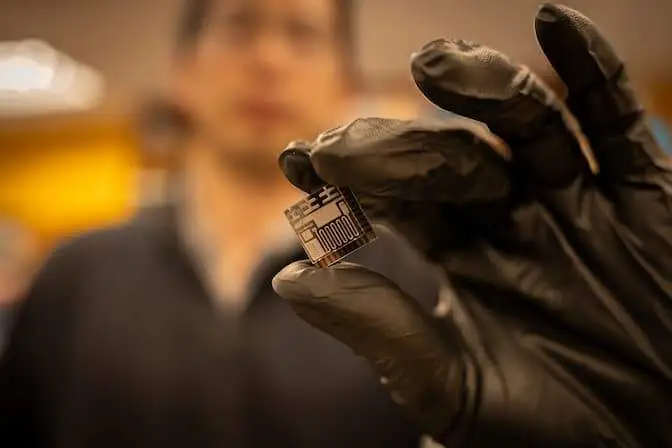
Advancements in Gas Chromatography
Gas chromatography (GC) has been essential for detecting volatile organic compounds (VOCs) in fields like environmental monitoring and pharmaceuticals. Recent micro-GC systems have miniaturized the technology into portable devices, but they still rely on complex components like pumps and valves. monoGSA solves this problem by integrating everything into a compact 15mm x 15mm silicon-on-insulator chip, significantly reducing size, complexity, and failure risk.
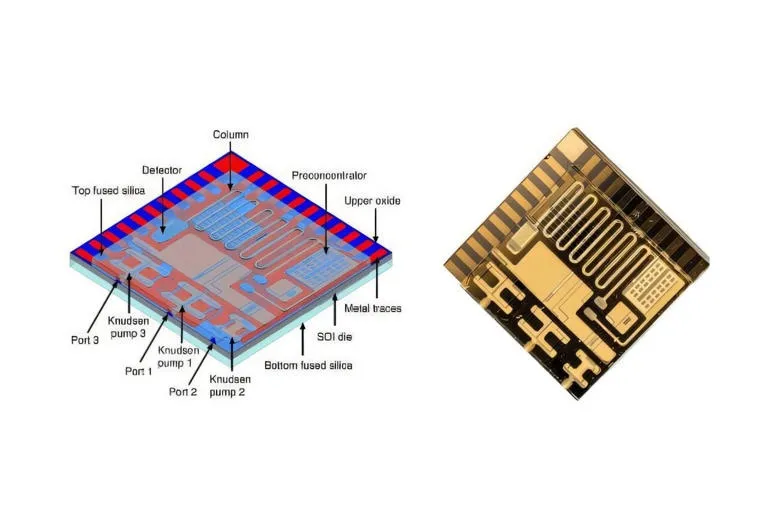
The monolithic gas sampling and analysis system, or monoGSA system for short, uses three Knudsen pumps to move gas through ultra-narrow channels from the cold side (bottom) to the hot side (top), a process known as thermal transpiration. The pumps work together to bring in the sample and move it to the preconcentrator, through the column, and to the detector.
Key Innovation: Knudsen Pumps
The system relies on three Knudsen pumps that use thermal transpiration to move gas molecules through narrow channels. These pumps, which have no moving parts, control the flow of gas through the system—drawing the sample, separating components, and directing them to the detector. The heat differential between hot and cool sides of the pumps ensures precision, eliminating the need for traditional pumps and valves.
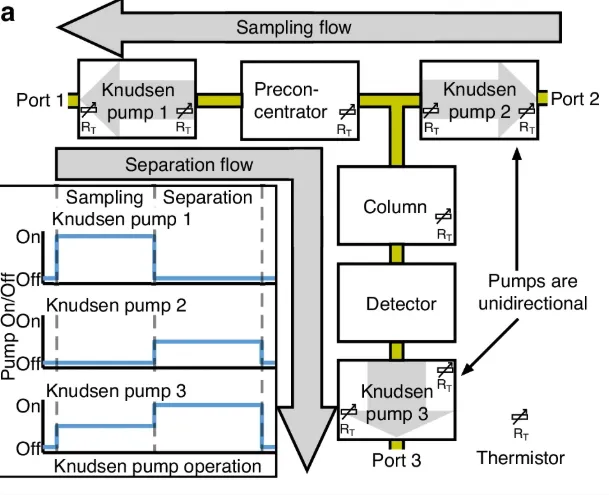
The architecture of the monoGSA where three different Knudsen pumps operate together to control the gas flow of the system.
High Accuracy with Low Gas Volume
In tests, monoGSA demonstrated high performance, accurately quantifying chemical components with a ±6.5–8.5% margin of error. It operates effectively across a range of humidity levels (15% to *) and requires much smaller gas volumes compared to traditional systems. This makes it ideal for long-term, low-power applications, such as continuous monitoring.
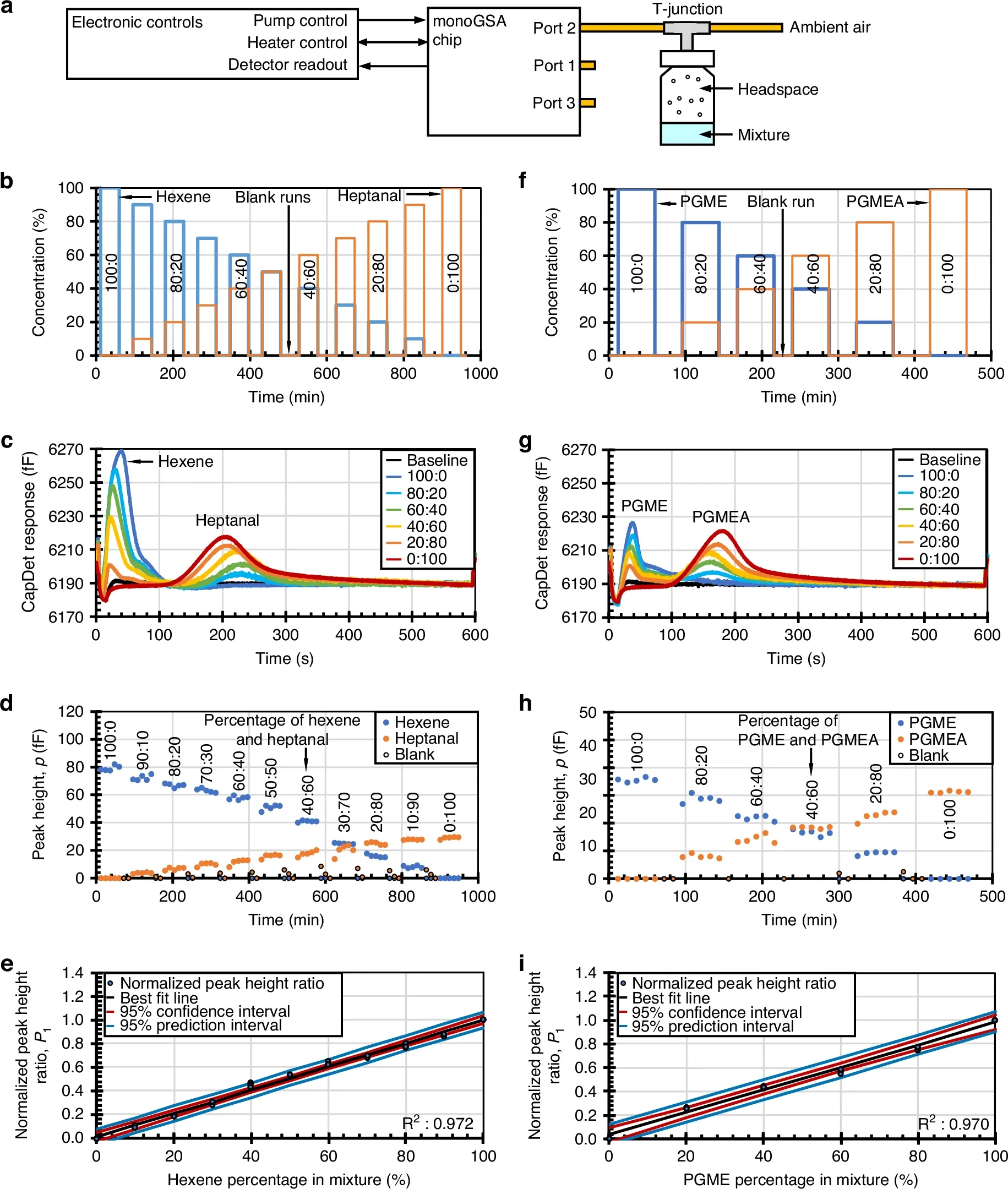
Chemical tests with the monoGSA system. a Schematic of the monoGSA test setup. For Mixture 1 (hexene and heptanal: The (b) concentrations tested, (c) chromatogram results, (d) peak heights from repeated tests, and (e) normalized peak height ratio for different concentrations. For Mixture 2 (PGME and PGMEA): The (f) concentrations tested, (g) chromatogram results, (h) peak heights with repeated tests, and (i) normalized peak height ratio for different concentrations
Future Applications
In addition to industrial and environmental monitoring, monoGSA has potential for medical diagnostics, including breath analysis, and could be incorporated into wearable devices like smartwatches for real-time pollution tracking or air quality monitoring.
|  |  |
The University of Michigan team is now exploring commercialization through partnerships and patent protection, with plans to bring the device to market and expand its impact on the gas analysis industry.

