


Researchers at the Chinese Academy of Sciences have developed an artificial compound eye inspired by the fruit fly's exceptional vision. This new technology allows robots to see and smell simultaneously, enhancing their navigation in tight or hazardous environments.
Why the Fruit Fly?
Fruit flies have fast, wide-angle vision that helps them detect movement and avoid threats. In contrast, current drone cameras are bulky, power-hungry, and have limited peripheral vision.
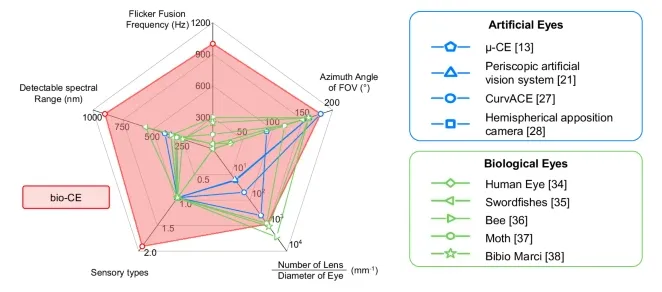
Comparison chart of this work (bio-CE) with other artificial eyes and biological eyes in terms of fusion frequency, azimuth angle, lens density, sensory type, and measurable spectral range.
Innovative Engineering
The team used femtosecond laser two-photon polymerization to create a 1.5-mm sensor with 1,027 visual units. They also added tiny hairs between lenses to prevent moisture and debris buildup, mimicking natural eyes.
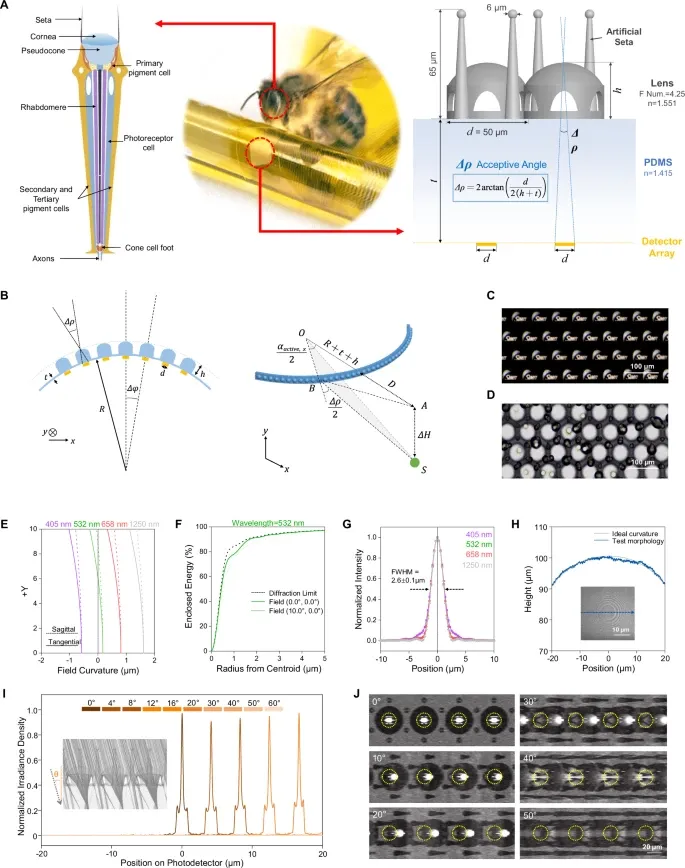
Design, fabrication, and characterization of bionic micro-lens arrays.
Dual-Sensing System
The compound eye is paired with a bionic nose—a chemical array that detects hazardous gases. This hybrid system reduces payload weight while maintaining functionality. The sensor provides a 180-degree field of view, improving obstacle detection and threat avoidance.
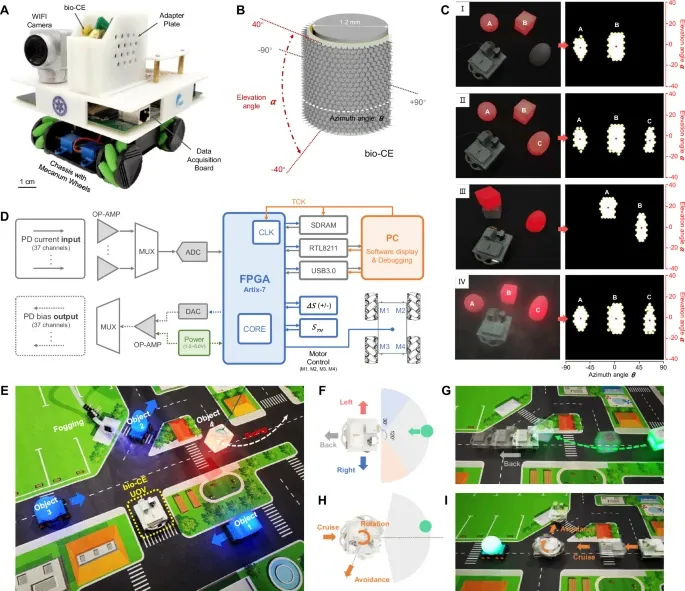
The bio-CE equipped unmanned omnidirectional vehicle (UOV) and obstacle avoidance in a comprehensive scenario.
Real-World Potential
This bio-inspired system could enhance drone navigation for tasks like search-and-rescue or detecting chemical leaks in dangerous environments. However, challenges remain, such as image resolution limitations and slower chemical detection speed.
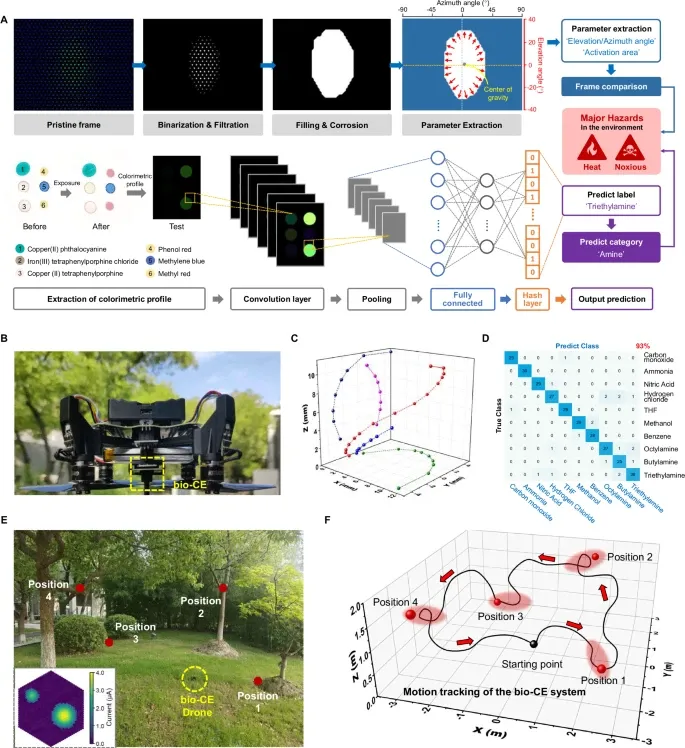
Target recognition and drone motion tracking of the bio-CE system.
The Road Ahead
Once refined, this technology could revolutionize drone performance, enabling safer, more efficient robots for disaster response and other critical missions.

