


Researchers at the University of Colorado Boulder have successfully developed high-performance optical microresonators that could revolutionize sensor technologies. These tiny devices, capable of trapping and amplifying light, hold the potential to enable a wide range of applications, from navigation to chemical detection.
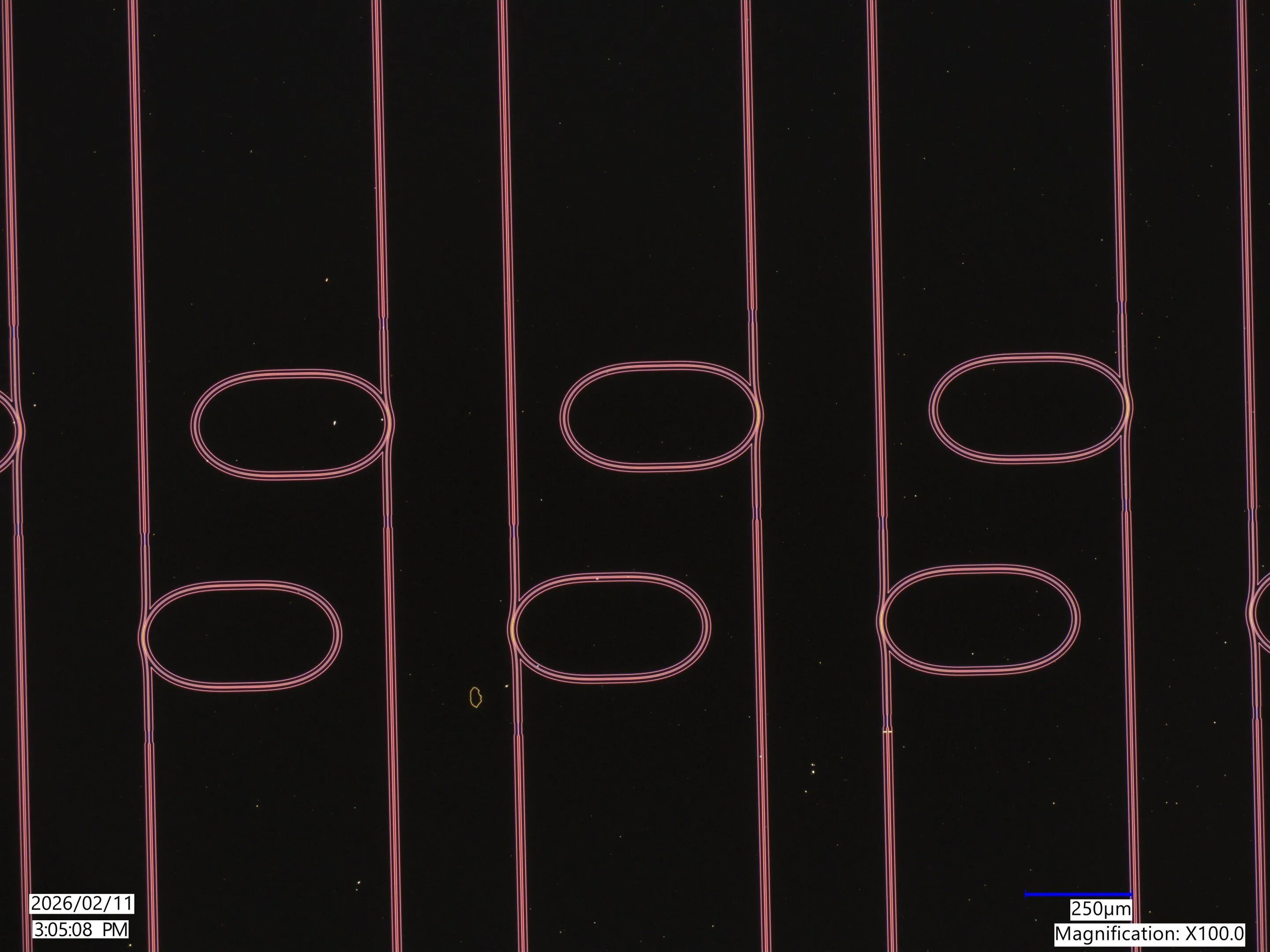
Optical waveguide microresonators on a chip created in this effort, which are ten times thinner than human hair.
What Are Optical Microresonators?
At their core, optical microresonators are small devices that trap light, allowing it to build up intensity over time. This intense light is then used for various photonic operations. By using less optical power, microresonators offer an energy-efficient alternative for future sensor applications.
Key Innovation: Racetrack Resonators
The research team focused on the design of "racetrack" resonators, which have an elongated shape resembling a running track. These resonators are based on Euler curves—a smooth curve used in road and railway design. The innovative shape minimizes bending loss, allowing light to travel through the resonator without sharp, damaging turns. This design reduces light loss, enabling longer photon circulation and stronger interactions within the device.

Scientists have engineered tiny light-trapping racetracks that could supercharge future sensors and quantum technologies. Credit: AI/ScienceDaily.com
Microresonator Fabrication: Precision at the Microscale
The microresonators were fabricated using a state-of-the-art electron beam lithography system at the Colorado Shared Instrumentation in Nanofabrication and Characterization (COSINC) clean room. Unlike traditional photon-based lithography, electron beam lithography can achieve sub-nanometer resolution, critical for constructing highly precise microresonators at the microscopic scale.

The Role of Chalcogenides
One of the key materials used in this research is chalcogenides, a family of semiconductor glasses. Chalcogenides offer excellent transparency and nonlinearity, which are essential for high-intensity light transmission. However, they are difficult to process, requiring careful balancing. The research team overcame these challenges, demonstrating that microresonators made with chalcogenides can achieve performance comparable to the best devices in other material platforms.

Testing and Measurement
After fabrication, the microresonators were tested by monitoring how light interacted with the device. By coupling lasers into the resonators and analyzing the resulting light transmission, the researchers identified sharp resonances in the data. These "dips" in light intensity indicated high device quality, confirming that the microresonators were capable of trapping light effectively.
Applications and Future Potential
These high-performance microresonators open the door for various future applications, including compact microlasers, chemical and biological sensors, and quantum metrology tools. As photonic technologies continue to develop, microresonators will play a crucial role in integrating different components like lasers, modulators, and detectors.
The ultimate goal of this research is to scale these devices for mass production, allowing manufacturers to produce hundreds of thousands of them for widespread use in advanced sensor systems.

