


A breakthrough in soft robotics has led to the creation of an insect-scale robot that jumps using nothing but light—no motors, batteries, or electronics involved. Powered entirely by the physics of liquid crystal elastomers, this robot demonstrates impressive mechanical intelligence and autonomy.
 | No motors |
How It Works
The robot is made primarily from a rubber-like material, liquid crystal elastomers, which deforms in response to light. When exposed to light, the material bends, storing elastic energy in its curved structure. The energy is then released rapidly, propelling the robot into the air. As it leaps, the robot casts a shadow, blocking the light source, which allows the material to cool and reset. This cycle repeats, causing the robot to jump again.
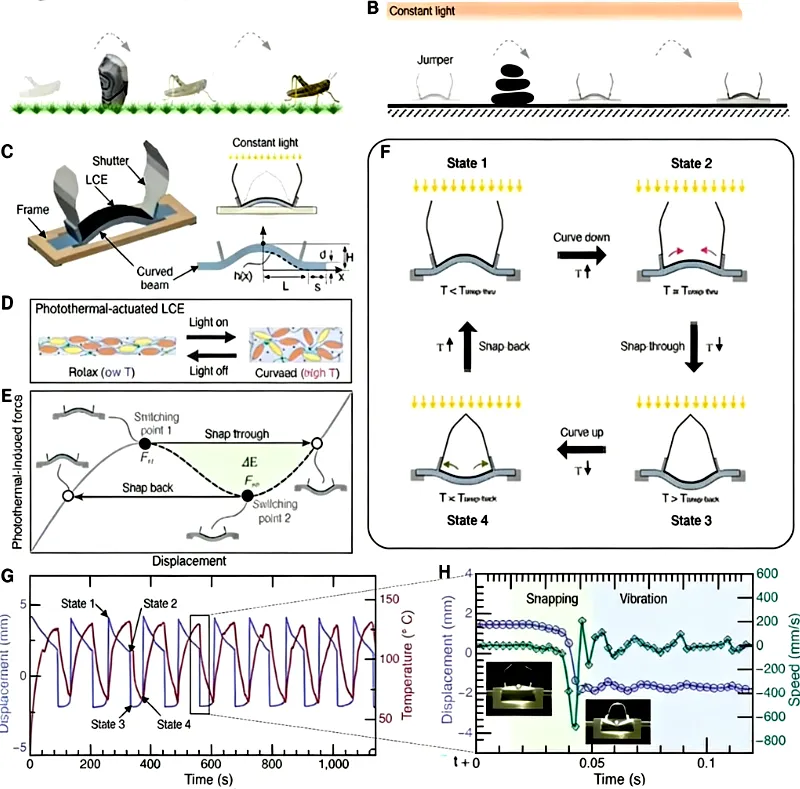

This robot is made of material that bends and snaps when exposed to light, facilitating a jump.
Continuous Performance
In tests, the robot performed an unexpected 188 continuous jumps without any loss in performance. Notably, it could carry up to 1,700 times its body weight—about 300 milligrams—showing the strength and durability of the material.
 |  |  |
The mechanism relies on the simple physical principle of rapid deformation followed by a snap-through instability. When light hits the elastomer, it contracts, storing energy until a critical point, when the stored energy is suddenly released, propelling the robot into the air.
Built-In Mechanical Intelligence
This robot is a prime example of "mechanical intelligence," where sensing, actuation, and resetting are embedded directly into the material itself. This eliminates the need for complex circuits or processors. The robot’s geometry and material composition are engineered to generate repetitive motion, allowing it to perform tasks autonomously.
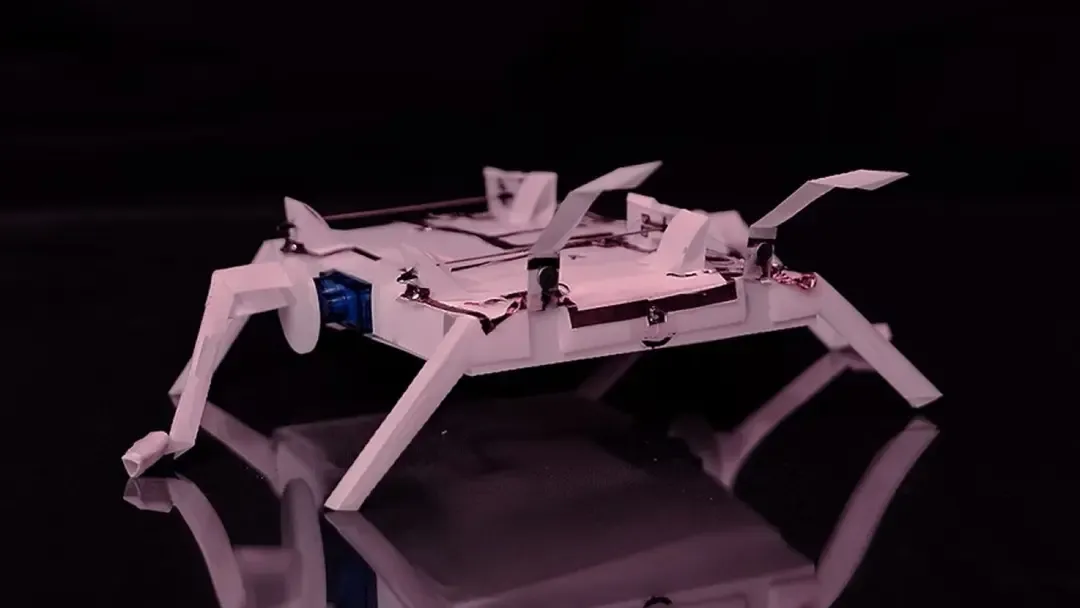
Made from functional sheet materials and threads, the robot detects obstacles and makes decisions to reverse direction.
Real-World Applications
Researchers are exploring real-world applications for this light-powered robot. One potential use is in wildfire monitoring, where these robots could carry sensors and move across rough terrain, jumping continuously. Once they detect smoke or flames, they could alert a monitoring system. These robots could also be deployed in hazardous environments, such as collapsed buildings, radioactive zones, or tight underground spaces.
 |  |
| Fire outbreak site | Collapsed buildings |
 |  |
| Radioactive areas | Narrow underground spaces |
The work of Wenzhong Yan, assistant professor at the University of California, Davis, who co-authored the research, pushes the boundaries of soft robotics, opening doors to new types of intelligent materials that could revolutionize robotics and wearable technologies.

