


Researchers at Loughborough University have developed a novel computing device that leverages the intrinsic physics of materials to process time-dependent data directly in hardware, offering a promising pathway toward more energy-efficient artificial intelligence (AI). Their findings, published in Advanced Intelligent Systems, indicate that the approach can achieve up to 2,000× greater energy efficiency than conventional software-based methods in certain applications.

The Loughborough University chip during testing. Credit: Loughborough University
The technology is based on reservoir computing, a framework widely used for analyzing dynamic data such as weather patterns, biological signals, and sensor streams. Traditionally implemented in software, this method transforms input data into high-dimensional representations for pattern recognition and prediction. In contrast, the Loughborough team has realized this transformation physically within the device itself.
At the core of the system is a nanoporous oxide memristor, an electronic component capable of retaining memory of past inputs. Its randomly distributed nanopores form a network of conductive pathways that function analogously to the hidden layer of a neural network. This structure enables the material to inherently perform nonlinear data transformations, effectively embedding computation within the hardware.
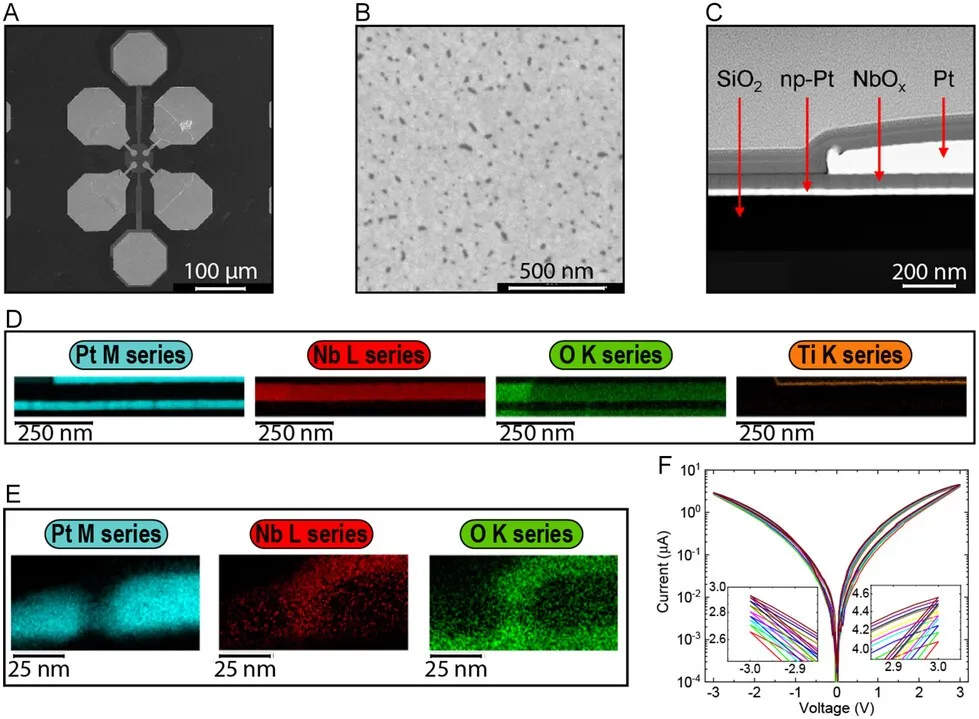
(A) SEM image of the device comprising of nanoporous (np)-Pt/nitrogen-doped NbOx/Ti/Pt, with a np-Pt bottom electrode (20 nm), nitrogen-doped NbOx switching layer (53 nm), and four top Pt electrodes (120 nm). (B) Top view SEM image of the np-Pt bottom electrode. (C–E) Cross-section images of the device from (A); general SEM (C), SEM with EDX analysis (D) for Pt (light blue), Nb (red), oxygen (green), and Ti (orange), and magnified view of SEM EDX images (E) of a different cross-section where a nanopore in Pt (light blue) bottom electrode can be seen as filled by both Nb (red) and oxygen (green) denoting NbOx. (F) Consecutive I–V sweeps of a singular nitrogen-doped NbOx based output channel shown in (A). Insets highlight current behavior between sweeps.
Experimental validation demonstrated the device’s versatility across multiple tasks. It successfully predicted short-term behavior in the chaotic Lorenz-63 system and reconstructed missing data, accurately classified simple pixelated numerical images, and executed basic logic operations. These results show that a single hardware platform can support diverse computational functions when coupled with a simple linear readout model.
By shifting computation from software to physical processes, the approach significantly reduces energy consumption—addressing a critical challenge as AI systems grow increasingly power-intensive. The design is inspired by the brain’s dense and complex neural connectivity, implemented here through nanoscale porous structures in niobium oxide films.
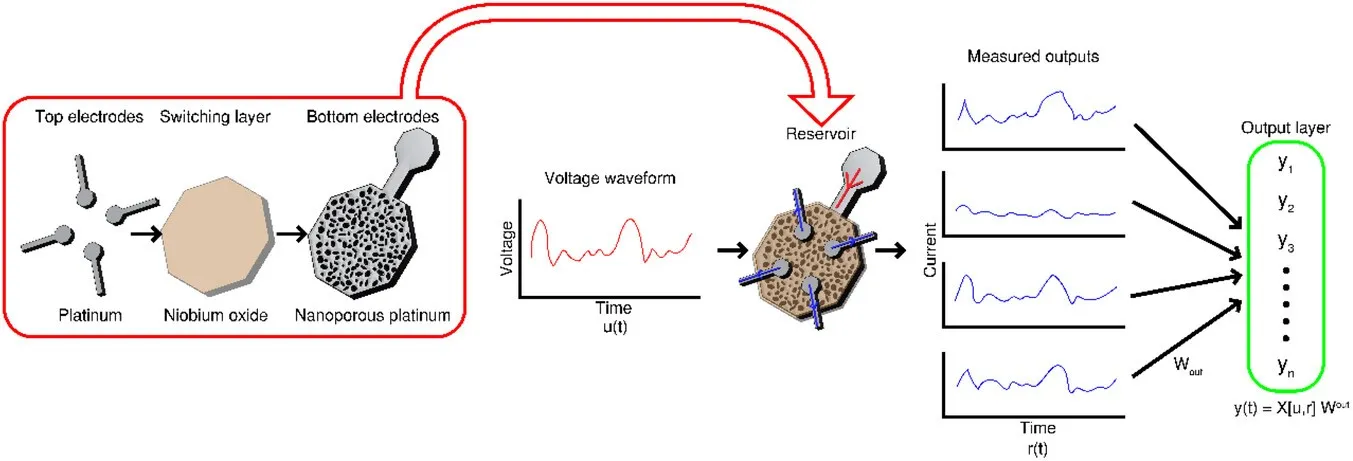
The principle of physical RC using a nanoporous memristor oxide device. From the left to the right: Composition of the physical reservoir, including the top electrodes, the memristor switching layer, and bottom nanoporous layer. Schematic representation of the voltage input u(t), current waveforms representing the reservoir states r(t), output layer y(t) produced by a product of the concatenated input vector X[u(t), r(t)] with the weight matrix Wout.
Despite its promise, the technology remains at an early stage. Current demonstrations are limited to relatively simple and low-noise tasks. Future work will focus on scaling network complexity, improving robustness to noisy real-world data, and assessing integration into practical, industry-compatible systems.
Overall, this work highlights a paradigm shift in AI hardware design: exploiting the natural complexity of physical systems to perform computation, potentially enabling scalable, low-power, and efficient AI solutions.

