Summary:Terahertz sensors are emerging as a breakthrough technology for advanced imaging, non-destructive inspection, and future 6G communications. With growing investment from the United States, Europe, and Asia, the technology is rapidly moving from laboratory research toward real-world industrial, medical, and autonomous system applications.
As artificial intelligence, autonomous systems, and next-generation communications continue to evolve, one emerging technology is attracting increasing global attention: the Terahertz Sensor.
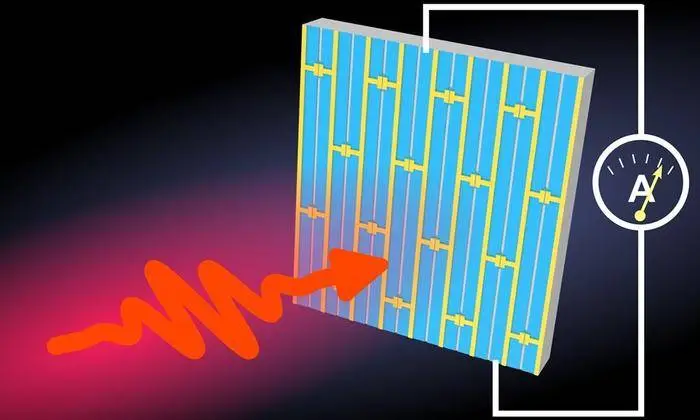
Terahertz (THz) waves occupy the electromagnetic spectrum between microwaves and infrared light. This unique position gives them both strong penetration capabilities and high-resolution imaging performance, making terahertz technology a promising bridge between electronics and photonics. In recent years, terahertz sensing has increasingly been viewed as a key enabling technology for advanced detection, imaging, and wireless communication systems.
Unlike conventional optical or microwave sensors, terahertz sensors can perform non-contact and non-destructive analysis with remarkable precision. Their operating principle relies on detecting how different materials absorb, reflect, or scatter terahertz waves. Since many substances exhibit unique spectral signatures in the terahertz range, the technology can identify chemical compositions, structural defects, and even biological tissue variations with high sensitivity.
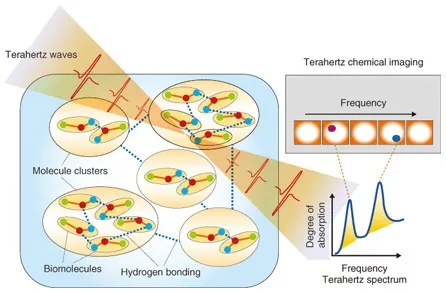
Terahertz spectrum of molecular network.
Globally, terahertz research and commercialization are accelerating. In the United States, NASA has long explored terahertz imaging for astronomical observation and deep-space research, using the technology to study interstellar dust and molecular structures. In Europe, Germany’s Fraunhofer institutes are developing industrial terahertz inspection systems for semiconductor packaging and composite material analysis, particularly for the automotive and aerospace sectors.
Japan and South Korea are investing heavily in terahertz-based wireless communication, viewing the spectrum as a potential foundation for future 6G networks capable of ultra-high-speed data transmission. Meanwhile, several research groups in the United Kingdom and Singapore are exploring medical applications, including early-stage skin cancer detection and pharmaceutical quality inspection.
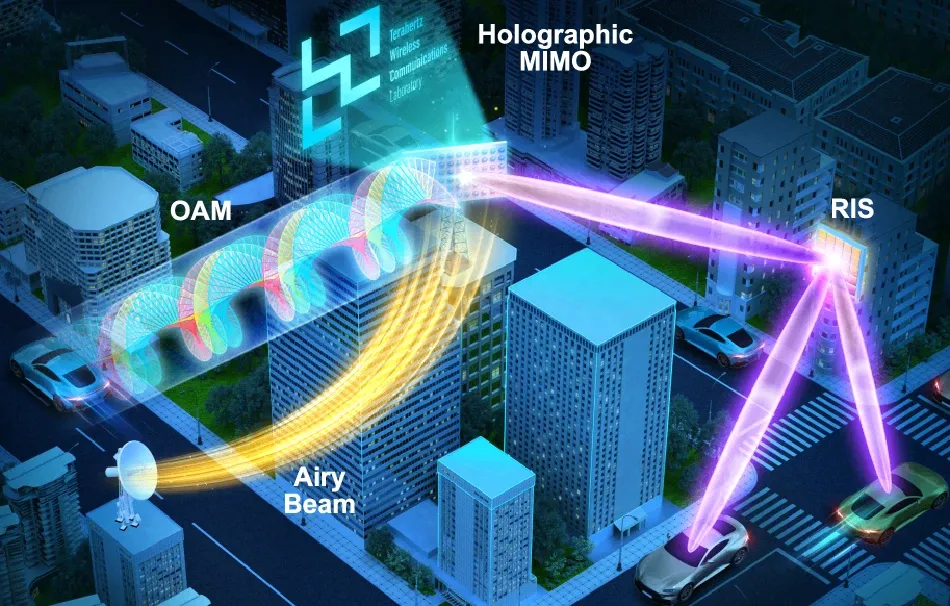
Beam manipulation for terahertz communications in a comprehensive environment.
One reason for the growing interest is that terahertz waves can detect subtle differences in water content and molecular structure, enabling highly detailed imaging beyond the capabilities of many traditional sensors. Combined with advances in AI-driven signal processing, nanomaterials, and semiconductor engineering, modern terahertz systems are becoming smaller, faster, and more practical for commercial deployment.
However, the technology still faces significant challenges. High system costs, signal attenuation in atmospheric conditions, and difficulties in large-scale chip integration remain barriers to widespread adoption. Even so, industry analysts widely believe terahertz sensing will become an important component of future intelligent infrastructure.
From smart manufacturing and airport security to autonomous mobility and next-generation healthcare, terahertz sensors are gradually transforming how machines perceive and interpret the physical world.