


Summary:Caltech researchers have developed an ultrafast optical metasurface chip that steers light beams in 74 femtoseconds, opening new possibilities for next-generation photonic computing, ultra-fast communications, and advanced optical sensors.
Researchers at the California Institute of Technology have developed a new optical chip capable of redirecting light beams in just 74 femtoseconds, marking a major advance in ultrafast photonics, optical computing, and high-speed communication technologies.
The chip uses a specially engineered optical metasurface to achieve all-optical beam steering without relying on traditional electronic control methods. Unlike conventional optical modulators, which typically operate at nanosecond or picosecond speeds due to electronic limitations, this technology uses light itself to control the direction of another light beam.

At the core of the device is the optical Kerr effect, a phenomenon where an intense light pulse temporarily changes the refractive index of a material. To enhance this normally weak effect, researchers created a nanoscale patterned amorphous silicon metasurface containing tiny pillars smaller than the wavelength of light. These structures allow light to circulate within the material longer, amplifying the interaction and enabling efficient beam control.
The system uses two light beams: a high-intensity “pump” beam that creates a temporary optical pattern on the metasurface, and a weaker “probe” beam that is redirected according to that pattern. The chip can steer light at angles of up to 13 degrees, with its switching speed limited only by the duration of the laser pulse.
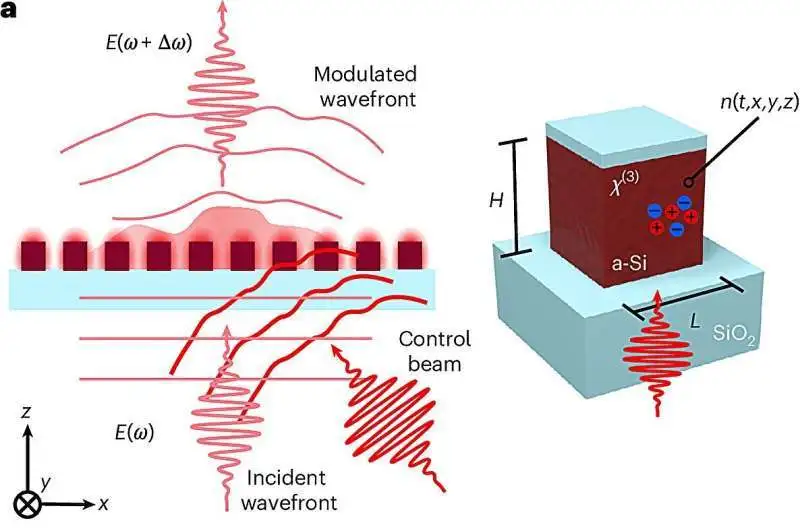
This ultrafast optical steering technology could provide a foundation for future photonic processors, optical communication networks, and high-speed sensing systems. By replacing electronic control with direct light-based manipulation, the technology may help overcome current speed barriers in next-generation information technologies.
Researchers say further improvements could push the platform toward even faster optical systems, supporting emerging fields such as time-varying photonics and advanced light-based computing architectures.

