Summary:The launch of the NEO humanoid robot’s 25-DoF dexterous hand brings robots closer to human-like manipulation through tendon-driven mechanics, tactile sensing, and a highly flexible design.
A humanoid robotics company has unveiled the next-generation dexterous hand for its humanoid robot NEO, marking a significant hardware advancement toward making home robots more practical and capable. The newly developed robotic hand features a human-inspired design and is designed to perform complex daily tasks such as grasping, twisting, organizing, and manipulating objects.
One of the key highlights of the NEO robotic hand is its 25 degrees of freedom (DoF). The hand and palm include 22 actively controlled degrees of freedom, while the wrist adds three additional degrees of freedom, giving the system movement capabilities that closely resemble the structure of a human hand. Unlike traditional robotic grippers that are limited to simple picking tasks, the NEO hand can perform more delicate operations, including handling small objects, using tools, opening zippers, and sorting items.
In terms of mechanical design, the robotic hand adopts a proprietary tendon-driven system, with motors positioned in the forearm and connected to the fingers through tendon-like transmission mechanisms. This approach reduces hand weight and inertia while improving safety and flexibility. The design allows the robotic hand to respond smoothly to external forces, making it more suitable for operation in human environments such as homes.
The NEO robotic hand also integrates tactile sensing capabilities, enabling it to detect contact pressure and object slippage, allowing the robot to automatically adjust gripping force. This capability helps the robot safely handle fragile objects such as glass cups and fruit without applying excessive pressure. The hand is also designed with an IP68 water-resistance rating, supporting potential household applications that require durability and easier maintenance.
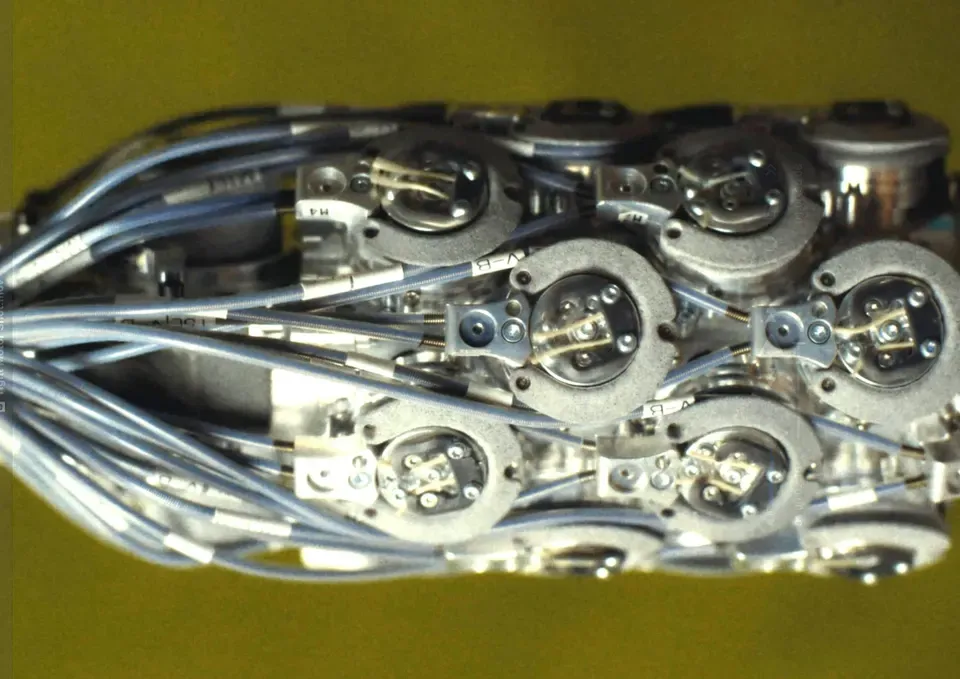
Tendons and motors inside 1X humanoid robot Neo's lower arm that control its hands.
Beyond hardware improvements, the NEO robotic hand represents an important step toward more intelligent humanoid robots. Data collected through real-world interactions can be used to further train AI models, improving the robot’s ability to learn and perform unfamiliar tasks in dynamic environments.
The NEO humanoid robot is positioned as a home assistant capable of performing household chores, object transportation, and everyday support tasks. The development of its advanced dexterous hand highlights the growing trend toward robots with more human-like physical capabilities and greater autonomy.