


Summary: A new soft force sensor developed by researchers at the National University of Singapore enables robots to sense, react, and learn from touch without electronics, computers, or external power, advancing the future of embodied intelligence and soft robotics.
Researchers at the National University of Singapore (NUS) have introduced ME-SOFS (Mechanical Soft Force Sensor), a novel soft robotic sensing system that can transform physical touch directly into robotic motion without relying on electronic sensors, processors, or external power sources. The technology, published in Science Advances on July 8, 2026, could significantly simplify robotic systems while improving reliability in harsh environments.

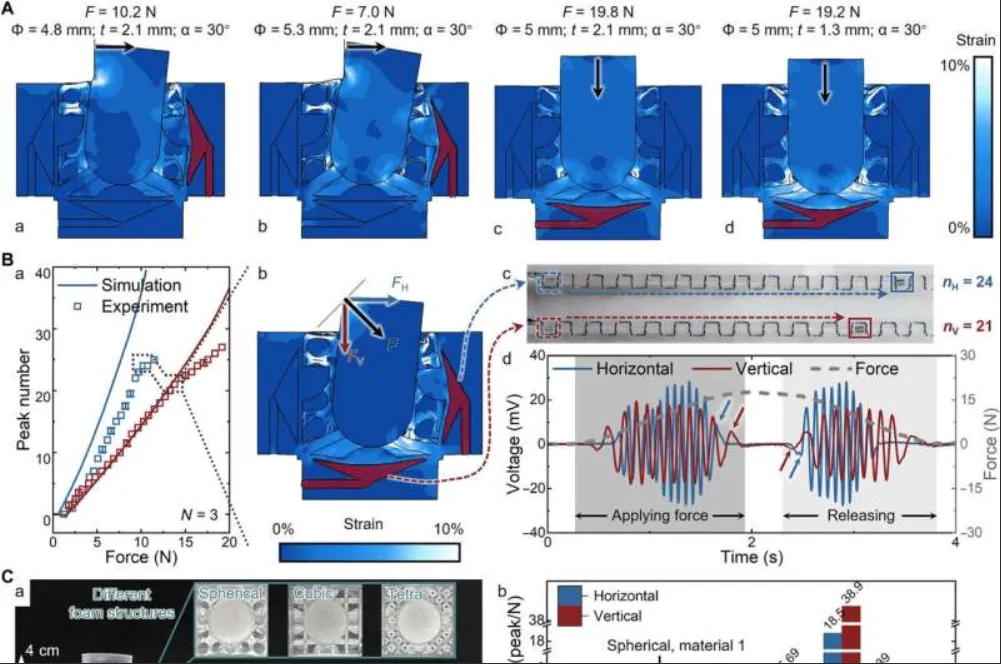
Unlike conventional robots that depend on a chain of electronic sensors, signal processors, and actuators, ME-SOFS uses a fully mechanical design to create a direct sensing-to-action pathway. The 3D-printed device consists of a central pillar connected to five fluid-filled chambers—four arranged horizontally and one vertically. When a force is applied, the pillar tilts and compresses specific chambers, pushing fluid through soft channels that immediately activate robotic actuators.
The sensor can independently distinguish forces across three directions—horizontal, lateral, and vertical—allowing robots to respond to complex physical interactions. To generate measurable data, researchers incorporated a passive magnetic induction system that produces voltage pulses as fluid movement displaces small magnets. The number of pulses corresponds to the applied force, providing a readable output without powered electronics.
To demonstrate its versatility, the research team integrated five miniaturized ME-SOFS units, each approximately the size of a green pea, into a soft robotic glove. The glove detected fingertip forces and estimated the weight of grasped objects. In another experiment, the sensor enabled real-time tactile feedback between a robotic gripper and a human operator, allowing delicate objects such as eggs, wooden blocks, and partially filled water bottles to be handled safely while simultaneously generating data for robot learning.
ME-SOFS also proved highly durable, maintaining stable performance in 90°C (194°F) water and under pressure equivalent to approximately 11 meters (36 feet) underwater. With no electronic components, the system is naturally resistant to electromagnetic interference.
The breakthrough highlights growing interest in soft robotics, tactile sensing, embodied intelligence, human-robot interaction, robotic learning, wearable robotics, and next-generation autonomous systems, with potential applications ranging from medical training and prosthetics to eldercare, industrial automation, and underwater exploration.

