


Summary: A newly developed photonic integrated accelerometer combines silicon nitride photonics, dual Mach–Zehnder interferometers, and phase-unwrapping technology to achieve high-sensitivity inertial sensing with a 39 dB dynamic range improvement, paving the way for next-generation chip-scale navigation, seismic monitoring, and industrial sensing systems.
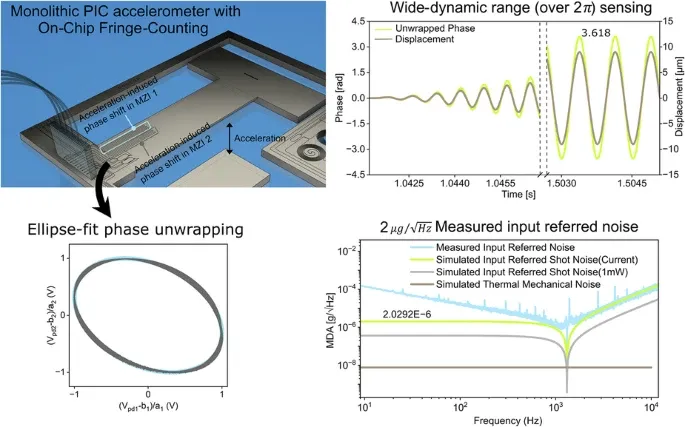
Researchers have demonstrated a new photonic integrated circuit (PIC) accelerometer that significantly improves the performance of chip-scale inertial sensors by combining optical sensing with advanced phase-unwrapping techniques. The innovation addresses one of the most persistent challenges in accelerometer design: achieving both high sensitivity and wide dynamic range within a compact device.
Built on a silicon nitride photonic platform, the accelerometer integrates two Mach–Zehnder interferometers (MZIs) directly onto a microfabricated cantilever structure. When acceleration causes the cantilever to bend, optical phase changes are generated within the waveguides and converted into highly precise motion measurements.
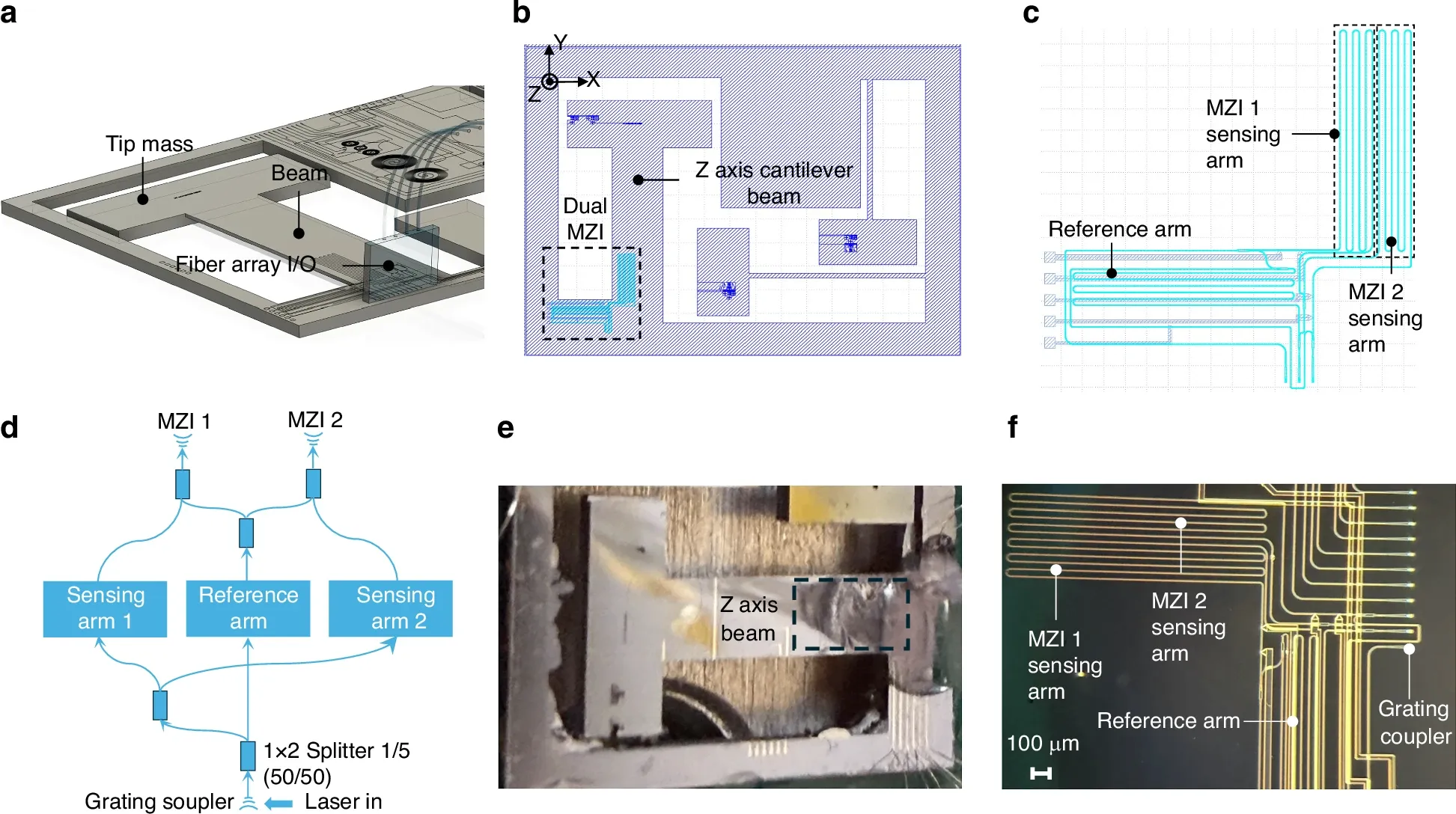
Concept and design of the photonic MEMS Z-axis accelerometer with dual Mach–Zehnder interferometer (MZI) readout.
Unlike conventional interferometric accelerometers that require operation near a fixed bias point, the new design employs a dual-MZI architecture with ellipse-fitting phase unwrapping. This allows continuous and accurate phase recovery across multiple optical fringes, eliminating ambiguity during large-amplitude motion events.
Experimental results showed a 39 dB improvement in dynamic range compared with traditional single-interferometer approaches while maintaining low distortion and high measurement fidelity. The sensor successfully tracked optical phase excursions exceeding an entire wavelength, demonstrating stable operation under conditions that would typically push conventional devices into nonlinear regions.
The technology also benefits from the inherent advantages of integrated photonics, including CMOS-compatible manufacturing, wafer-scale production, compact size, and immunity to electromagnetic interference. Noise characterization revealed that the device approaches the optical shot-noise limit at higher frequencies, with future designs expected to further reduce noise through increased optical power and longer waveguide sensing paths.
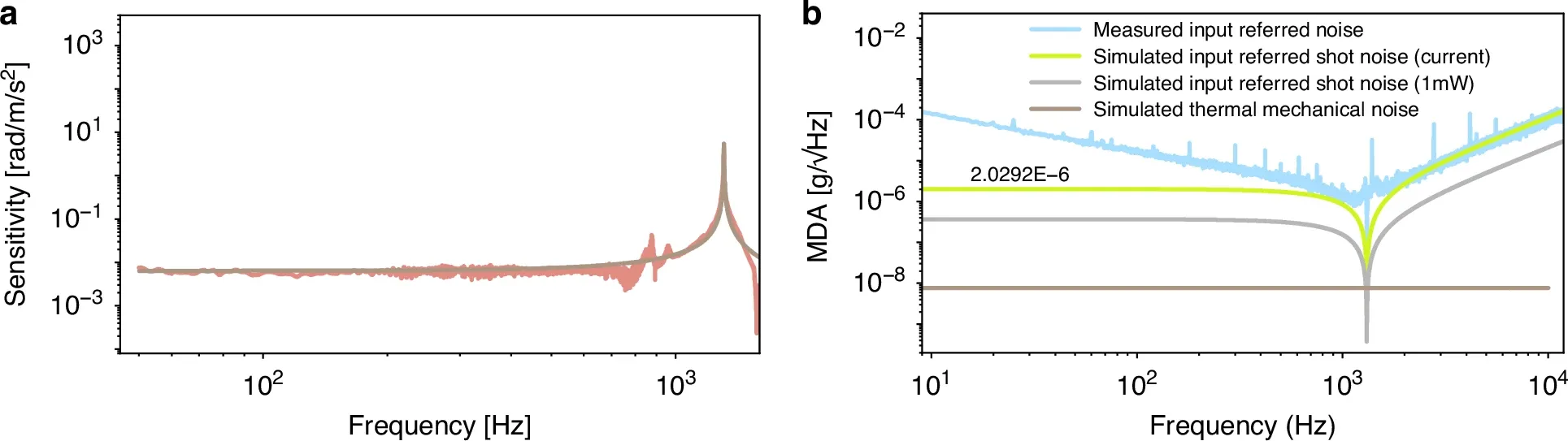
Frequency response and noise performance of the accelerometer.
As demand grows for high-performance MEMS accelerometers, photonic inertial sensors, and chip-scale navigation systems, this breakthrough highlights a practical pathway toward next-generation motion sensing. Potential applications include autonomous robotics, drone navigation, virtual and mixed reality devices, seismic monitoring, industrial automation, and precision scientific instrumentation.
By integrating optical fringe counting directly onto a photonic chip, the new accelerometer demonstrates how integrated photonic sensing technology can overcome traditional trade-offs between sensitivity and measurement range, opening new possibilities for ultra-compact, high-accuracy inertial measurement systems.

