


Summary:Researchers have developed long-range surface polaritons (LRSPs) using a two-dimensional hexagonal boron nitride (h-BN) heterostructure, enabling ultra-long mid-infrared light transport and opening new possibilities for compact on-chip photonic devices.
A new breakthrough in mid-infrared (mid-IR) photonics could reshape the future of compact optical chips. Researchers have demonstrated long-range surface polaritons (LRSPs) in a two-dimensional van der Waals (2D vdW) material platform, achieving light propagation distances far beyond conventional graphene plasmons and hyperbolic phonon polaritons.
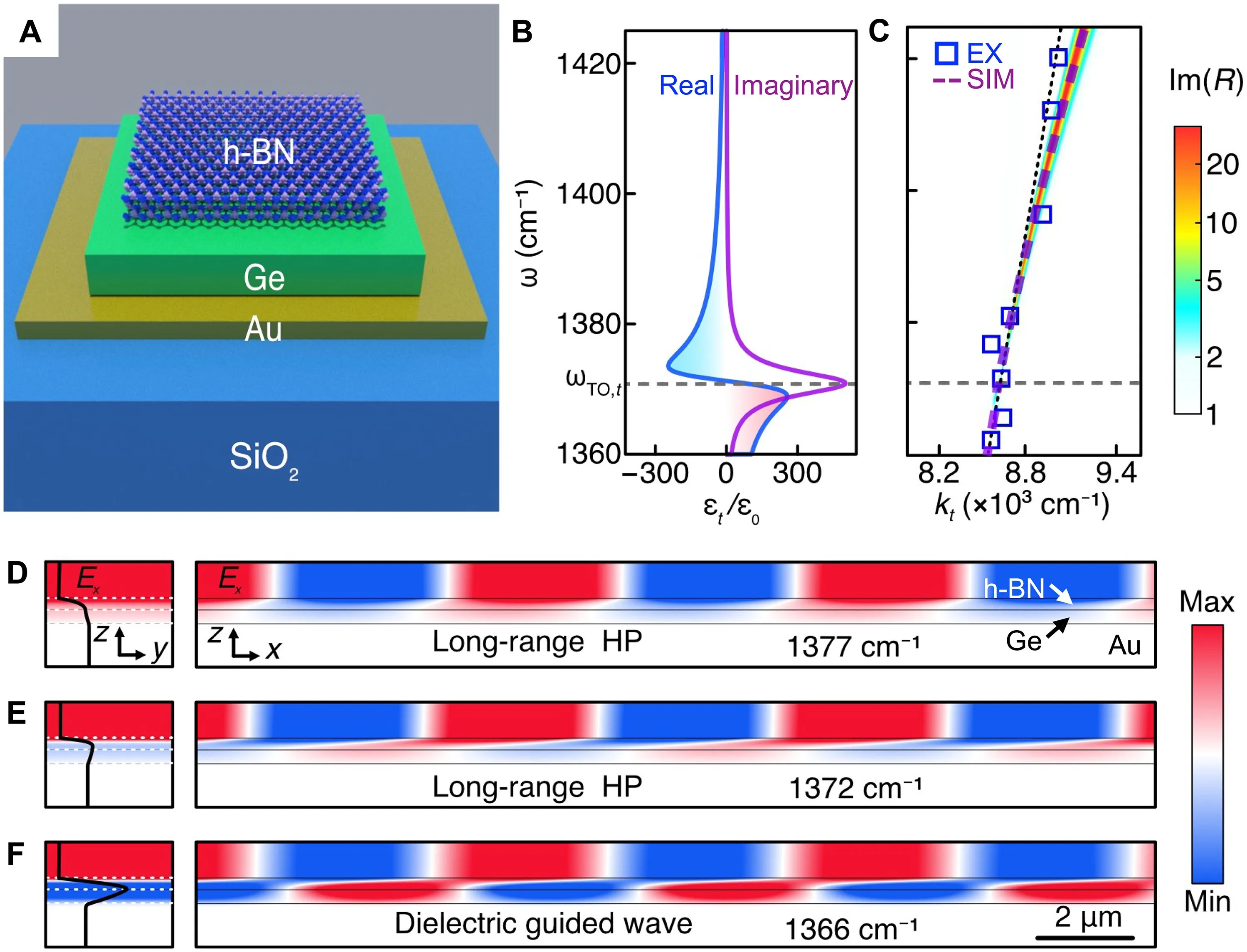
LRSPs on an h-BN-substrate heterostructure.
The technology is based on a specially designed h-BN–germanium–gold (h-BN/Ge/Au) heterostructure, where a thin layer of hexagonal boron nitride (h-BN) acts as the polaritonic medium. Unlike traditional graphene plasmons, which typically propagate only a few micrometers in the mid-infrared range, the new LRSP technology experimentally achieved propagation distances exceeding 80 micrometers across an entire h-BN flake. Theoretical simulations predict propagation lengths of approximately 925 micrometers.
The research shows that the key innovation comes from controlling the phonon resonance properties of h-BN. Near its transverse optical phonon resonance, h-BN exhibits a strong infrared response, allowing LRSPs to travel close to the speed of free-space light while maintaining low energy loss.
The optimized device structure contains a 119-nanometer h-BN layer, a 293-nanometer germanium layer, and a 100-nanometer gold reflector, with an overall thickness of only about 1/14.2 of the operating wavelength. The gold layer helps prevent optical leakage, while the germanium layer improves field confinement and supports long-distance polariton transport.
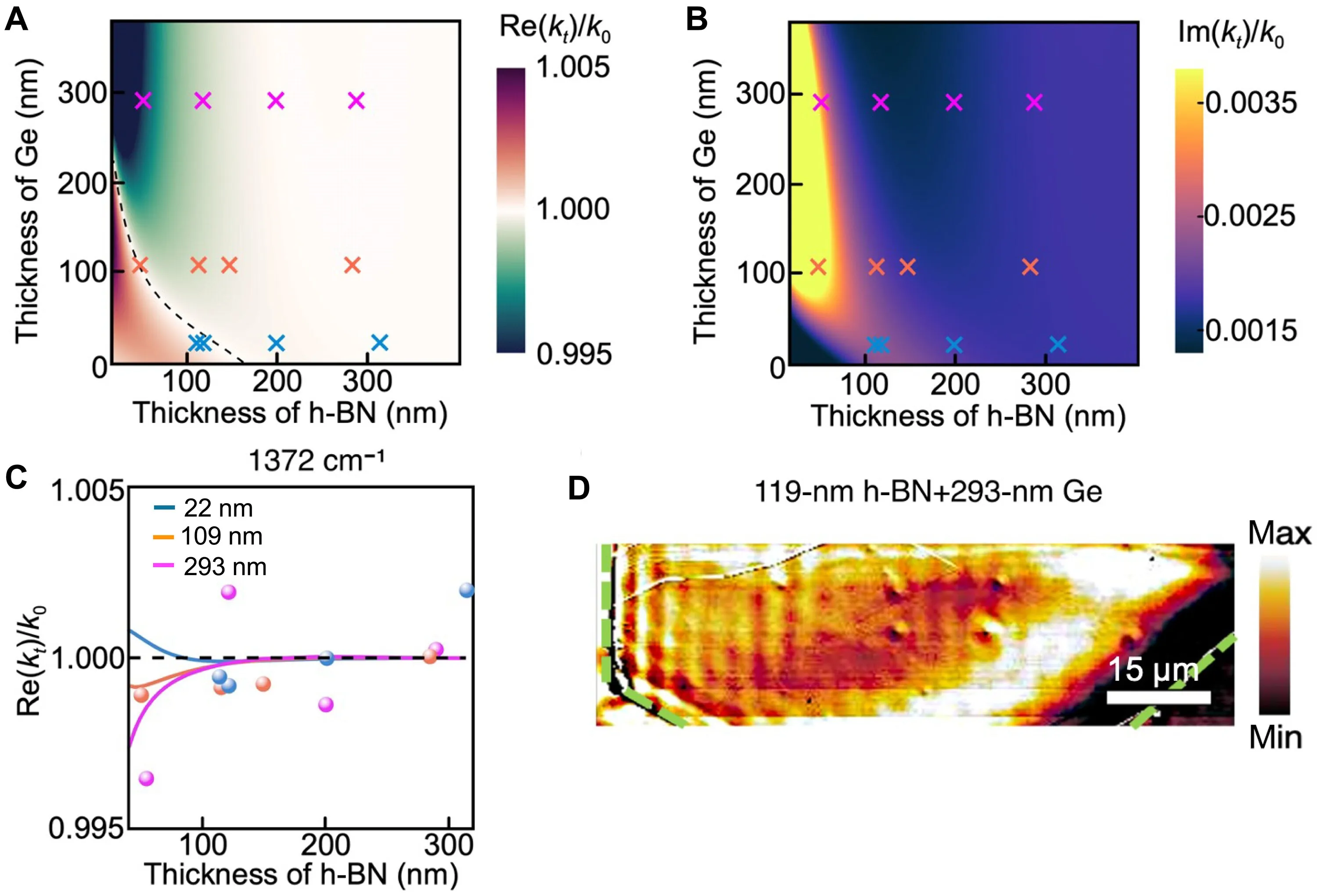
LRSPs at 1372 cm−1 on h-BN + Ge + Au samples.
Using scattering-type scanning near-field optical microscopy (s-SNOM), the researchers directly observed LRSP propagation in the mid-infrared wavelength range. Compared with existing graphene plasmons (GPs) and hyperbolic phonon polaritons (HPhPs), the new platform offers significantly longer transmission distances and faster group velocities.
The researchers suggest that LRSP-based waveguides could become a foundation for future mid-infrared photonic chips, optical interconnects, chemical sensors, biomedical imaging systems, and integrated quantum or AI photonic devices.
By combining 2D materials, nanophotonics, and advanced heterostructure engineering, this technology provides a new pathway toward high-speed, miniaturized infrared information processing systems.

