


Summary:A new gradient zinc anode technology significantly improves the stability of aqueous zinc-ion batteries by preventing dendrite growth and enhancing cycling performance. The breakthrough could support safer and more sustainable energy storage solutions for future renewable energy systems.
A breakthrough in aqueous zinc-ion battery technology could overcome one of the biggest challenges in next-generation energy storage. A newly developed gradient-engineered zinc anode enables highly stable zinc deposition, suppresses dendrite formation, and extends battery operating life to more than 5,000 hours, offering a promising pathway toward safer and more durable rechargeable batteries.
Unlike conventional lithium-based batteries, aqueous zinc-ion batteries (AZIBs) use water-based electrolytes, providing advantages in safety, cost, and material availability. However, their commercial development has been limited by unstable zinc metal anodes. During repeated charging and discharging, uneven zinc growth can create dendrites, accelerate electrode degradation, and reduce battery lifespan.
To address these challenges, researchers developed a multi-component gradient zinc anode framework that integrates a three-dimensional conductive structure with functional surface layers and zinc-guiding active sites. The advanced architecture regulates zinc-ion transport and creates a uniform deposition environment, allowing zinc to grow smoothly inside the electrode structure rather than forming unstable surface dendrites.
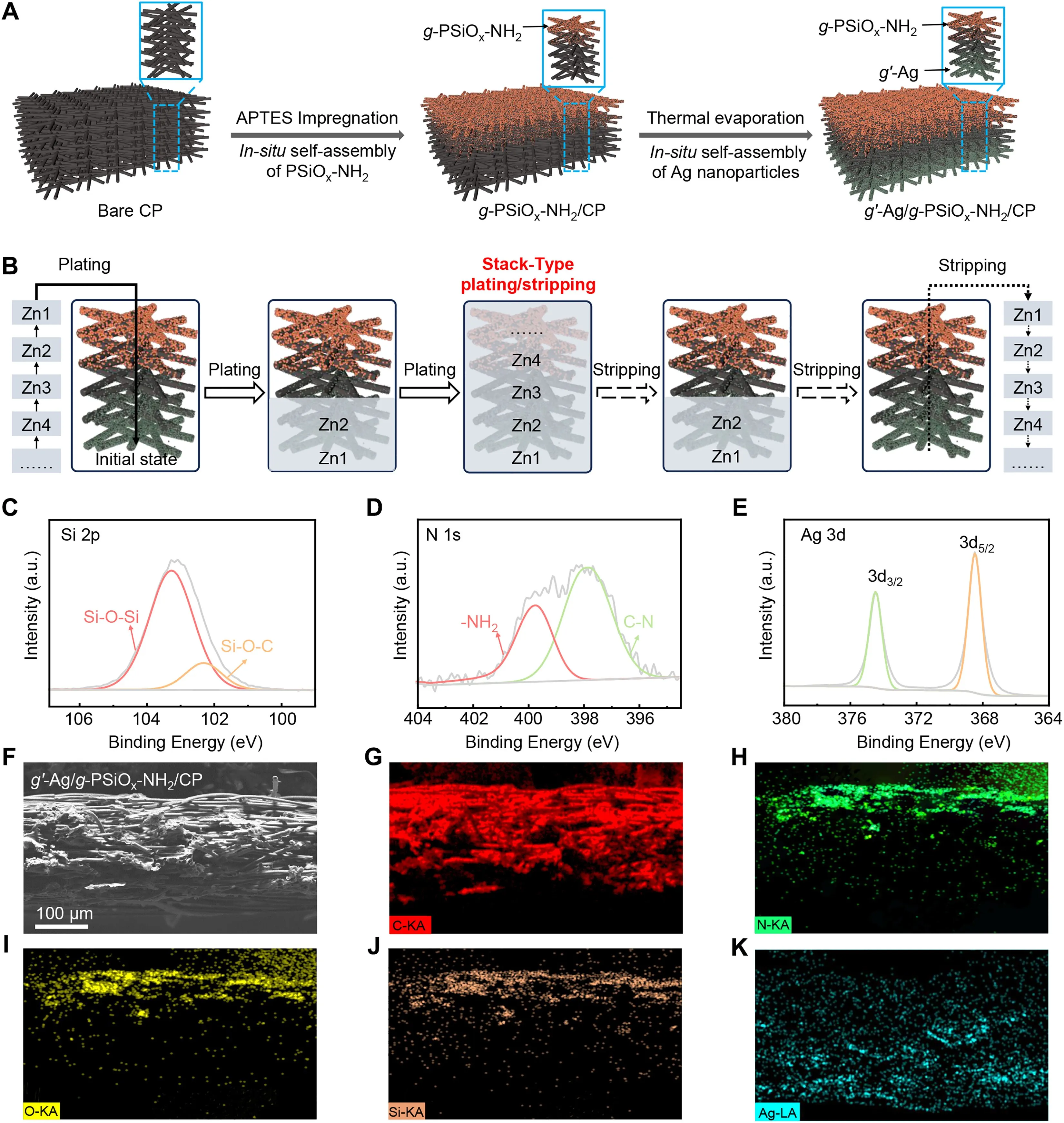
Interfacial properties and zinc deposition observations.
The core innovation is a controlled “first-in/last-out” zinc plating and stripping mechanism. This design improves the reversibility of zinc reactions, reduces unwanted side reactions, and maintains electrode integrity during long-term operation.
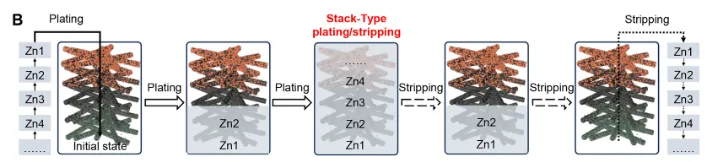
Schematic illustration of the stack-type zinc plating/stripping behavior with a “first-in/last-out” mode enabled by the g’-Ag/g-PSiOx-NH2/CP host.
Experimental results demonstrated outstanding performance. The optimized zinc anode achieved stable cycling for more than 5,000 hours at 10 mA cm⁻² and 10 mAh cm⁻², showing strong resistance against dendrite growth and degradation. When paired with a manganese dioxide cathode, the Zn||MnO₂ full battery delivered 200.1 mAh g⁻¹ after 800 cycles, maintaining 82.2% capacity retention.
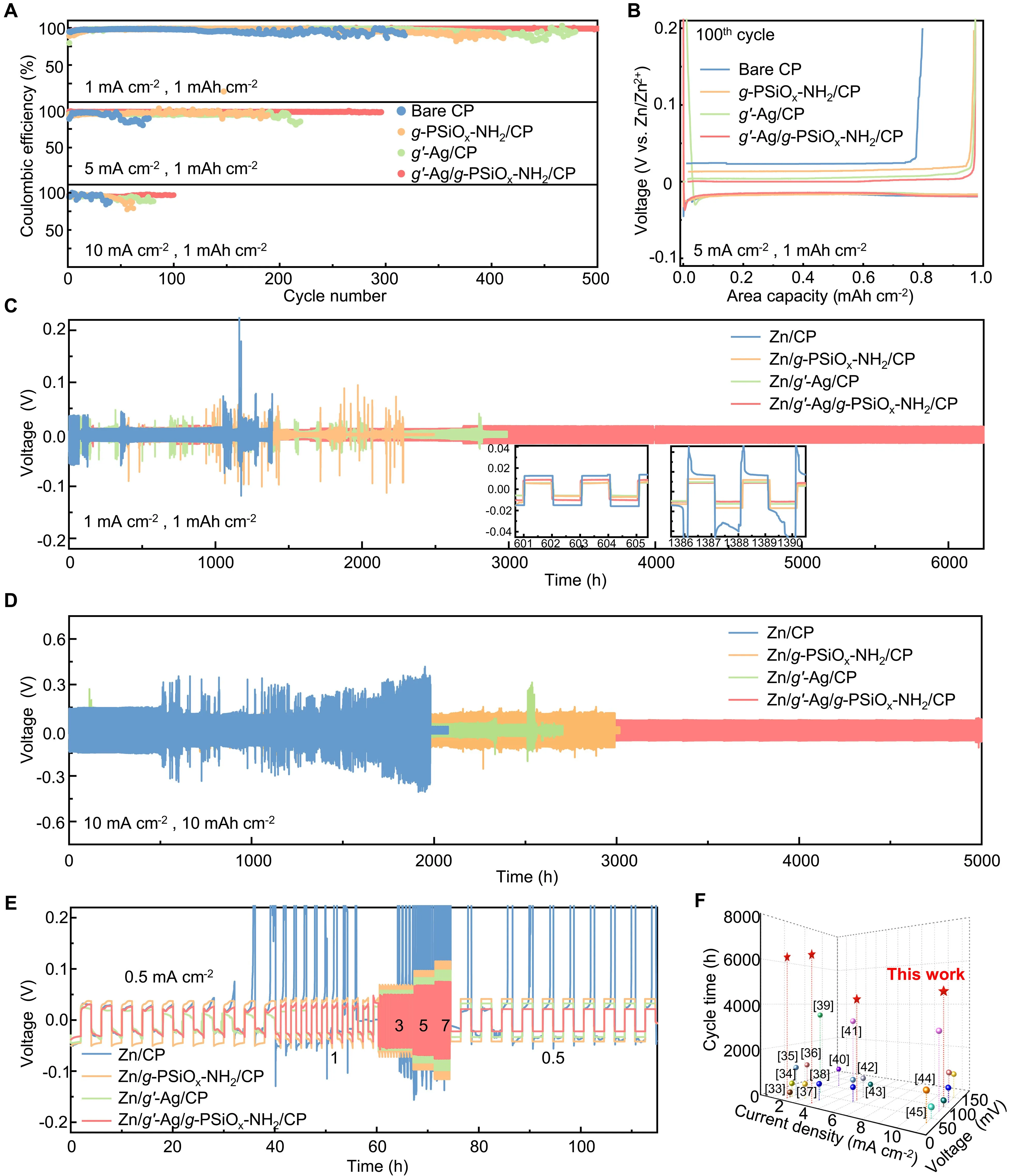
Electrochemical performances of different Zn host electrodes.
The technology was further validated through the development of a larger 6 × 7 cm² pouch-type zinc battery prototype, demonstrating its potential for scale-up toward practical energy storage applications.
With growing global demand for affordable and reliable energy storage, advanced zinc-ion batteries are attracting increasing attention for renewable energy integration, grid storage, and backup power systems. This gradient zinc anode strategy provides a new design approach for building longer-lasting, safer, and more sustainable battery technologies.

