


Summary: Published in Science Robotics, the BeyondMimic framework combines reinforcement learning and diffusion models to enable humanoid robots to perform humanlike athletic movements and solve previously unseen tasks without retraining.
Humanoid robots have long promised to bring human-level mobility and versatility to factories, public spaces, and everyday environments. However, teaching robots to move naturally while adapting to new situations remains one of the most difficult challenges in robotics. A new framework called BeyondMimic, published in Science Robotics, offers a significant step toward that goal by enabling humanoid robots to learn diverse human motions and apply them to tasks they have never encountered before.
The research introduces a two-stage architecture that combines large-scale human motion learning with a diffusion-based decision-making model. In the first stage, the system learns from approximately 2.5 hours of human motion data, covering a wide range of behaviors such as sprinting, jumping, cartwheels, dance routines, balance recovery, martial arts techniques, and expressive movements. Unlike many previous approaches that require extensive tuning for each motion, BeyondMimic uses a shared training framework and common hyperparameters to learn hundreds of skills efficiently.
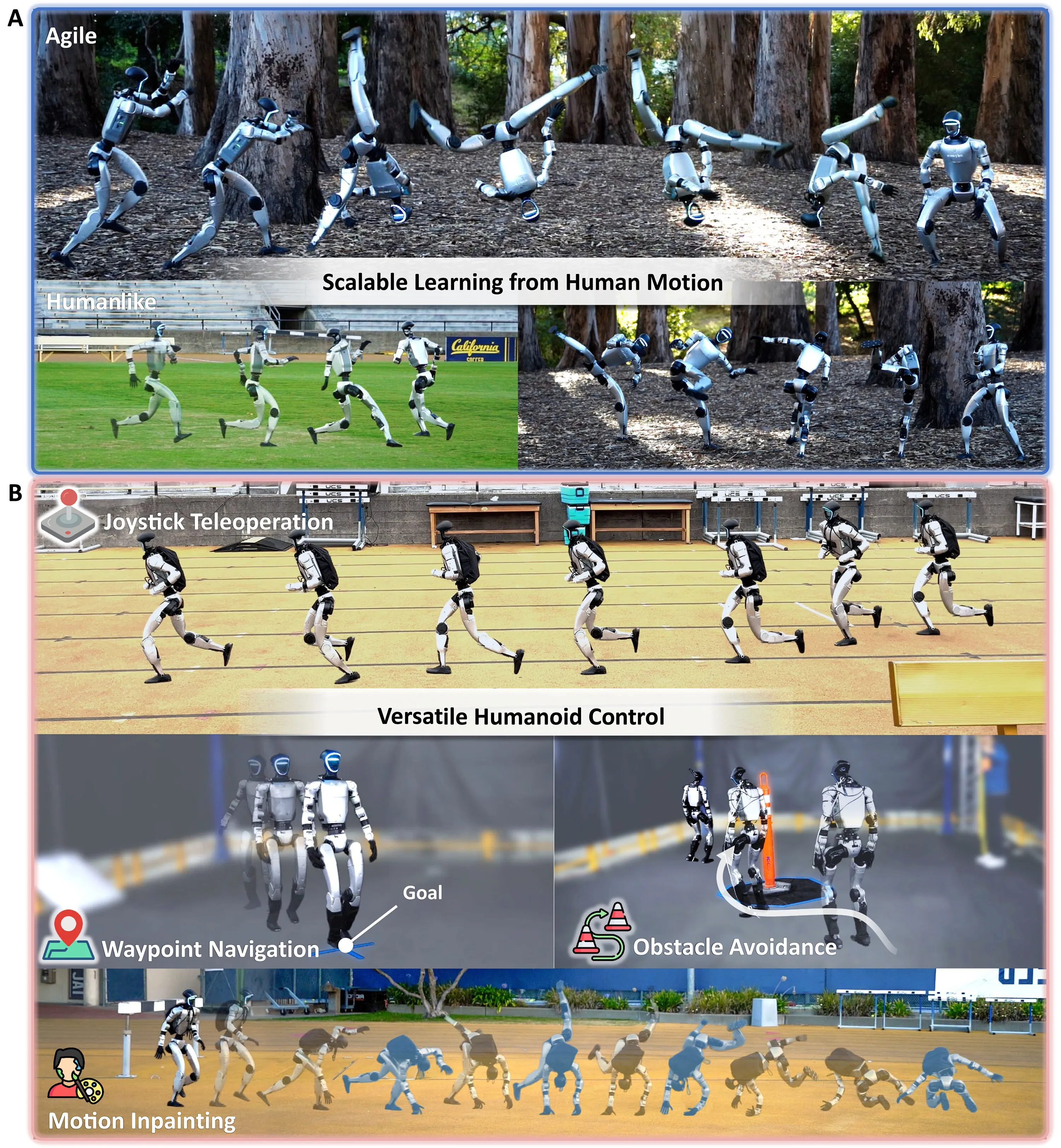
Overview of the proposed versatile humanoid control framework.
Real-world demonstrations showed the robot performing highly dynamic actions on uneven outdoor terrain, including aerial cartwheels, spin kicks, flip kicks, crawling, and rapid recovery maneuvers. Researchers reported that the robot reached levels of agility comparable to skilled human athletes, while maintaining stable landings and coordinated body control. The system also reproduced complex motion sequences continuously without losing balance, highlighting its robustness in challenging environments.
Beyond physical agility, the framework introduces a latent diffusion model that allows robots to compose learned skills and generate new behaviors at runtime. Through diffusion-based guidance, the robot can respond to goals that were never included in training. Demonstrated capabilities include waypoint navigation, joystick teleoperation, obstacle avoidance, command-conditioned locomotion, and motion inpainting, where the robot fills in missing movement segments to create smooth transitions between actions. Importantly, these tasks were achieved without task-specific retraining or fine-tuning.
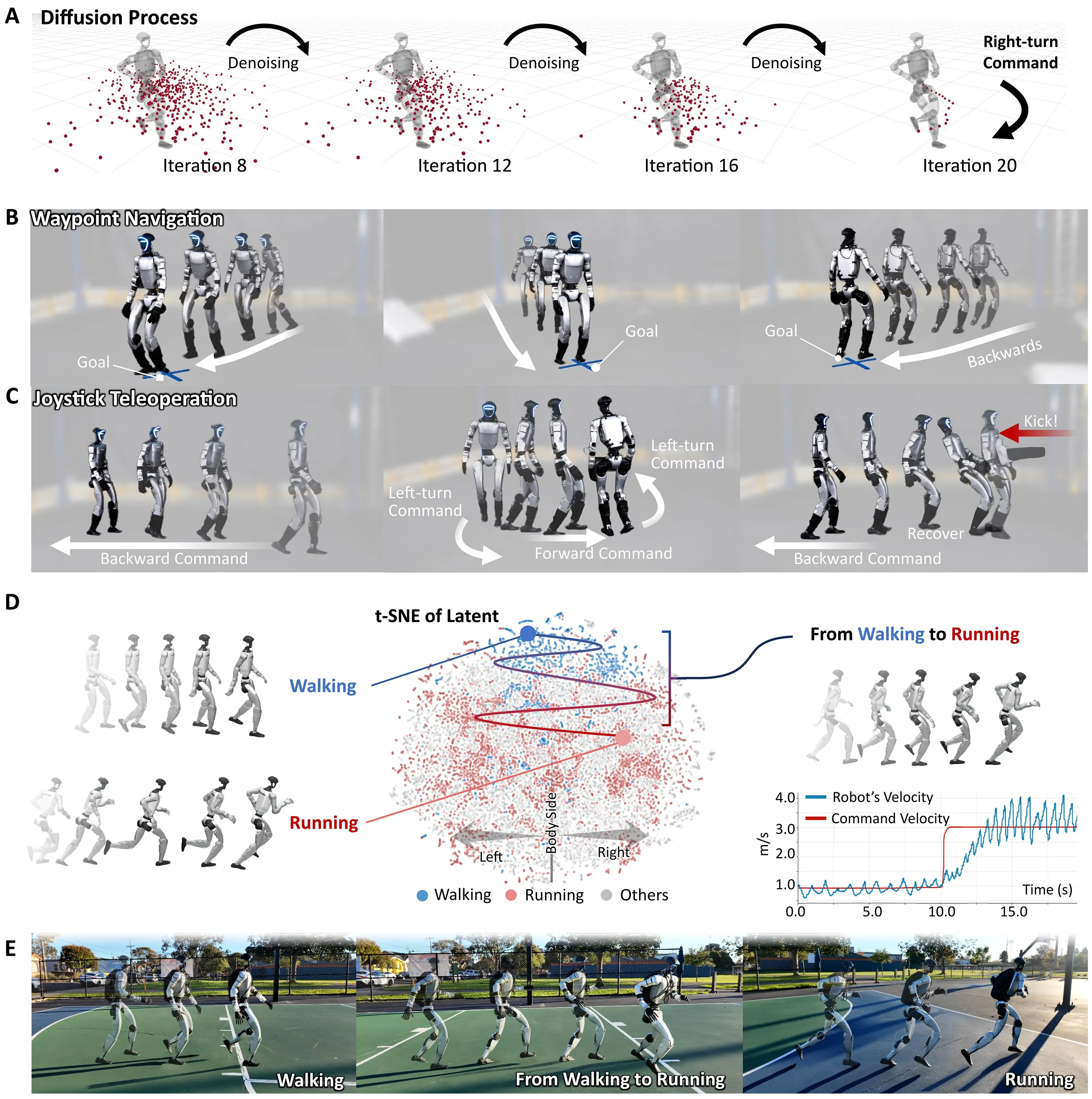
Command-conditioned locomotion via guided diffusion.
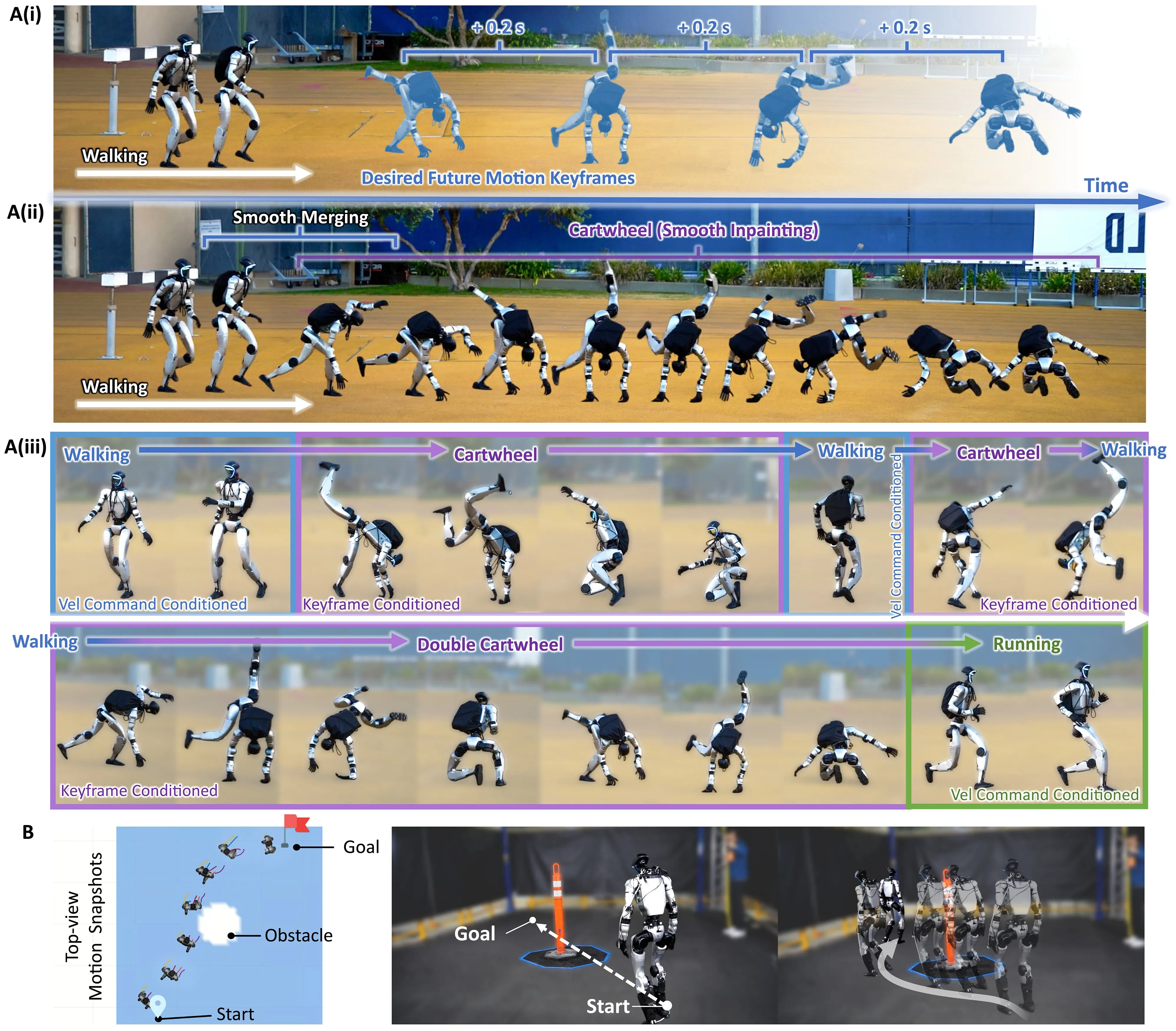
Task transition and composition.
Researchers describe BeyondMimic as a move beyond simple motion imitation toward a more general-purpose humanoid intelligence system. By learning from human demonstrations and synthesizing skills on demand, the framework can adapt to changing objectives while preserving natural, humanlike movement. The team argues that this approach could form the basis of future foundation models for humanoid robotics, where robots continuously expand their capabilities through additional motion data rather than task-specific programming.
The open-source release of BeyondMimic has already been adopted by parts of the robotics community and reproduced on multiple humanoid platforms, suggesting broad potential for next-generation embodied AI systems. As humanoid robots move closer to real-world deployment, frameworks such as BeyondMimic may help bridge the gap between human motor intelligence and autonomous robotic behavior.

