


Summary: Researchers have demonstrated the world’s most advanced topological polariton logic platform, achieving ultrafast room-temperature optical logic operations based on a Majorana-like topological state with record-low energy consumption and sub-picosecond switching speeds.
A research team has unveiled a breakthrough in topological photonics by demonstrating dynamic topological logic operations using exciton-polaritons inside a perovskite Dirac vortex microcavity. The study, published in Science Advances, marks a significant step toward ultrafast, low-power optical computing and future on-chip photonic processors.
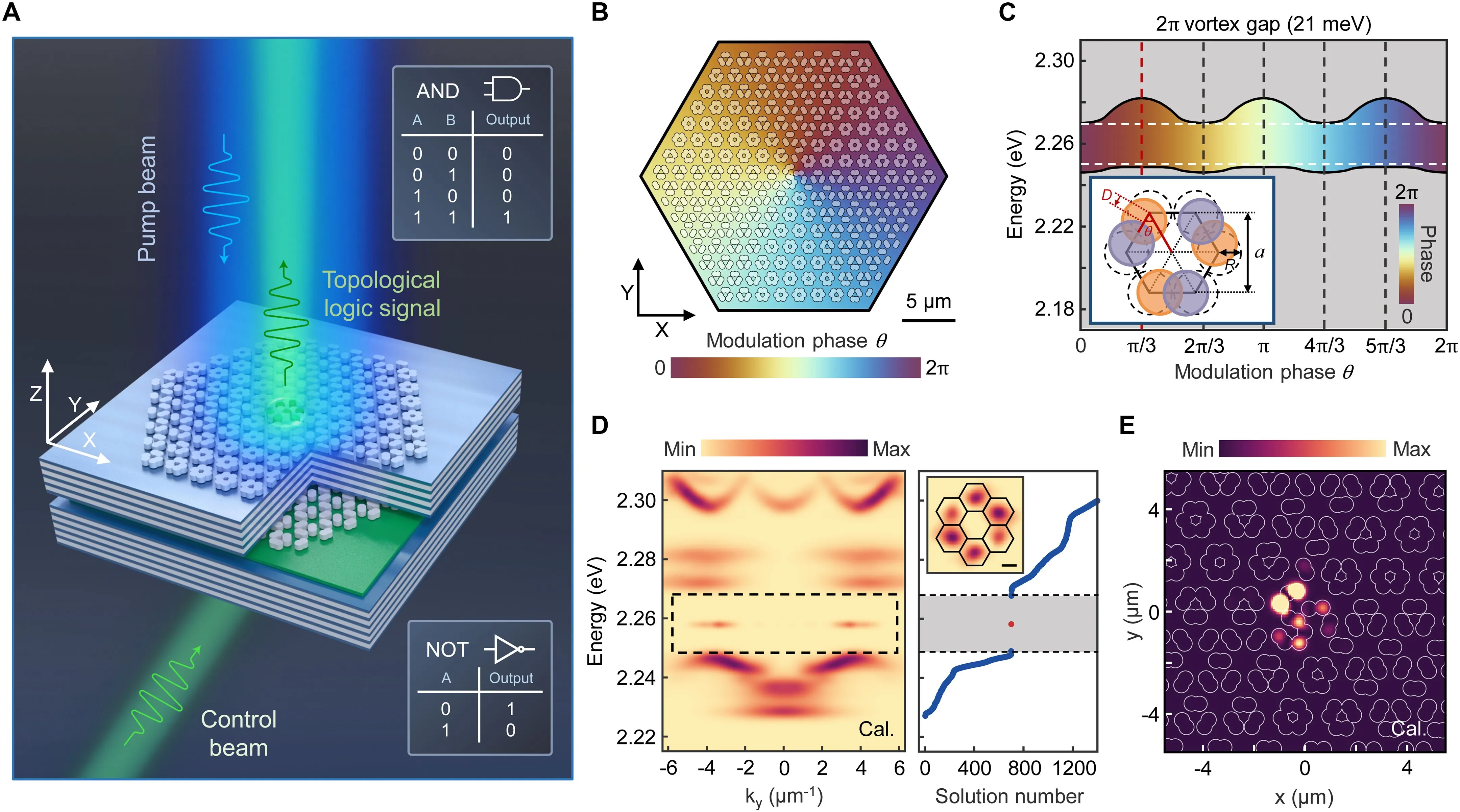
Scheme and design of the topological perovskite Dirac vortex microcavity.
The device exploits a topological Majorana-like state—a highly protected quantum-inspired mode confined within a large topological bandgap. By combining strong light-matter interactions in perovskite exciton-polaritons with a specially engineered Dirac vortex lattice, the researchers achieved stable polariton condensation at room temperature and dynamically controlled it using optical signals.
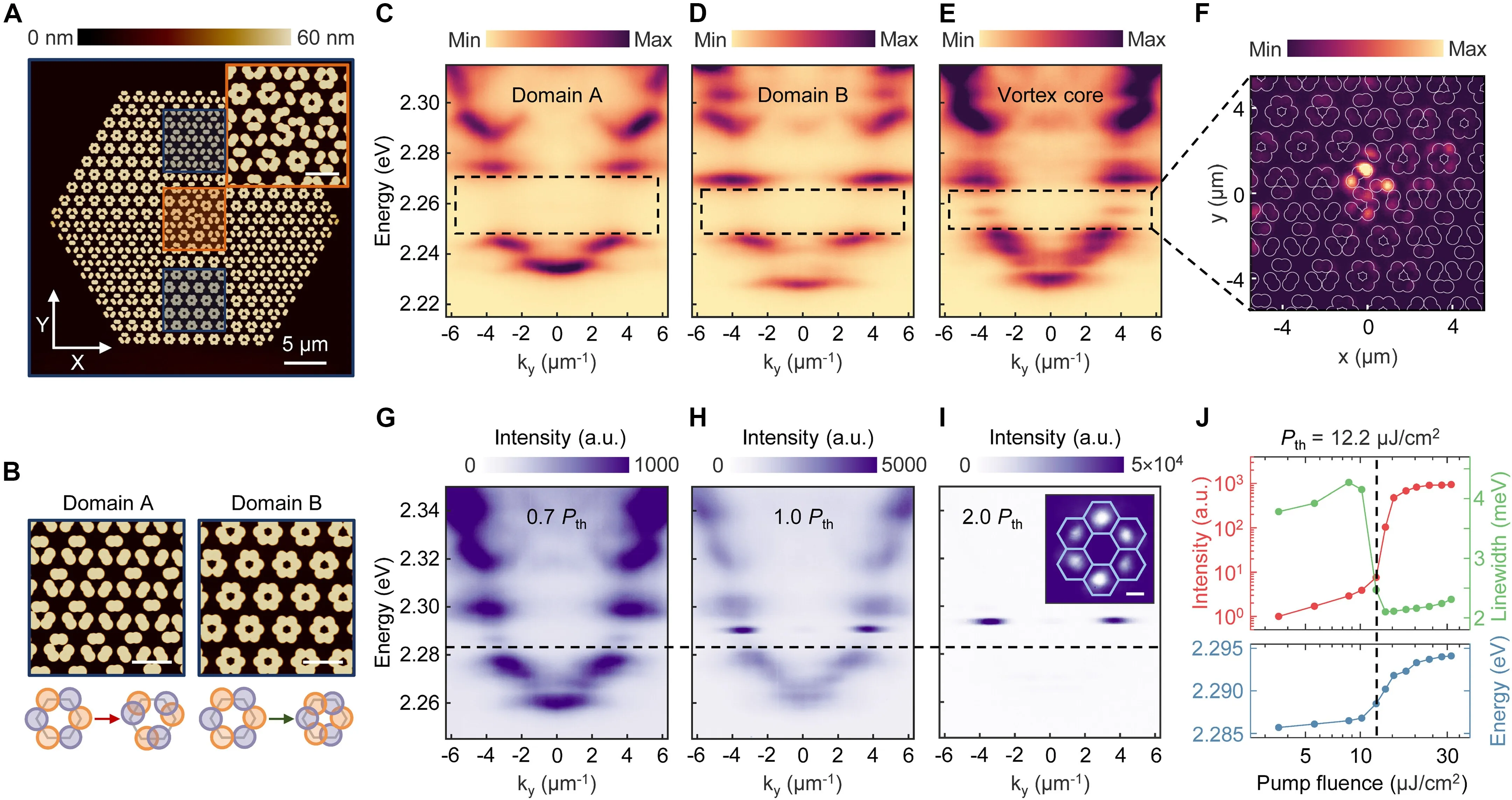
Experimental demonstrations of the polaritonic Majorana-like state with its spontaneous condensation.
Unlike conventional optical logic systems, the platform uses topological protection to improve robustness against defects and fabrication imperfections. The team successfully implemented both AND and NOT logic gates by selectively amplifying or suppressing the topological condensate through synchronized control beams. This approach enables reliable all-optical information processing without electronic conversion.
Performance metrics set new benchmarks for polaritonic logic devices. The topological AND gate achieved an extinction ratio of approximately 20 dB, while the NOT gate reached 16.4 dB. More importantly, the system required an extremely low control fluence of only 0.2 nJ/cm² and delivered switching times of about 500 femtoseconds—equivalent to operating speeds in the terahertz regime.
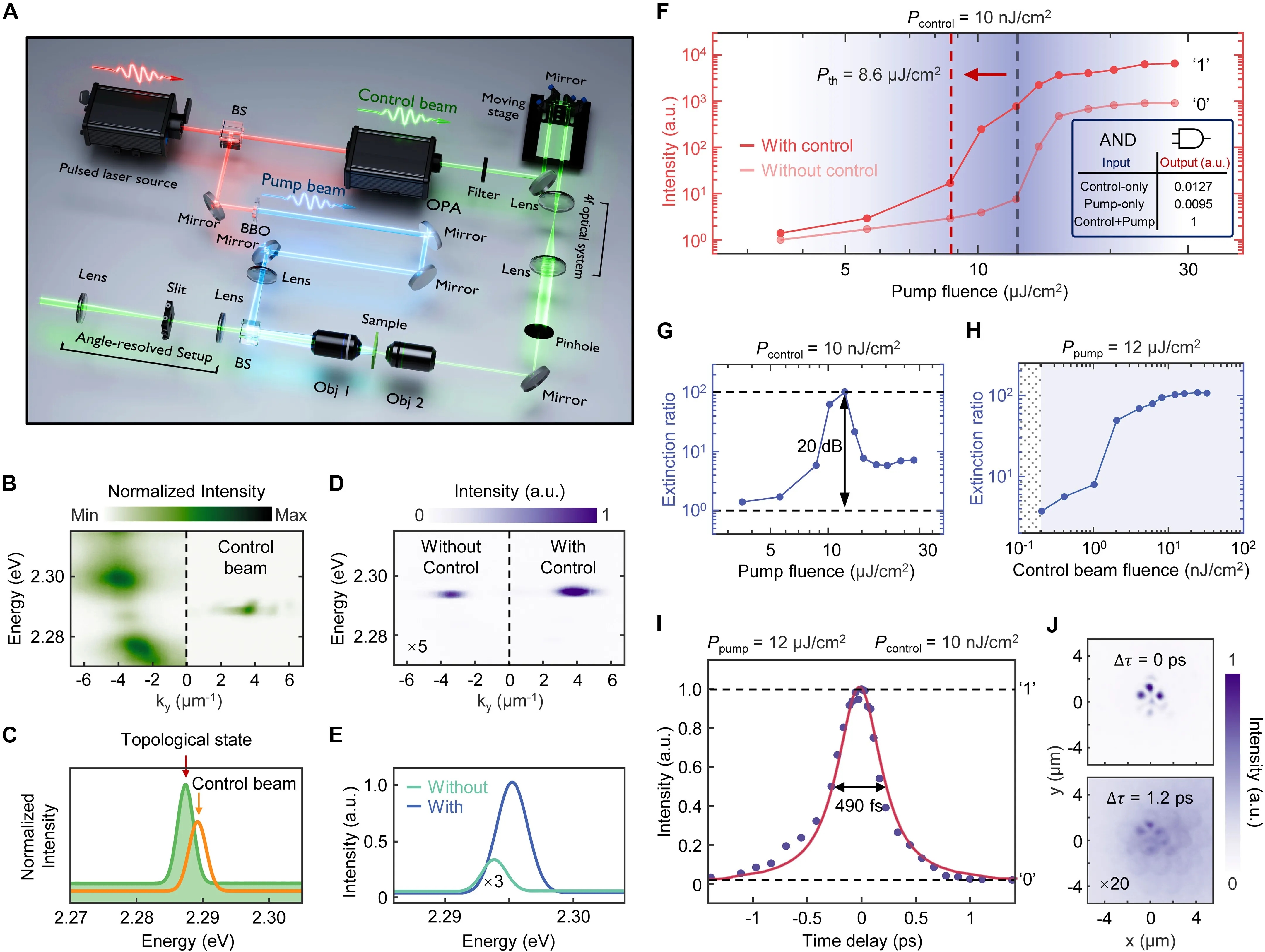
Dynamic amplification of topological exciton-polariton condensation enables topological AND gate.
The underlying architecture is based on a CsPbBr₃ perovskite microcavity featuring a Dirac vortex lattice that hosts a spectrally isolated Majorana-like state at the center of a roughly 21 meV topological bandgap. This large spectral separation minimizes crosstalk and enables precise control of optical logic states.
Researchers believe the technology could provide a foundation for next-generation topological photonic circuits, ultrafast AI accelerators, optical interconnects, and future quantum information systems. Beyond Boolean logic, the Majorana-like state used in the device is also considered a promising building block for advanced topological quantum computing architectures.

