


Summary: Researchers have developed a miniature soft ocean-sensing tag that combines real-time CTD monitoring with long-range underwater acoustic communication, offering a lightweight alternative to conventional oceanographic instruments.
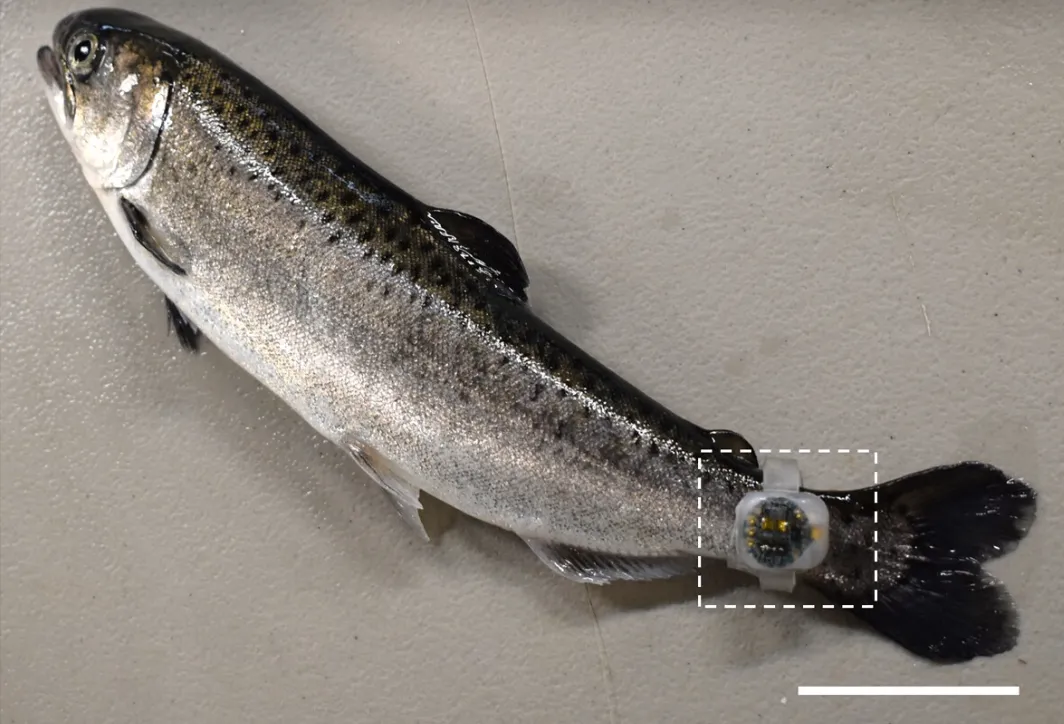
The soft ocean-sensing tag attached to a juvenile Chinook salmon, demonstrating its potential for real-time marine monitoring and biotelemetry.
Published in Science Advances, a new soft electronics platform could transform how scientists collect ocean data by dramatically shrinking the size and weight of traditional conductivity, temperature, and depth (CTD) monitoring systems while enabling real-time underwater communication.
The newly developed soft ocean-sensing tag measures just 17 mm × 20 mm × 7.5 mm and weighs only 4.9 grams, making it nearly two orders of magnitude smaller and lighter than many conventional oceanographic CTD devices. Designed for deep-sea monitoring, marine biotelemetry, ocean sensing, and underwater IoT applications, the device integrates flexible CTD sensors, onboard electronics, a rechargeable battery, and an acoustic telemetry system into a compact wearable package.
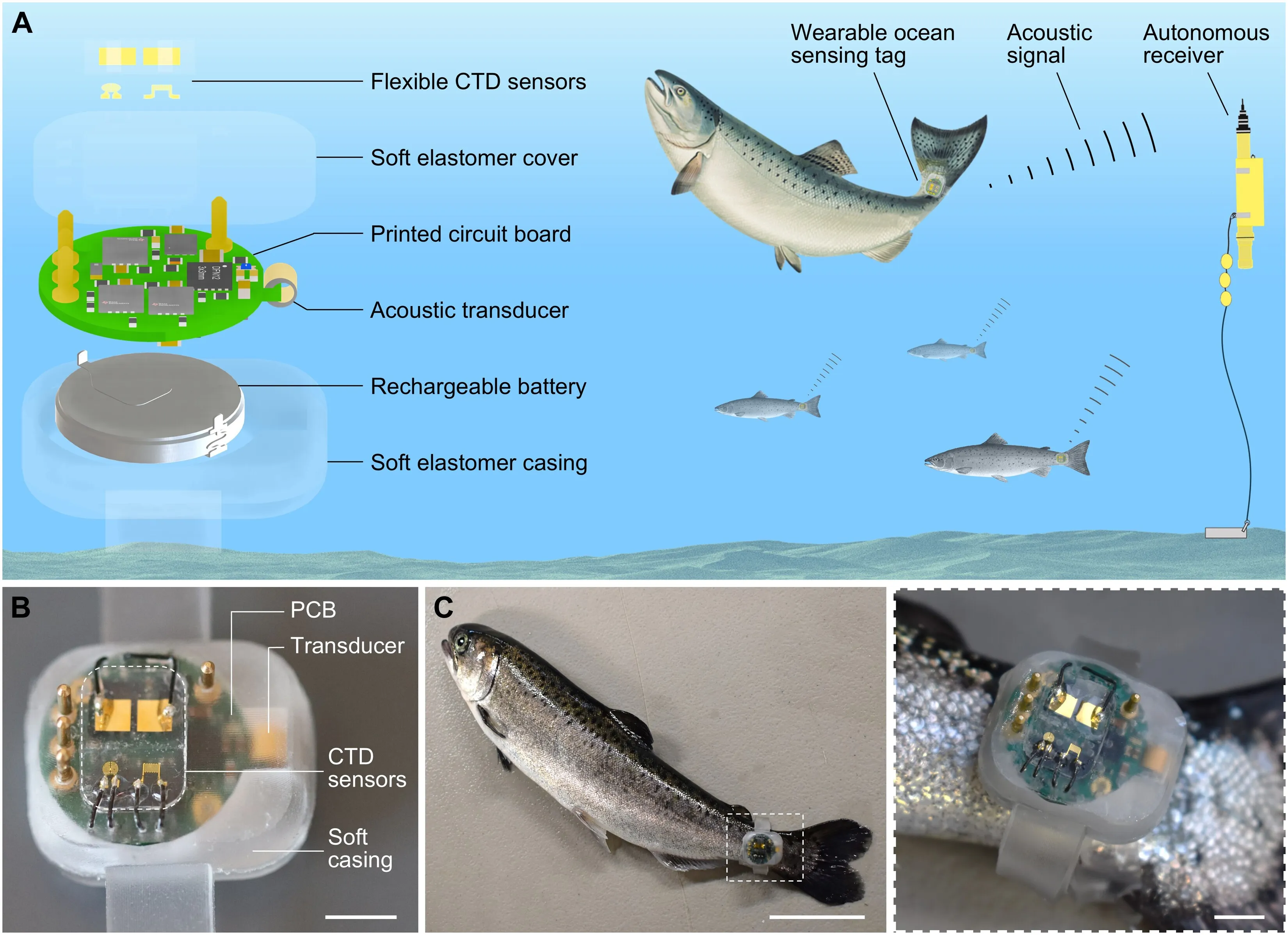
Design and application of a soft ocean-sensing tag.
Unlike traditional CTD instruments that rely on heavy titanium housings to survive extreme ocean pressure, the new platform uses soft pressure-tolerant electronics capable of operating at depths of up to 1,500 meters (15 MPa hydrostatic pressure). Laboratory testing showed stable performance after months of continuous exposure to simulated deep-sea conditions and hundreds of pressure cycles.
A key innovation is the integration of underwater acoustic communication, which overcomes the limitations of Bluetooth and other electromagnetic wireless technologies that perform poorly underwater. The tag transmits sensor data using binary phase-shift keying (BPSK) ultrasound signals at 416.7 kHz, achieving communication distances of up to 492.7 meters in freshwater and more than 300 meters in seawater.
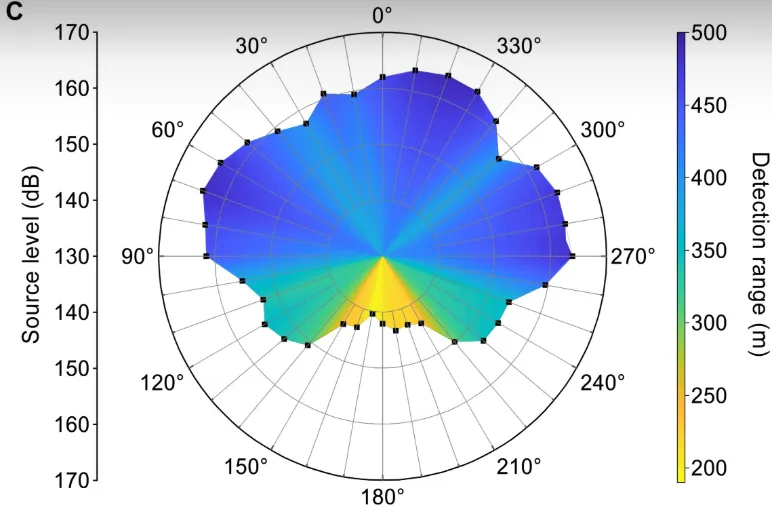
Acoustic telemetry enables underwater data transmission over hundreds of meters, far exceeding the range of conventional wireless technologies underwater.
Field trials conducted in the Salish Sea, Washington, demonstrated real-time wireless monitoring of salinity, temperature, and pressure with accuracy comparable to commercial CTD systems. The acoustic telemetry network achieved 87.34% detection efficiency and * decoding accuracy across tested transmission ranges, confirming reliable operation in real marine environments.
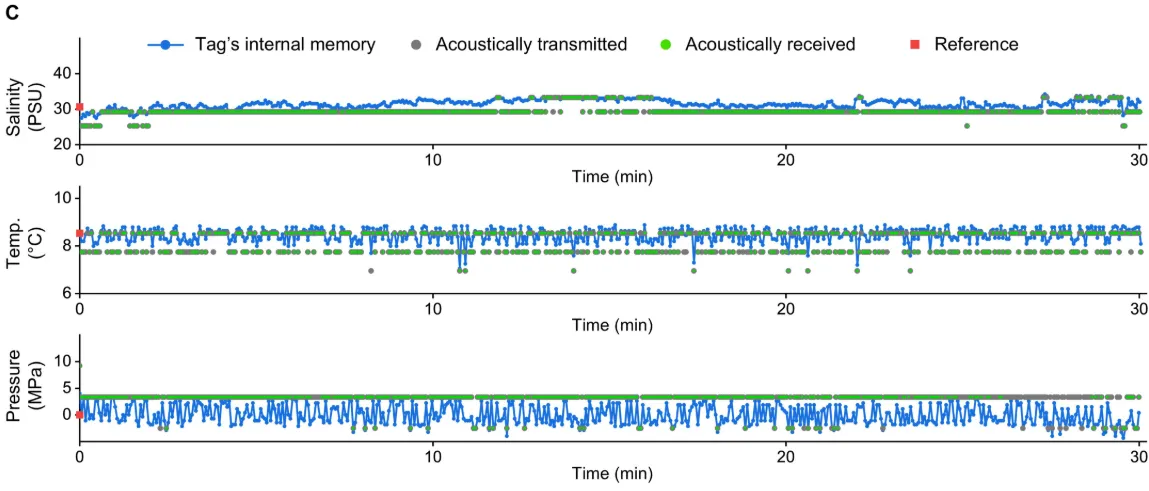
Field testing in the Salish Sea showed that measurements from the soft tag closely matched those from commercial CTD instruments.
The lightweight design also opens new possibilities for marine animal tracking and environmental monitoring. Researchers successfully attached the tag to a juvenile Chinook salmon using a noninvasive wearable band, highlighting its potential for studying fish migration, ocean conditions, and marine ecosystems simultaneously.
As demand grows for higher-resolution ocean data to support climate research, weather forecasting, ocean exploration, fisheries management, and autonomous underwater vehicles, this soft ocean-sensing platform represents a significant step toward scalable, low-power, and cost-effective ocean observation networks.

