


Summary: Researchers have developed programmable robotic metamaterials that can actively control mechanical wave propagation, opening new possibilities for adaptive materials, vibration management, and future intelligent machines.
A research team has demonstrated a new class of robotic metamaterials capable of dynamically changing their mechanical properties and manipulating elastic waves in real time, marking a significant advance in smart materials and programmable robotics.
Published in Science Advances, the study introduces a modular system composed of robotic platforms and tunable connecting springs arranged in honeycomb-like structures. Unlike conventional metamaterials with fixed properties, these robotic metamaterials can actively reconfigure stiffness and geometry, enabling unprecedented control over wave behavior and energy transmission.
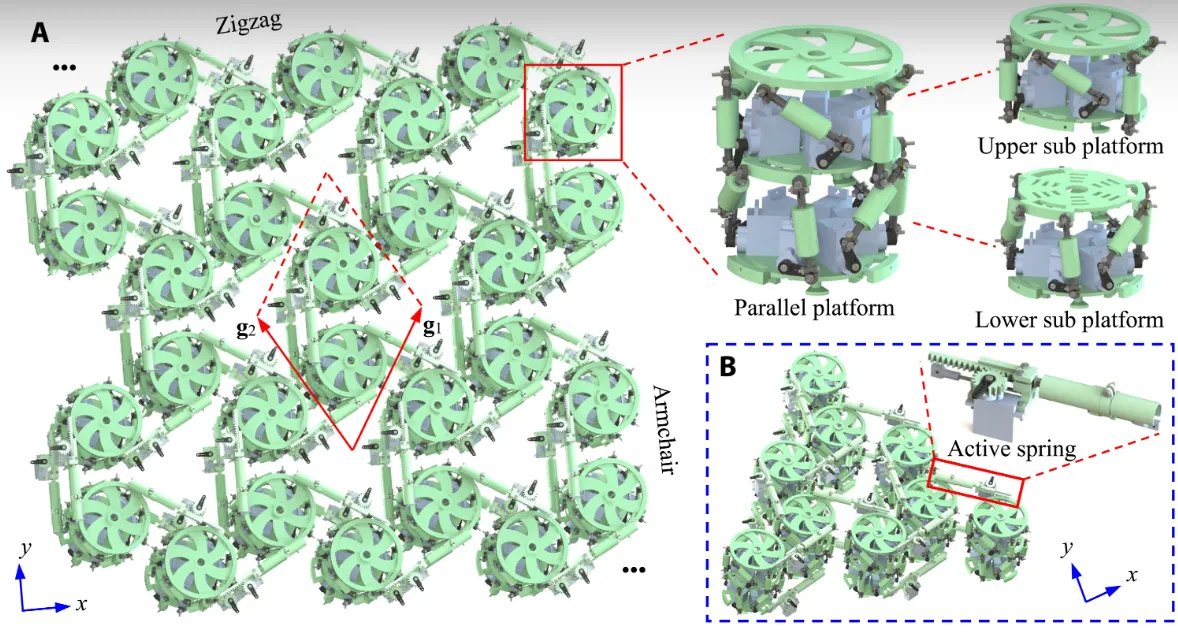
Overall robotic metamaterial architecture
The system uses individually controlled robotic elements, including parallel platforms and adjustable springs, to alter how mechanical waves travel through the material. Researchers demonstrated that these active structures can generate artificial “pseudomagnetic” fields, creating phenomena similar to electronic Landau levels observed in condensed matter physics.
One of the most notable achievements is the construction of large-scale programmable metamaterials containing 88 robotic platforms and 270 active springs. Each component functions as an independent robotic unit, allowing the entire structure to adapt its mechanical characteristics on demand. This approach eliminates the need for multiple spring types while significantly expanding the range of controllable behaviors.
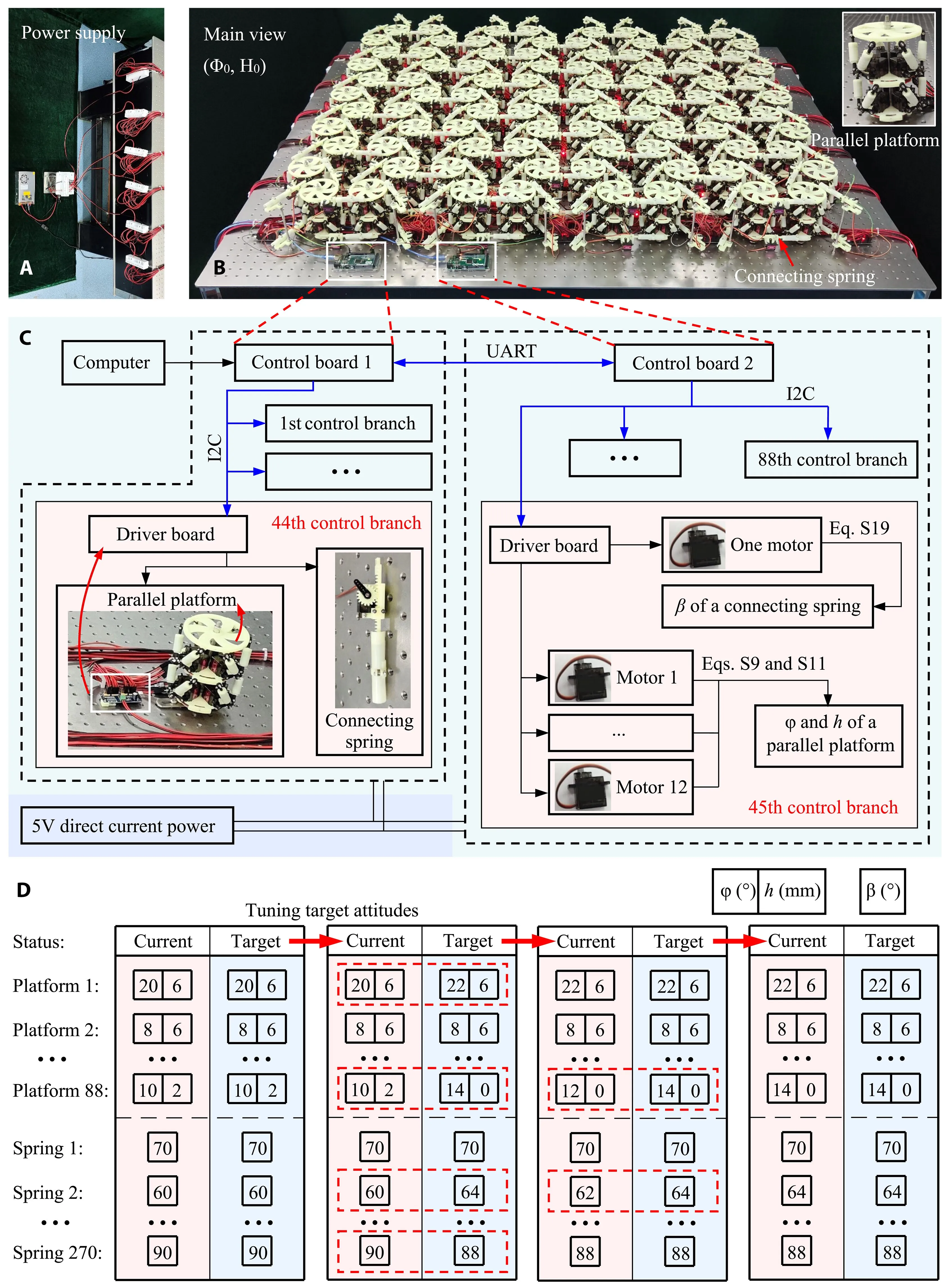
Large-scale experimental robotic metamaterial with 88 platforms and 270 springs
The researchers believe the technology could lead to new applications in wave control, vibration isolation, acoustic engineering, smart infrastructure, and next-generation adaptive robotic systems. By combining robotics with metamaterial design, the platform offers a practical route toward materials that can sense, respond, and reconfigure themselves according to changing conditions.
Future work will focus on miniaturizing the robotic units through advanced actuators and high-resolution manufacturing techniques. Smaller and faster robotic metamaterials could enable compact intelligent devices and unlock new opportunities for programmable mechanical computing, energy management, and physical AI systems.

