


Summary: KAIST researchers have developed a Venus flytrap-inspired soft robotic material that can detect nearby charged objects, grasp them under UV light, and maintain its shape for over 10 minutes without continuous power.
Inspired by the natural trapping mechanism of the Venus flytrap, researchers at KAIST have unveiled a new soft robot hand material called Ionograsper that integrates sensing, actuation, and shape retention into a single structure. The study, published in Advanced Materials (DOI: 10.1002/adma.74981), could help simplify future soft robotics, robot grippers, and Physical AI robots by reducing the need for separate sensors, actuators, and complex wiring.
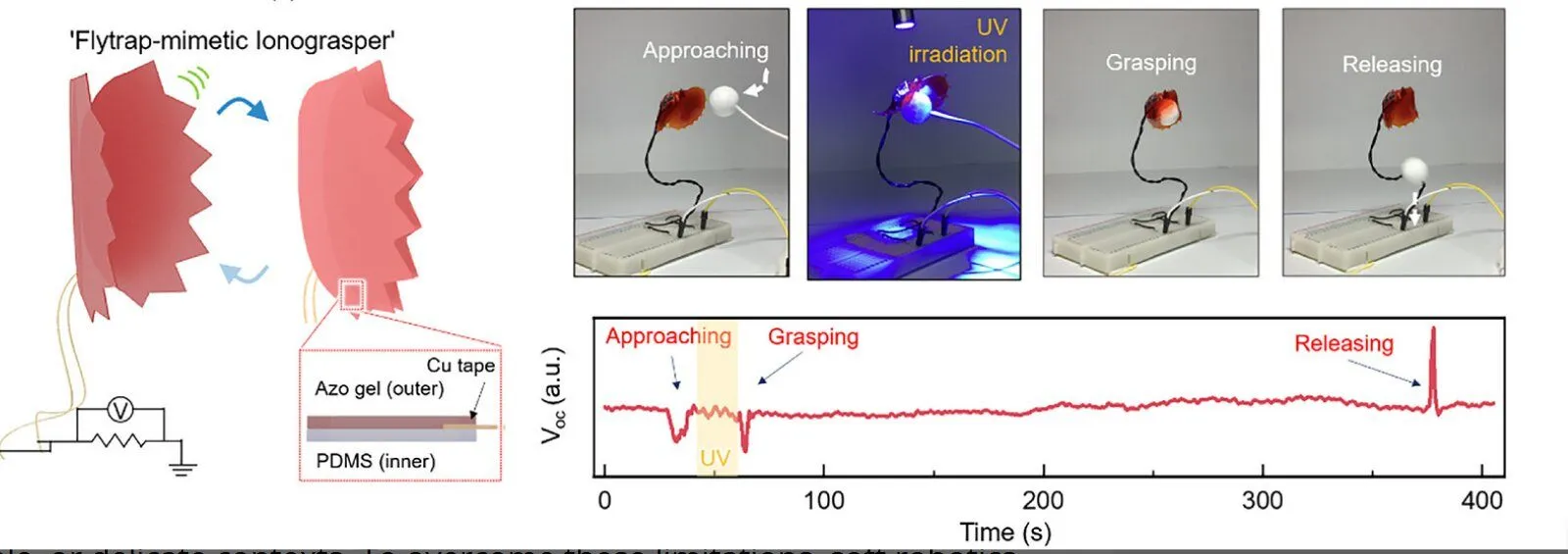 Flytrap-mimetic Ionograsper detecting and grasping an object under UV irradiation.
The Ionograsper is built from a polymer network that combines light-responsive azobenzene molecules with a moisture-absorbing polymer. This design allows ions inside the material to move when a charged object approaches. As the electric field changes, the material generates an electrical signal without requiring an external sensing voltage, enabling non-contact object detection.
Once an object is detected, ultraviolet (UV) light triggers the material to bend. The azobenzene molecules change shape under illumination while moisture escapes from the exposed surface, causing the soft material to curl toward the light and grasp nearby objects. This biomimetic approach mimics how plants respond to environmental stimuli.
Void formation and enhanced hydration after UV-induced polymer locking.
A notable breakthrough is the material’s ability to hold its deformed shape for more than 10 minutes after the UV light is turned off. Nanoscale pores formed during irradiation allow moisture to re-enter the material, creating a reverse-bending effect while maintaining the grasping configuration. This reduces energy consumption because continuous light exposure is unnecessary.
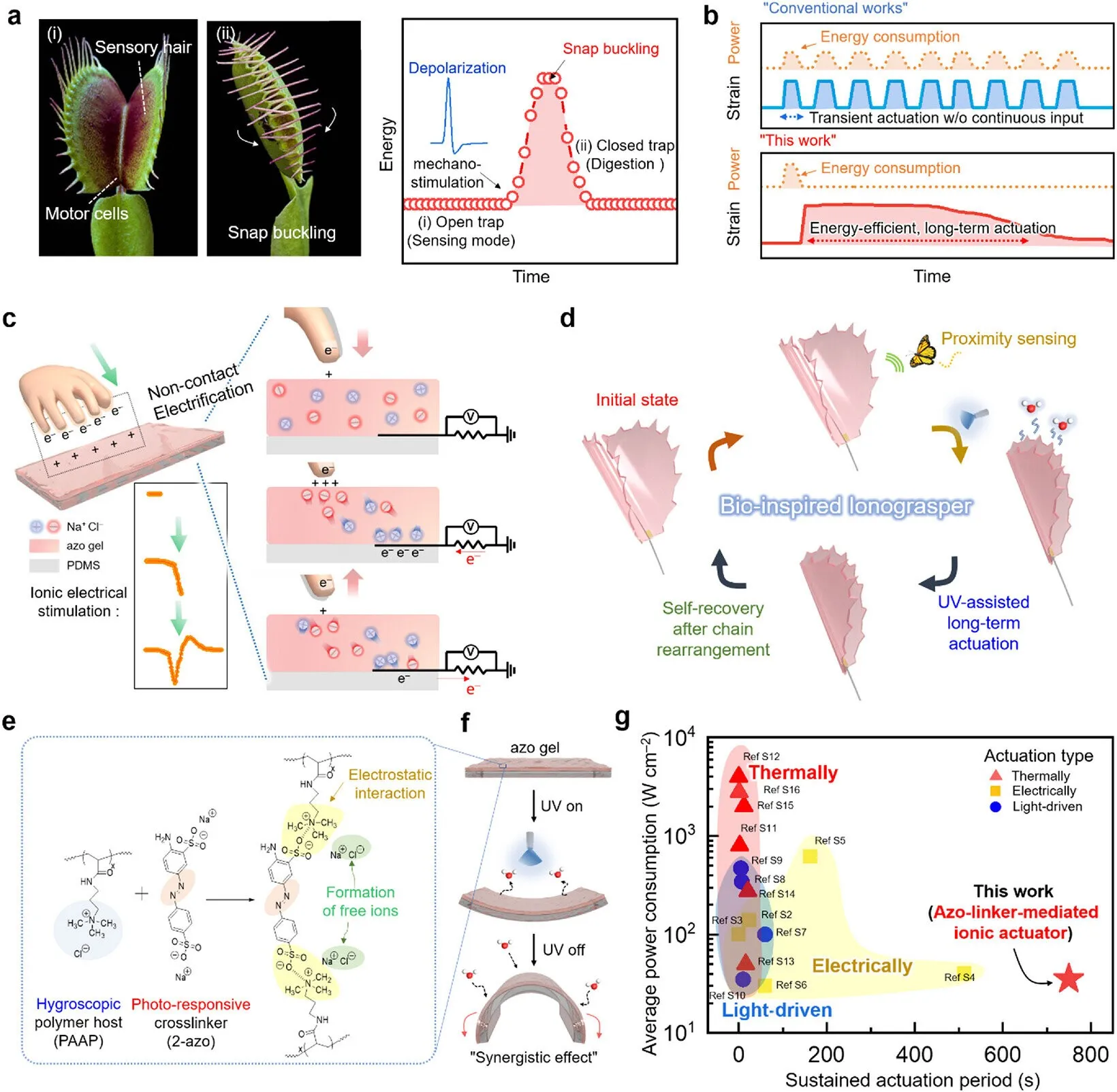 Development of the energy-efficient biomimetic Ionograsper.
According to Professor Hong Chul Moon and his team, future research will focus on increasing sensing range, actuation speed, durability, and load capacity, while enabling responses to visible and near-infrared light. The researchers also plan to integrate the technology with AI robotics, opening new possibilities for next-generation soft robotic grippers, smart materials, and Physical AI systems.

