


Abstract: Researchers have developed the "FiberMotor," a flexible electrostatic linear actuator in a thin fiber format that delivers bidirectional, fast, stepping motion with a stroke limited only by fiber length. It holds up to 750 mN per fiber, exceeds 85 mm/s in no-load speed, and works while bent — pointing the way toward a new generation of soft exosuits and wearable assistive devices.
When we think of a motor, we picture metal, magnets and whirring gears. But a team of researchers has reimagined the machine as something far softer — a flexible fiber no thicker than a ballpoint refill that slides like a muscle and hums in silence.
The device, called the FiberMotor, is built from two coaxial fibers, each wrapped with three helically wound wire electrodes. When driven by three-channel high-voltage square waves, electrostatic forces between the inner and outer fibers pull them into alignment step by step — generating smooth, reversible linear motion. No permanent magnets. No heat from Joule losses. Just an electric field, a thin film of silicone oil, and motion.
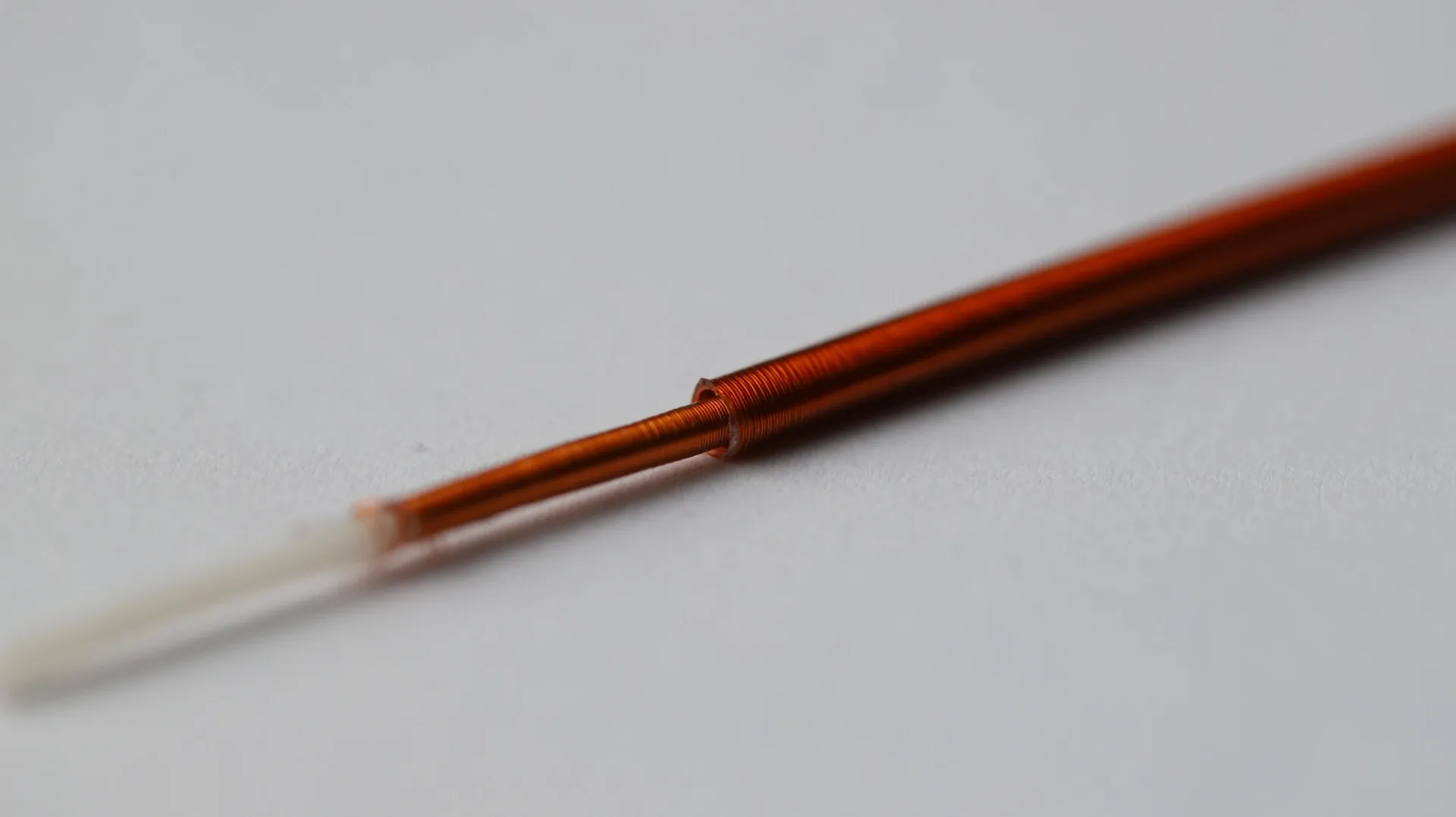
A close look at the FiberMotor's fiber-within-a-fiber design
What makes it different
Most artificial muscles work by deforming — stretching, contracting or twisting a material — which caps their stroke and makes force collapse at full extension. The FiberMotor instead slides: two surfaces move relative to each other, so the stroke is limited only by the fiber's length, and the force stays constant throughout. It is bidirectional, inherently back-drivable (it yields harmlessly when pulled too hard), and bends on two axes — a critical trait for wearable tech.
How it performed
In the lab, the numbers are striking. Single fibers reached no-load speeds above 85 mm/s, with axial holding forces exceeding 750 mN. Longer overlap means more force — pulling output scaled from 102 mN for a 10 mm motor to 530 mN for a 70 mm one. Specific force hit roughly 450 N/kg and force density about 775 kN/m³. Bundling four motors in parallel quadrupled output, letting a fiber bundle raise a 46-gram chocolate bar and drive a tendon-powered robotic finger. The motor worked smoothly when bent to a 60 mm radius of curvature, and could hold a fixed position under load for long stretches — a feat many conventional actuators burn power to achieve.
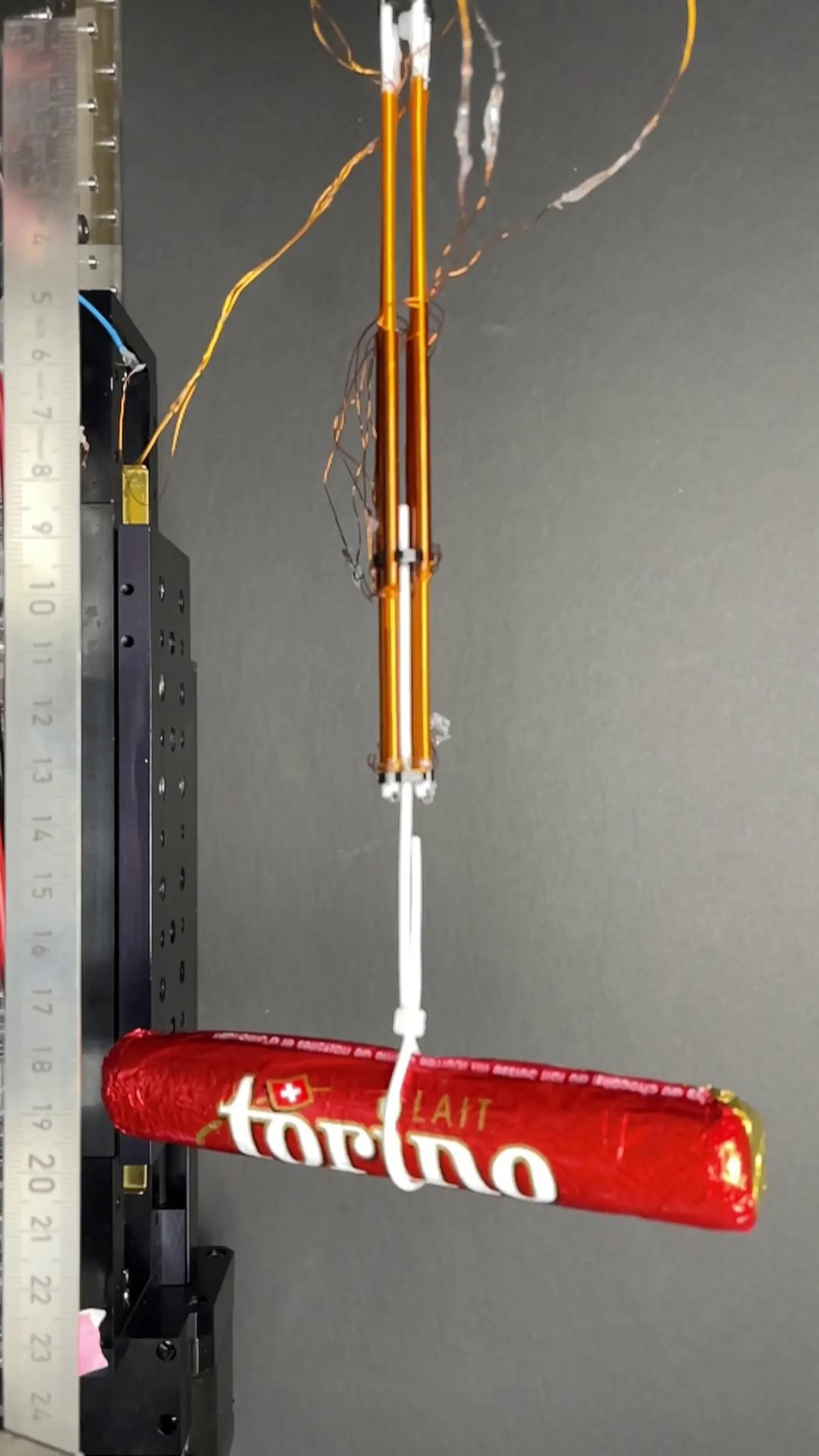
Four bundled FiberMotors lift a chocolate bar
Work density reached 5.1 kJ/m³, approaching the ballpark of human skeletal muscle, and devices kept running for over 1,000 cycles, some continuously for 24 hours.
Why it matters
The implications ripple across robotics and medicine. Because the fibers are lightweight, silent and flexible, they can be woven directly into textiles — the team demonstrated motors embedded in a pair of pants bending around a knee. That opens the door to soft exosuits that assist walking, implantable devices and kinesthetic haptic interfaces that feel natural against the body. By sidestepping stroke limits and cooling delays, the FiberMotor bridges the gap between rigid electromagnetic motors and compliant artificial muscles.
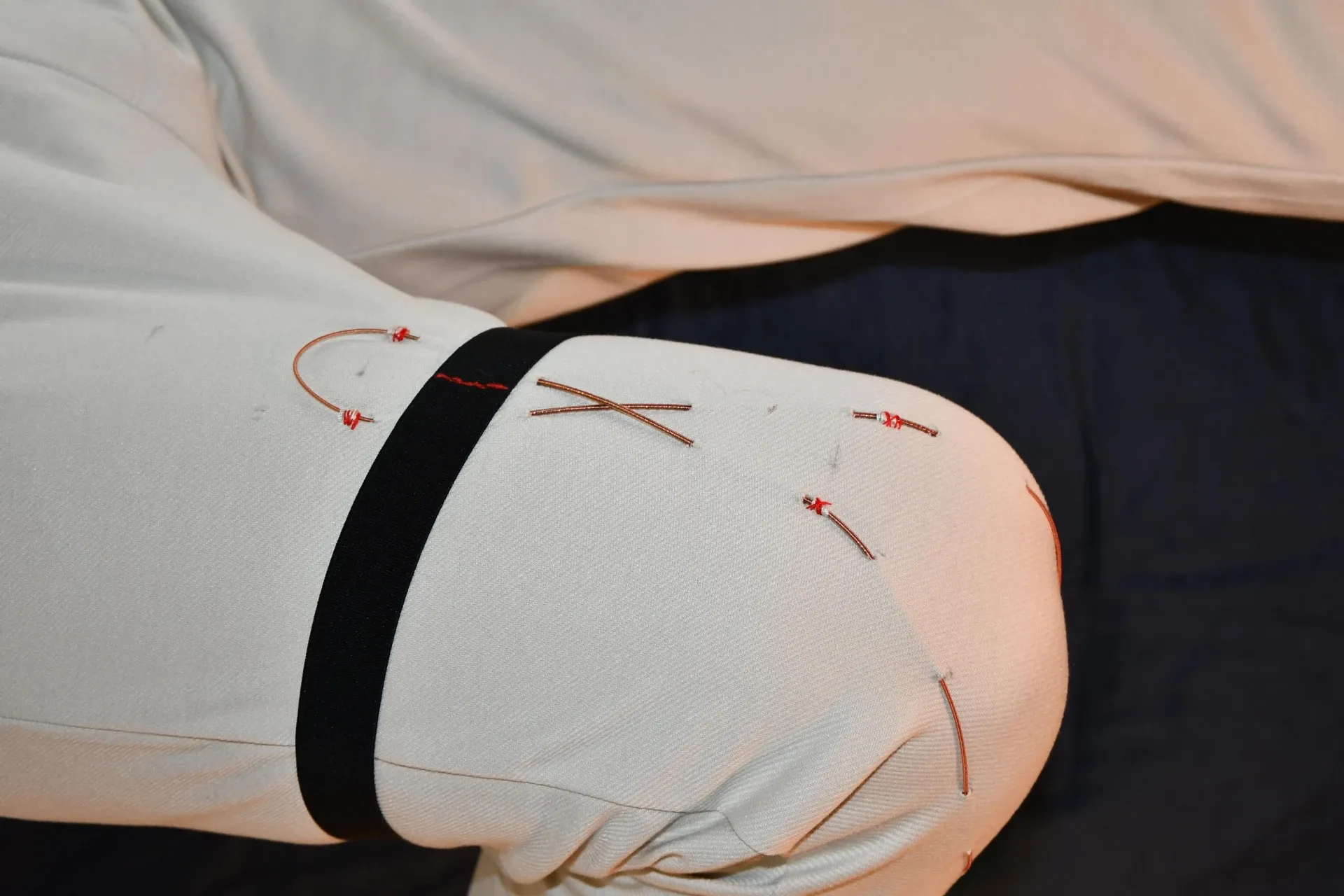
The team also integrated the FiberMotor into aprototype assistive garment to fit the shape of a knee
Where it stands
Current prototypes are still tethered to a lab power supply, and researchers flag next steps: closed-loop sensing, stronger dielectrics, and sealing the oil to make the device truly wearable. But the architecture is inherently scalable — winding tools already exist that can produce nine-meter fibers. The vision is ambitious: hundreds of micron-thin motors bundled into powerful, fabric-like muscles.
For a field long split between brute-force rigidity and soft-but-weak actuation, the FiberMotor offers a quiet middle path — one that may one day move like us, only softer.

