


Abstract: South Korean researchers have demonstrated a functional electric motor using carbon nanotube (CNT) composite cables instead of conventional copper windings. The technology could reduce motor weight in electric vehicles and electric vertical takeoff and landing (eVTOL) aircraft, although manufacturing costs and electrical performance remain key challenges.
Carbon Nanotubes Offer a Lightweight Alternative to Copper
Copper windings account for a significant share of electric motor weight, creating challenges for electric vehicles (EVs) and eVTOL aircraft, where every kilogram affects efficiency and performance. Researchers at the Korea Institute of Science and Technology (KIST) have developed core-sheath composite electric cables (CSCEC) designed to replace conventional metal conductors with carbon nanotube (CNT) wires.
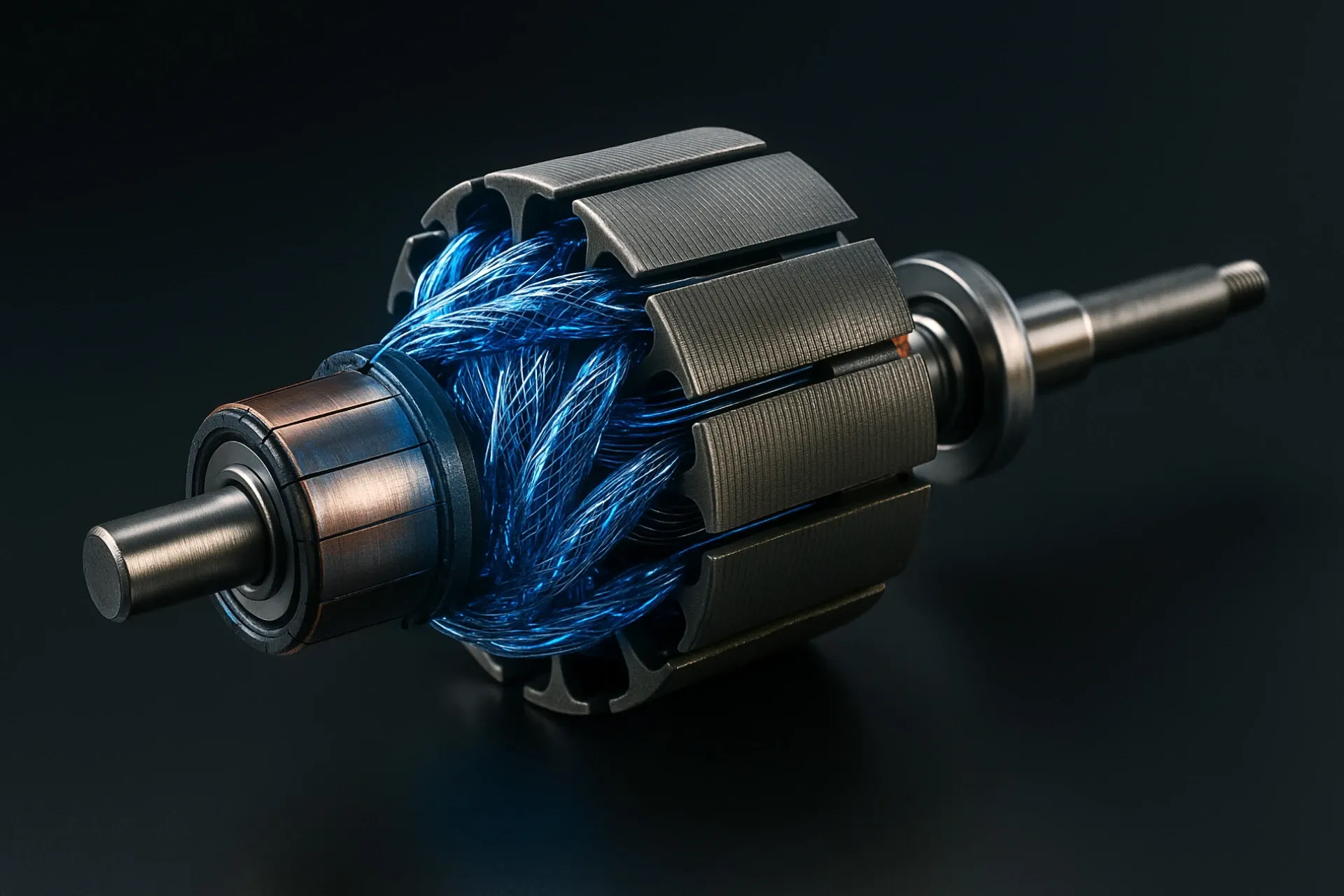
The team used a Lyotropic Liquid Crystal-Assisted Surface Texturing (LAST) process to align tangled nanotubes, remove metallic catalyst impurities and preserve their nanostructure. This approach increased electrical conductivity by more than 130%, producing lightweight, flexible conductors with improved performance.
Each insulated CSCEC wire measures just 0.3 millimeters in diameter, featuring a 256-micrometer conductive core and a 10-micrometer sheath. Using these cables, the researchers built a functional miniature motor that powered a model car at 2–3 volts and 3.5 watts.

The toy car, the motor, the CSCEC wire, and the CNT
Weight Savings Come With Performance Trade-Offs
CNT conductors have a reported conductivity of 7.7 million siemens per meter (MS/m), compared with approximately 59 MS/m for copper. However, the CNT conductive core weighs only about one-fifth as much as an equivalent copper winding.
In bench tests, the CNT motor reached 3,420 revolutions per minute (RPM), compared with 18,120 RPM for its copper-wound counterpart. Despite the lower absolute speed, the researchers reported a specific rotational velocity approximately 6% lower than that of the copper motor, highlighting the potential of CNT conductors for weight-sensitive applications.

The basics of what a carbon nanotube structure looks like
Implications for Electric Mobility
Replacing copper windings could reduce motor mass and rotating inertia, potentially improving vehicle responsiveness and easing cooling requirements. In eVTOL aircraft, where payload capacity and energy efficiency are especially important, lightweight motors could offer additional design flexibility.
However, commercial adoption faces substantial obstacles. CNT cable production costs an estimated $375–500 per kilogram, compared with roughly $10–11 per kilogram for copper. Motor insulation, winding geometry and electrical design would also require substantial redesign rather than a direct conductor swap.
Further challenges include the energy demands and hazardous chemical waste associated with CNT production. Improving nanotube alignment, optimizing the polymer sheath and scaling manufacturing will be essential to narrowing the conductivity and cost gaps.
CNT-based motor technology remains at an early stage, but it presents a potential route toward lighter electric propulsion systems. Its long-term viability will depend on whether engineering advances can translate laboratory demonstrations into affordable, reliable motors for next-generation EVs and eVTOL aircraft.

