


Summary: Researchers at Technische Universität Darmstadt in Germany have developed an iron-nickel spinel-carbon catalyst that improves the rechargeability of zinc-air batteries. Laboratory tests demonstrated up to 500 charge-discharge cycles and more than 300 hours of continuous operation, marking progress toward high-energy-density energy storage.
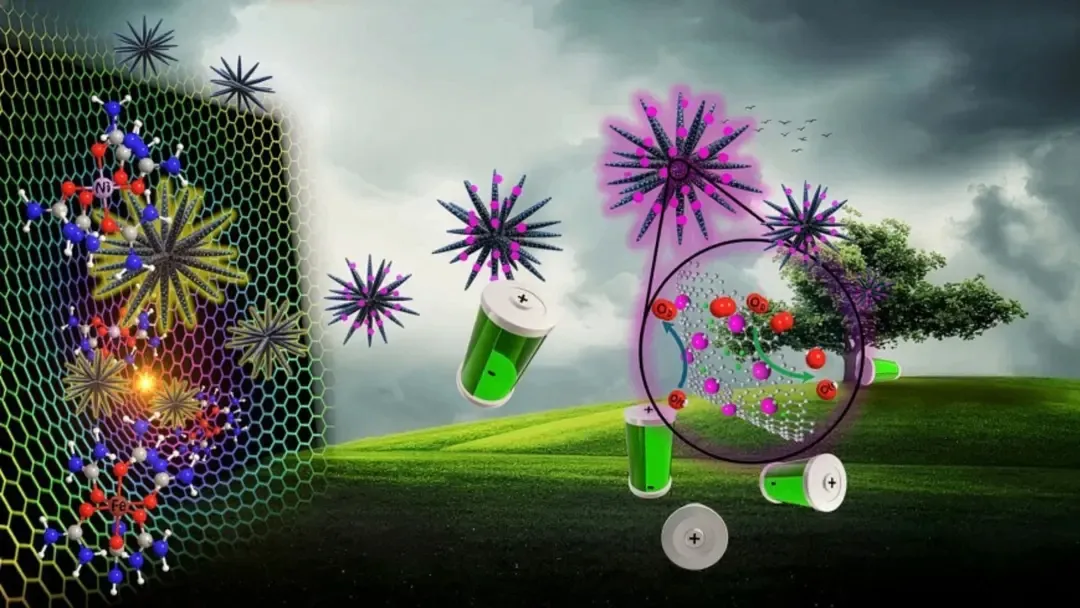
Structure of a bifunctional composite catalyst (center). It consists of nanoscale nickel ferrite particles anchored to the surface of carbon nanohorns. Together with the electrolyte and a carbon anode, they form the rechargeable zinc-air battery.
Zinc-air batteries have long attracted interest as an alternative to lithium-ion technology because of their high theoretical energy density and the potential to use abundant, low-cost materials. However, their limited rechargeability has largely confined commercial applications to devices such as hearing aids. Now, researchers at Technische Universität Darmstadt, led by Professor Jörg J. Schneider, have reported a materials advance that could help overcome this longstanding challenge.
The key lies in oxygen electrochemistry. During discharge, a zinc-air battery draws oxygen from the surrounding air. Charging reverses the oxygen-related reactions, requiring a catalyst that can efficiently support both the oxygen reduction reaction and the oxygen evolution reaction while remaining stable over repeated cycles.
To address this problem, the team developed a composite catalyst featuring nanoscale iron-nickel spinel particles anchored to a nitrogen- and phosphorus-modified carbon framework. The carbon structure provides electrical conductivity and supports the nanoparticles, while the spinel component promotes the oxygen reactions needed for reversible operation.
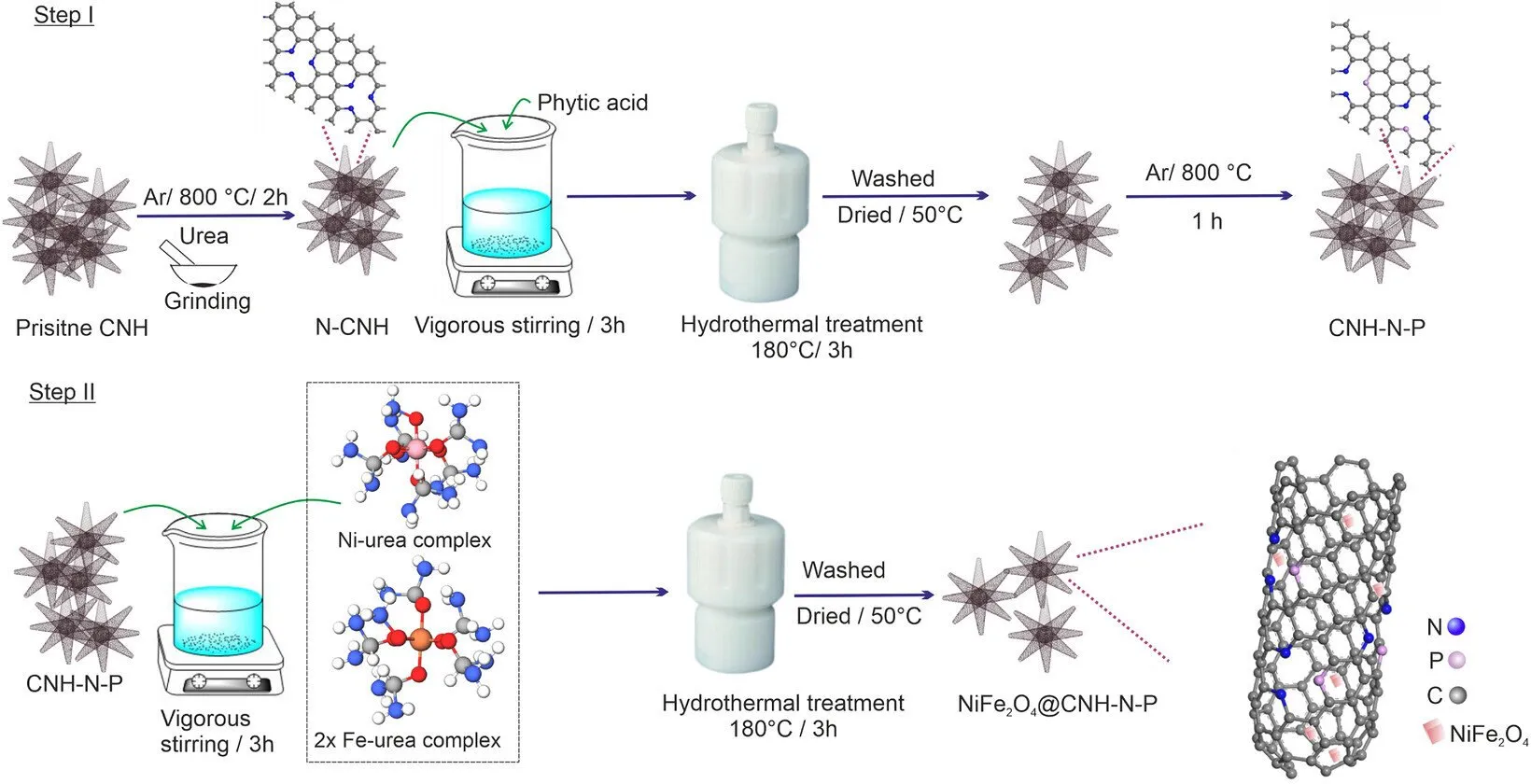
Schematic representation demonstrating the two-step process to obtain the NiFe2O4@CNH-N-P catalyst material.
Stabilizing the critical interface
A central feature of the design is its ability to maintain the three-phase boundary where the solid catalyst, liquid electrolyte and oxygen meet. This interface, known as the triple-phase boundary, is essential to efficient oxygen reactions. Its degradation can undermine battery performance during repeated charging and discharging.
By stabilizing this interface, the composite catalyst helped the laboratory zinc-air battery achieve up to 500 charge-discharge cycles and more than 300 hours of continuous galvanostatic cycling, according to the study published in Advanced Science.
What it means for energy storage
The findings offer a promising route toward rechargeable zinc-air batteries for stationary energy storage and other applications where cost and energy capacity are important. Zinc-air systems could complement lithium-ion batteries, particularly where their material advantages prove useful.
However, laboratory cycle life alone does not establish commercial readiness. Further work is needed to assess energy efficiency, practical capacity, durability under real operating conditions and manufacturing scalability. The new catalyst represents a meaningful materials advance, but its ultimate impact will depend on how well these laboratory results translate into practical battery systems.

