


Summary: Researchers at UCSB and Caltech have developed a chip-scale optical gyroscope that detects rotation as low as 37 degrees per hour. Built on silicon nitride photonics and compatible with CMOS manufacturing, the technology could enable compact, high-precision navigation for aircraft, spacecraft and vehicles in GPS-denied environments.
A New Approach to Precision Navigation
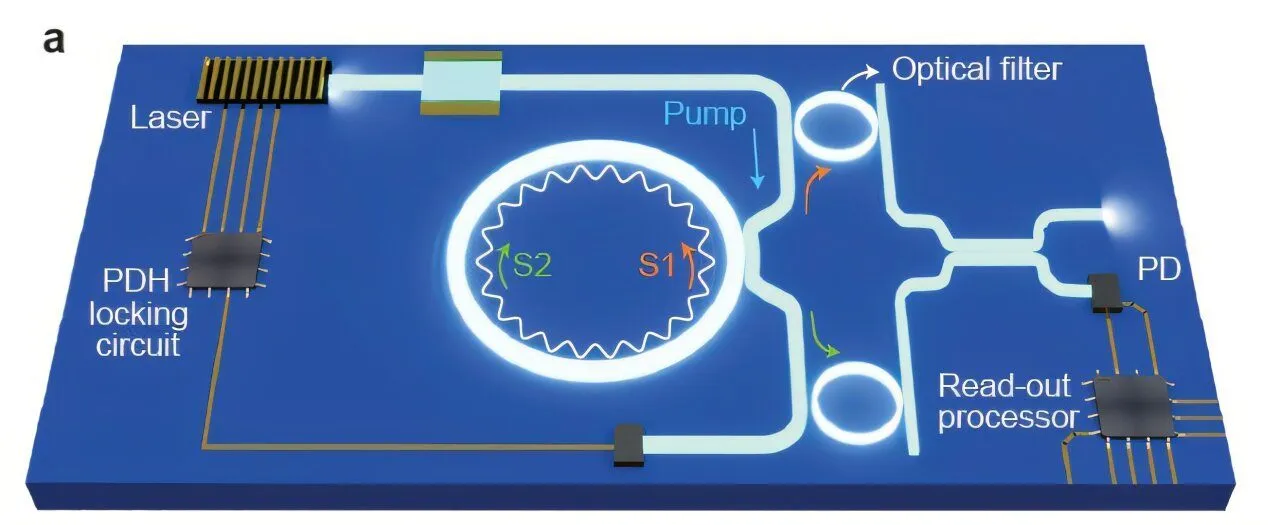
Researchers developed an integrated Brillouin laser ring gyroscope that measures rotation as slow as 37 degrees per hour. This image shows a conceptual schematic of the chip-based gyroscope.
Gyroscopes measure rotational motion to determine orientation and movement. Although microelectromechanical systems (MEMS) gyroscopes are widely used in smartphones and consumer electronics, their sensitivity can be insufficient for demanding navigation applications. Traditional optical gyroscopes offer higher precision but are often too large and costly for compact systems.
The new device combines advances in Brillouin laser technology with an integrated silicon nitride photonic circuit, achieving nearly 2,000 times greater sensitivity than the research team's earlier chip-scale gyroscope.
How the Optical Gyroscope Works
At the heart of the device is a ring microresonator with an ultra-high quality factor (Q) exceeding 163 million, allowing light to circulate with minimal loss.
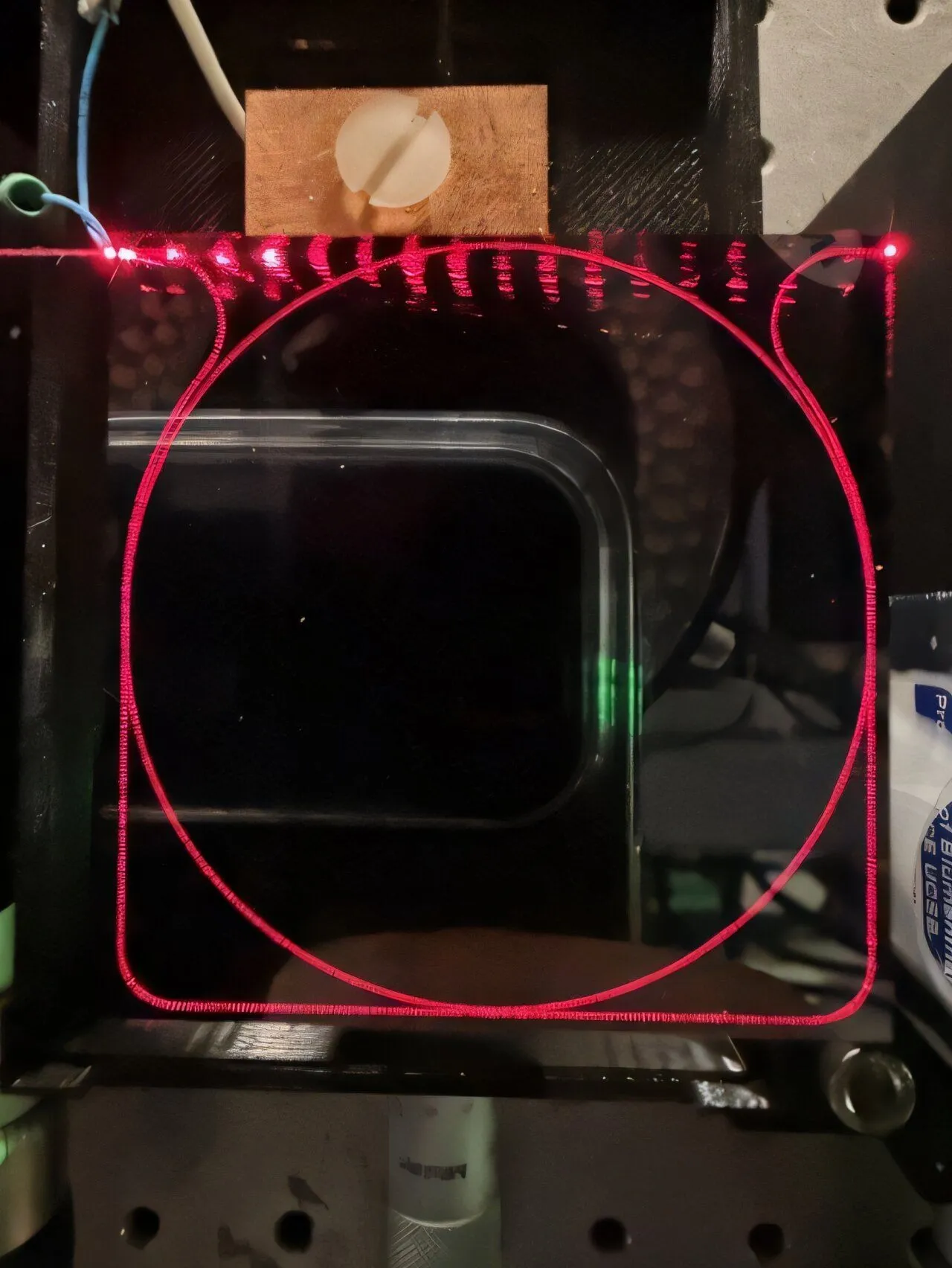
The optical ring-laser gyroscope uses a relatively large ring (pictured), which helped improve sensitivity.
Two laser beams travel in opposite directions around a 24 mm optical ring. When the device is stationary, their frequencies match. Rotation produces a small frequency difference between the beams, which the sensor measures to determine angular velocity.
The prototype can detect rotation as low as 37 degrees per hour, approaching Earth's rotation rate of approximately 15 degrees per hour. This sensitivity marks an important step toward compact optical inertial sensors.
Advantages of Chip-Scale Integration
Reported in Optics Letters, the device is fabricated using processes compatible with standard CMOS manufacturing. It consumes only milliwatts of optical power and contains no moving mechanical parts, potentially improving durability under vibration and shock.
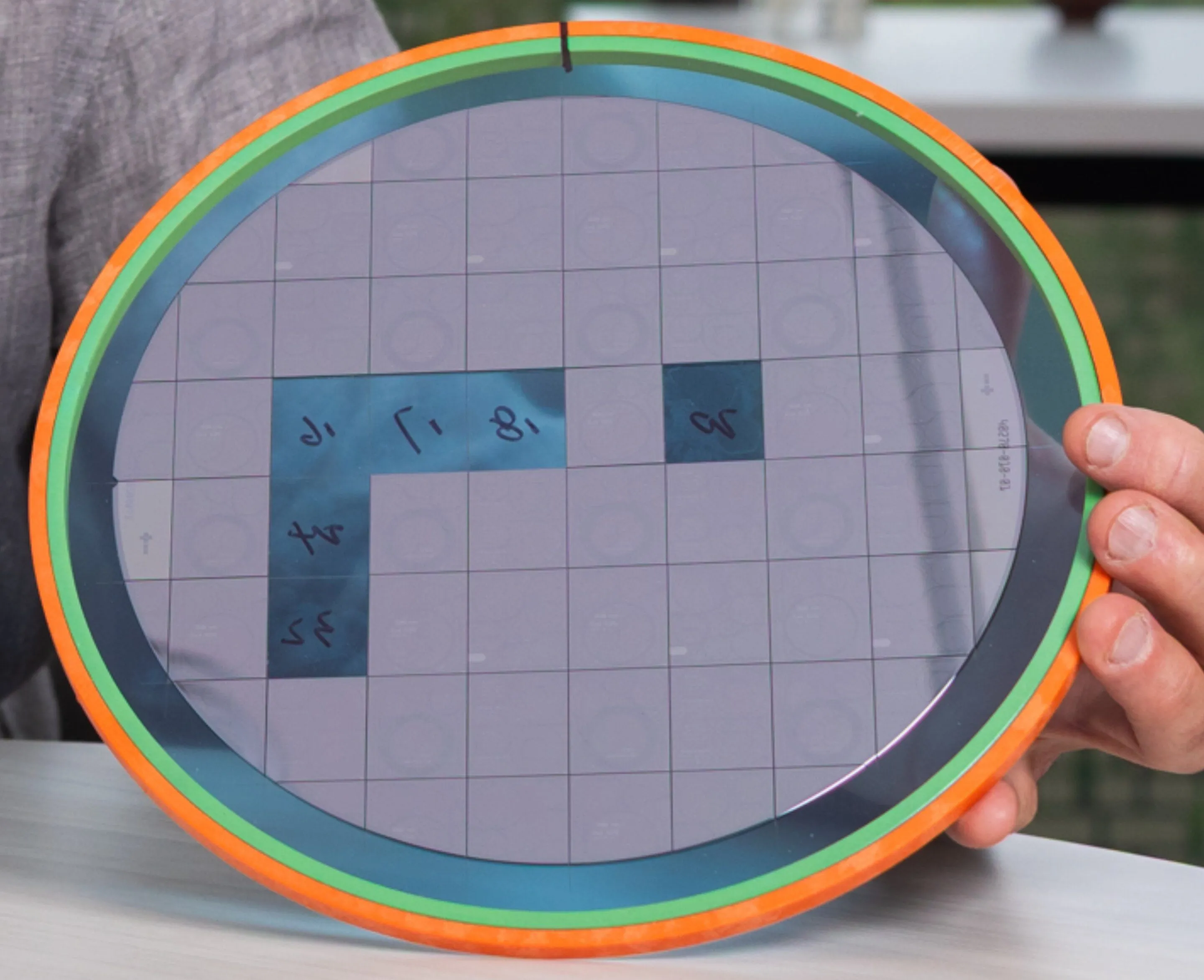
The optical ring-laser gyroscope was fabricated using standard CMOS-compatible chip-processing methods. The circular wafer contains multiple device structures.
Tests on a piezoelectric rotation stage demonstrated a linear response and stable detection of very slow rotation in a packaged, centimeter-scale device.
Toward GPS-Independent Navigation
The technology could eventually support inertial navigation systems in aircraft, spacecraft, autonomous vehicles and other platforms that must operate when satellite signals are unavailable or unreliable.
Further development will focus on reducing light-scattering losses, refining the resonator and integrating lasers and detectors onto a single chip. Field testing and system-level validation will be necessary before practical deployment.
If these challenges can be overcome, chip-scale optical gyroscopes could bring high-precision inertial navigation closer to mass production, offering a compact alternative to conventional optical sensing systems.

