


Summary: Researchers have developed a mechatronic metamaterial that spontaneously synchronizes local vibrations into stable, collective motion. Published in Nature on October 14, the research could open new possibilities for bio-inspired robots that coordinate their movements through internal interactions rather than centralized control.
Scientists have developed a robotic metamaterial that can organize its own movement, allowing an entire structure to pulse in unison. The international collaboration, involving researchers from Birmingham, Amsterdam, Lyon, Delft, Leiden and Cambridge, demonstrates a macroscopic time crystal built from mechanical units rather than atoms.
The system combines elastic frames, sensors, electronics and actuators. Its behavior relies on nonreciprocal interactions, in which one component's influence on its neighbor differs from the reverse response. This asymmetry enables local vibrations to develop into coordinated motion across the material.
The process, known as wave coarsening, begins with short-wavelength oscillations that gradually merge into larger patterns with longer wavelengths and periods. Eventually, the individual units synchronize into a collective rhythm. Co-lead author Dr. Jack Binysh compares the phenomenon to musicians naturally falling into the same beat without a conductor.
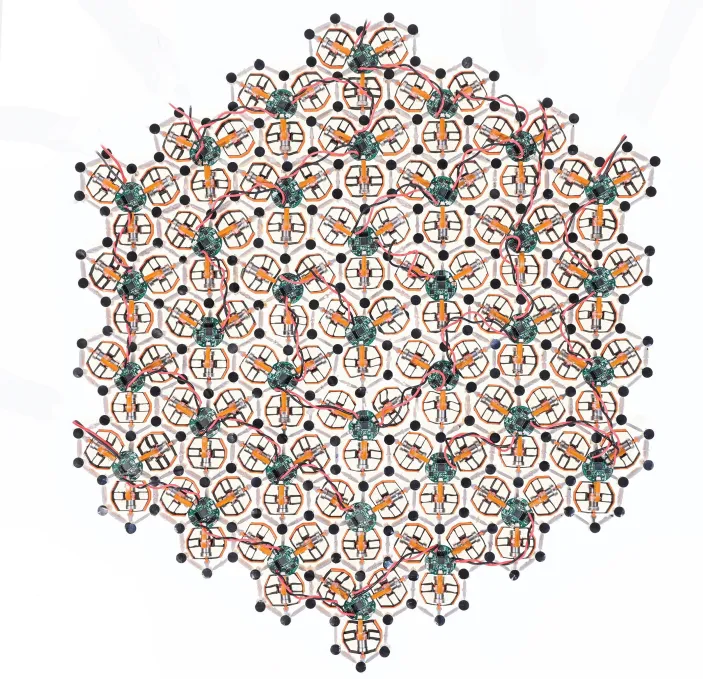
Image of wave coarsening in a metamaterial.
The team demonstrated the principle in two physical prototypes. A two-dimensional honeycomb structure containing 37 active units began oscillating at approximately 30 Hz after crossing a stability threshold. Initially localized vibrations then developed into large-scale collective waves. In a second experiment, an elastic ring equipped with 24 motorized units evolved from rapid local distortions into a slower, unified oscillation cycle.
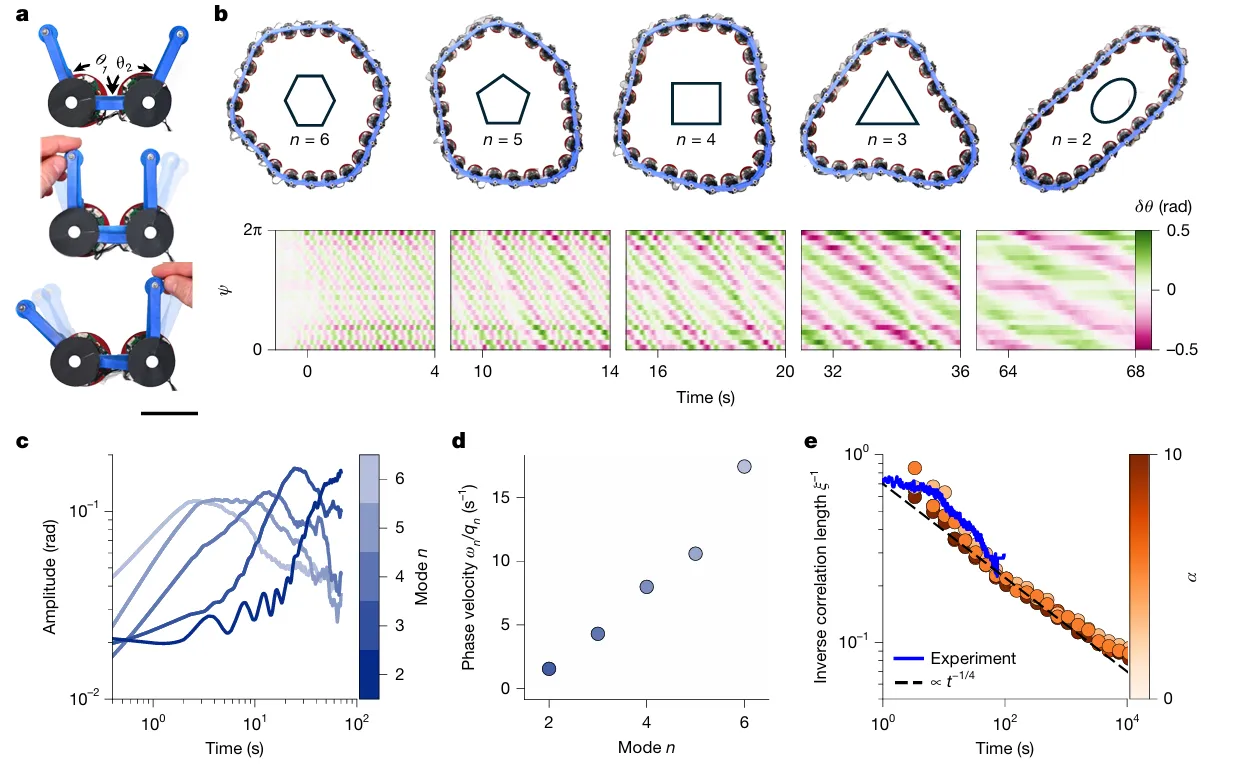
One-dimensional elastic chain wave coarsening with non-reciprocal interactions
Experiments and theoretical models indicated that the collective rhythm could withstand random disturbances and remain stable as the structure increased in size. These findings suggest that wave coarsening could provide a new way to coordinate increasingly complex robotic systems without requiring a central controller to direct every movement.
The approach could eventually allow a single robotic material to support multiple stable movement patterns, enabling it to adapt to different tasks without additional mechanical hardware. Potential applications include shape-changing robots, soft robotics and active materials capable of controlled bending, twisting and shearing. The underlying principles may also inform research into active matter and optomechanics.
The project originated in Dr. Corentin Coulais' laboratory in Amsterdam. The system incorporates more than 100 sensors and actuators, 3D-printed components and custom Lorentz actuators that convert electrical input into mechanical motion.
The researchers now aim to extend the concept to three-dimensional active metamaterials, where wave coarsening could enable more complex, coordinated deformations. Although practical applications remain under development, the work points toward a different approach to robotic design: creating materials whose physical interactions generate coordinated behavior, rather than programming every movement individually.

