


Summary: US startup Atomic Machines has unveiled Matter Compiler, an AI-driven manufacturing platform designed to turn digital designs into functional micromechanical devices. Its first product, PrimeSwitch, is a high-speed microrelay targeting high-voltage power protection in AI data centers, addressing key limitations in traditional MEMS manufacturing while facing challenges in reliability, scalability, and production costs.
From Digital Designs to Functional Micromachines
After six years in stealth development, US startup Atomic Machines has introduced Matter Compiler, an AI-powered manufacturing platform, alongside its first product, the PrimeSwitch microrelay. The company has raised a total of $250 million. Founder Jeff Holden previously led Amazon Prime and served as Uber’s first chief product officer. The company aims to transform micromachine manufacturing through AI, precision engineering, and automation.

Matter Compiler draws an analogy to a software compiler. Just as a software compiler translates code into executable instructions, the platform converts digital designs into working physical devices through material processing, precision assembly, and inspection.
Why Micromachine Manufacturing Needs a New Approach
Conventional 3D printing can produce complex structures but struggles to manufacture active micromechanical devices with consistent performance. Semiconductor-based microelectromechanical systems (MEMS) are already widely used in gyroscopes, sensors, and other products, yet different devices often require specialized materials, structures, and fabrication processes.
As a result, developing a new micromachine can involve extensive engineering work to create dedicated manufacturing and assembly procedures, slowing the transition from digital design to commercial production.
Matter Compiler seeks to integrate multiple manufacturing steps into a unified system. It measures components in real time during fabrication, adjusts processes to correct deviations, and uses experimental data to refine manufacturing parameters. Its long-term ambition is a “prompt-to-product” workflow in which users specify a device’s intended function and the platform helps turn that requirement into a physical product.
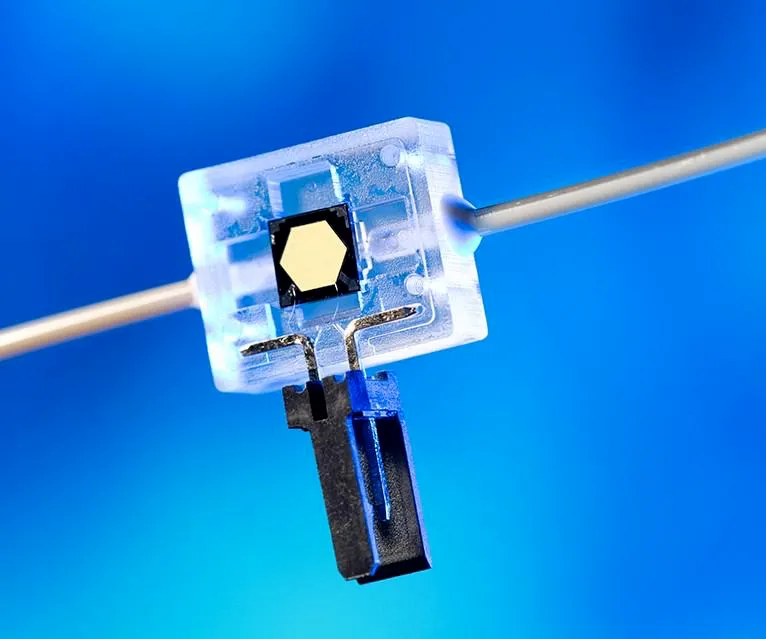
Silicon-based micropump prototype (Source: Fraunhofer EMFT)
PrimeSwitch Targets High-Voltage AI Data Center Power Systems
PrimeSwitch addresses emerging power-protection requirements in AI data centers. As the industry explores 800-volt DC power architectures, including initiatives associated with NVIDIA, circuit protection becomes increasingly demanding. High-voltage DC arcs do not naturally extinguish as readily as AC arcs, placing greater demands on switching speed, isolation, and fault interruption.
Traditional mechanical relays offer physical electrical isolation but can be relatively slow. Solid-state switches respond quickly but introduce conduction losses and generally do not provide the same physical contact separation as mechanical switching devices.
Atomic Machines’ PrimeSwitch PS-150 is designed to combine the advantages of mechanical isolation with high-speed operation. According to the specifications provided, the device measures 9.5 mm in diameter and 3 mm in thickness, supports a rated current of 150 A, and provides 1,500 V of electrical isolation. Its contact-opening time is approximately 50 microseconds, while its on-state resistance is rated at 200 micro-ohms. The device can also retain its switching state without continuous power.
The company has begun sending samples to customers for evaluation.
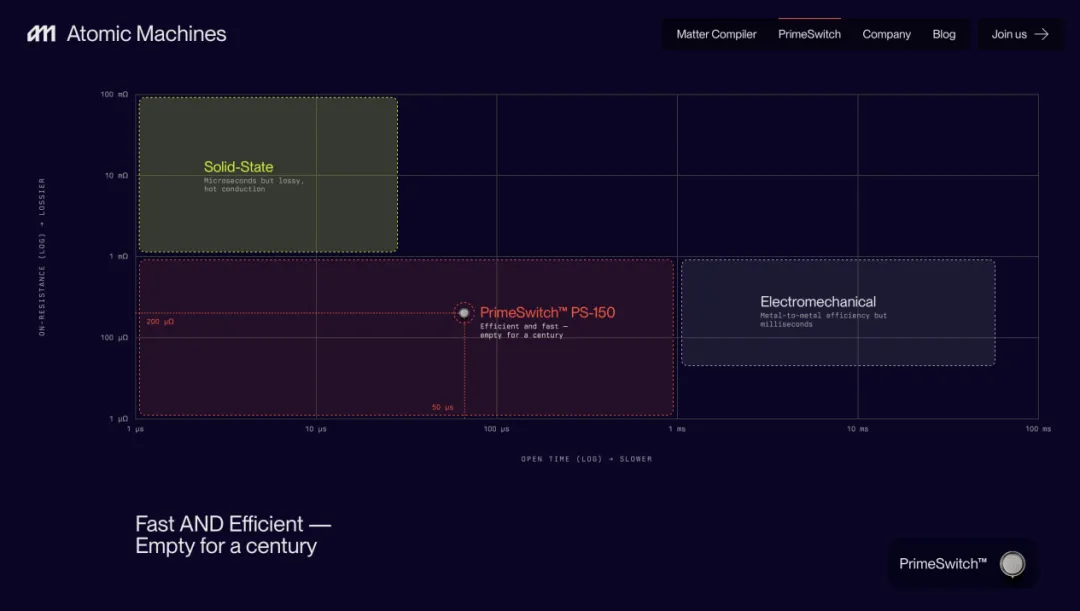
Performance Comparison of SSD Switch, Power Switch, and PrimeSwitch PS-150
Reliability and Manufacturing Costs Remain Key Challenges
Despite its potential, PrimeSwitch must undergo long-term reliability testing to establish its performance under demanding operating conditions. Its suitability for high-voltage DC protection will depend on more than switching speed alone, including fault-interruption capability, thermal behavior, durability, and system-level safety.
Matter Compiler faces a broader test: whether its manufacturing approach can scale beyond a single product category. Demonstrating consistent production of devices such as miniature pumps, sensors, and other micromechanical systems would provide stronger evidence that the platform can support a wider range of applications.
Manufacturing yield, equipment depreciation, process repeatability, and unit costs will ultimately determine its commercial viability.
If Atomic Machines can demonstrate reliable, cost-effective production across different device types, Matter Compiler could offer a new route from digital engineering to physical manufacturing. For now, its significance lies in a promising manufacturing concept and a first application aimed at one of the AI infrastructure sector’s increasingly important engineering challenges.

