


Summary: US fusion startup Marathon Fusion claims it has produced stable gold-197 from mercury using high-energy fusion neutrons, reporting a production rate 10 times CERN’s 2025 benchmark. The proposed technology could eventually generate gold alongside fusion power and help improve reactor economics, but independent verification, isotope-enrichment costs and the lack of commercial fusion plants remain major hurdles.
For thousands of years, turning mercury into gold has been the ultimate dream of alchemy. Now, a fusion startup based in San Francisco is bringing that ancient ambition back into the spotlight with a nuclear physics approach that could, in theory, make gold a valuable byproduct of fusion energy.
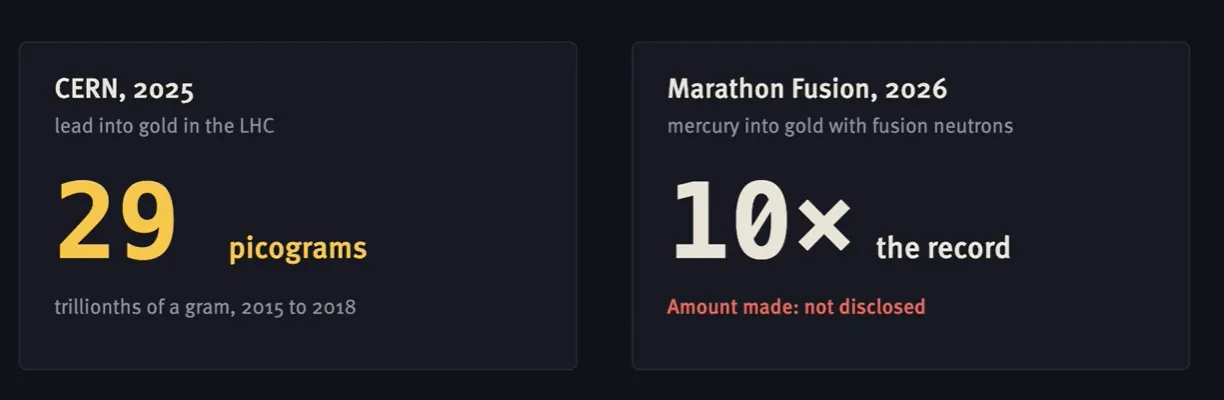
On October 21, 2026, Marathon Fusion announced on social media that it had conducted a nuclear transmutation experiment in September, using 14 MeV fast neutrons generated by deuterium-tritium (D-T) fusion to irradiate mercury. The company claims the process produced stable gold-197 at a rate 10 times higher than CERN’s 2025 benchmark. It also reported progress on its proprietary plasma centrifuge for isotope enrichment and said it was preparing to build a new fusion device. However, the full experimental dataset and independent verification of the gold-production claim have not yet been publicly established.
The underlying concept was first presented in a July 2025 arXiv preprint titled Scalable Chrysopoeia via (n, 2n) Reactions Driven by Deuterium-Tritium Fusion Neutrons. Rather than relying on conventional particle accelerators, the proposed method uses high-energy neutrons from a fusion reactor to transform a specific mercury isotope into gold.
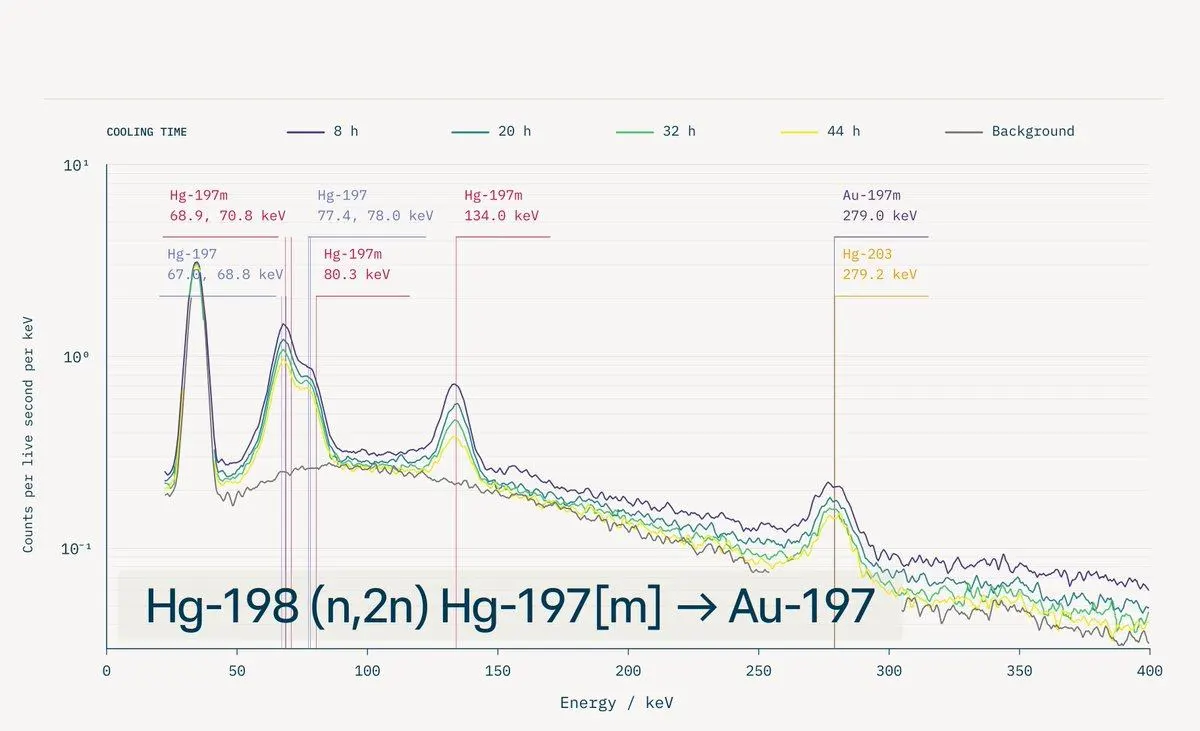
The process begins with enriched mercury-198 (Hg-198), which is exposed to 14 MeV neutrons produced by D-T fusion. Through a nuclear reaction known as (n,2n), the mercury-198 nucleus emits two neutrons and becomes mercury-197 (Hg-197). The radioactive Hg-197 then undergoes electron-capture decay, with a half-life of approximately 64 hours, converting into stable gold-197 (Au-197).
Unlike conventional attempts to manufacture gold solely for its market value, this approach is designed to integrate gold production into the neutron-multiplying blanket surrounding a fusion reactor. The same nuclear reactions could help multiply neutrons and support tritium breeding, a critical requirement for sustaining D-T fusion fuel cycles.
According to the team's theoretical simulations, a fusion system producing 1 gigawatt of thermal power could generate approximately two metric tonnes of gold annually. If achieved at scale, this additional revenue could improve the economics of fusion power plants, potentially making fusion deployment more financially attractive. The researchers have also proposed exploring whether the technology could help address mercury pollution by converting recovered mercury into a more valuable, stable material.
However, the gap between a promising nuclear concept and a commercially viable process remains substantial.
First, Marathon Fusion's recent gold-production claim requires further independent verification. Although the company has announced experimental progress, publicly available information does not yet establish the amount of gold produced, the overall conversion efficiency or the reproducibility of the result.
Second, isotope enrichment is expensive. Naturally occurring mercury contains only a limited proportion of Hg-198, so obtaining sufficient quantities of enriched material could create a significant cost and supply-chain challenge.
Third, neutron irradiation can produce radioactive intermediates and other nuclear reaction products. Any practical production system would need carefully engineered radiation shielding, cooling and chemical separation processes before the gold could be recovered and handled safely. The time required for radioactive decay and the management of contaminated materials would also affect operating costs.
Finally, commercial fusion power remains an engineering challenge. A system capable of delivering sustained, commercially competitive fusion energy at gigawatt scale is not yet a mature, widely deployed technology. The proposed gold output is therefore a theoretical projection, not a demonstrated annual production capacity.
The idea of transforming mercury into gold is not entirely new. Nuclear transmutation experiments using particle accelerators date back decades, including early work in the 1940s. Such experiments established that changing one element into another is physically possible, but the quantities produced were far too small and the costs far too high for commercial gold manufacturing.
Marathon Fusion's proposed approach differs in its attempt to use the high-energy neutron flux of a fusion reactor to pursue a scalable production route while supporting the reactor's fuel cycle. Its significance, if independently validated, would lie less in the symbolic achievement of making gold than in finding a potentially valuable use for fusion neutrons.
For now, this is not a shortcut to instant wealth or a technology poised to flood the gold market. It is an intriguing research direction at the intersection of nuclear physics, isotope engineering and fusion-energy economics. The ancient dream of alchemy may be receiving a modern scientific reinterpretation, but proving that it can work reliably and economically at industrial scale remains the real challenge.

