Understanding the New Surface Acoustic Wave (SAW) Current Sensor

Recent innovations in current sensing have led to the development of a novel surface acoustic wave (SAW) current sensor, offering significant advantages over traditional current detection technologies. By integrating the fast response characteristics of SAW technology with the high magnetic sensitivity of magnetostrictive thin films, this new sensor achieves multiple performance breakthroughs and represents a major advancement in the field of electrical measurement.
Key Differences from Traditional Current Sensors
The core distinction of the new SAW current sensor lies in its detection principle and structural design, leveraging a combination of SAW technology and magnetostrictive effects to address limitations found in conventional sensors:
Hall Effect Sensors: Rely on the Hall effect, requiring DC power supply, complex insulation, and sensitive to temperature variations and offset currents.
Fiber Optic Sensors: Utilize the Faraday magneto-optic effect and offer high sensitivity, but are expensive, fragile, and challenging to deploy and maintain.
New SAW Current Sensor: Features a compact, chip-integrable design with wireless, passive operation potential. It offers strong electromagnetic interference resistance, fast response, and high sensitivity, making it suitable for extreme environments, including high temperature and high pressure scenarios.
The SAW sensor overcomes traditional constraints in environmental adaptation and power supply dependency, while structural optimization mitigates inherent errors associated with magnetostrictive materials.
Working Principle
The sensor operates based on the interaction between magnetostrictive effects and surface acoustic wave propagation:
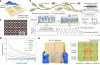
Structural Design: It uses a dual-channel differential oscillator architecture. One channel is coated with a FeCo magnetostrictive thin film, while the reference channel remains uncoated. This design effectively cancels out environmental disturbances such as temperature changes and vibrations.
Detection Process: The magnetic field generated by the measured current induces strain in the FeCo film through magnetostrictive effects. This strain changes the elastic modulus of the film, which in turn alters the propagation speed of surface acoustic waves. The resulting frequency shift accurately maps the electrical current, providing precise measurement.
Error Control: The FeCo film is patterned into a grating array, with strip width and spacing equal to one wavelength (λ). This design suppresses residual magnetization and minimizes hysteresis error, enhancing measurement accuracy.
Technical Highlights
High Sensitivity and Low Hysteresis: The grating array design achieves a sensitivity of up to 18 kHz/A, hysteresis error as low as 1.14%, and linearity of 0.73%, significantly outperforming conventional FeCo thin-film sensors.
Strong Environmental Adaptability: The dual-channel differential structure and inherent EMI resistance of SAW technology enable stable operation in high-temperature, high-pressure, and unmanned environments without additional shielding.
Chip-Scale Integration Potential: Fabricated using planar semiconductor processes and magnetron-sputtered FeCo films, the sensor is compact, suitable for dense installations, and supports batch production.
Flexible Operating Frequency: Sensitivity increases with frequency, achieving optimal performance at 300 MHz. The working frequency can be tuned between 80 MHz and 300 MHz to meet application-specific requirements.
Application Value
The new SAW current sensor addresses several limitations of conventional sensors and enables a wide range of applications:
Wireless, Passive Operation in Harsh Environments: Ideal for scenarios where on-site power supply is unavailable, reducing wiring and maintenance costs.
Advanced Magnetostrictive-SAW Integration: The grating array design solves magnetostrictive hysteresis issues, enhancing overall sensor performance.
Simplified Design: Eliminates the need for complex magnetic cores or feedback coils while maintaining performance comparable to high-end sensors.
Wide Measurement Range: Capable of detecting currents as low as 0.05 mA with fast response, suitable for both precision measurement and large-current monitoring.
Conclusion
The novel SAW current sensor represents a significant advancement in electrical measurement technology. By combining magnetostrictive thin films with surface acoustic wave technology and leveraging optimized structural designs, the sensor achieves high sensitivity, fast response, environmental robustness, and chip-scale integration potential. This makes it a compelling solution for modern industrial, high-voltage, and precision sensing applications, bridging the gap between traditional current sensing methods and next-generation measurement technologies.