Comparison of Planetary Gear Reducers and Conventional Gear Reducers
Planetary gear reducers and conventional gear reducers (such as cylindrical gear reducers and worm gear reducers) differ significantly in terms of structural design, transmission principles, and performance characteristics. The following analysis compares these two types of gearboxes across multiple dimensions:
1. Structural Design and Transmission Principles
Planetary Gear Reducer:
Structural Features:
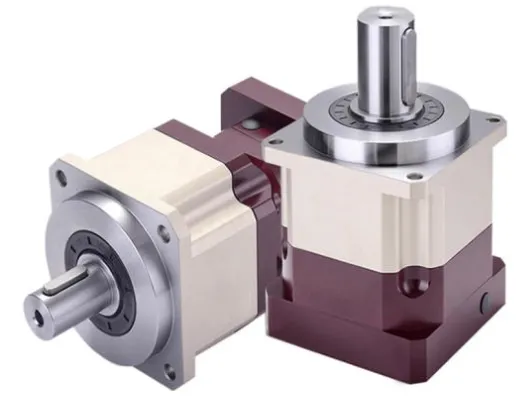
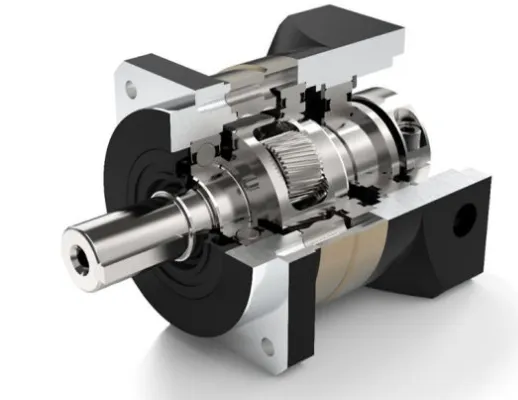
The planetary gear system consists of a sun gear, multiple planet gears, an internal gear, and a planet carrier, which form a "planetary gear train." The planet gears revolve around the sun gear while simultaneously rotating on their own axes, transmitting power through multiple tooth engagements. This results in a compact structure, with components arranged coaxially.
Transmission Principle:
The input shaft drives the sun gear, and the planet gears engage with both the sun gear and the internal gear, transmitting power through the planet carrier. The "revolution + rotation" of the planet gears achieves reduction. By adjusting the gear ratios between the sun gear, planet gears, and internal gear, the transmission ratio can be modified.
Conventional Gear Reducer (e.g., Cylindrical Gear Reducer):
Structural Features:
The conventional gear reducer typically consists of a driving gear and a driven gear arranged on parallel shafts. Gear types commonly include spur gears, helical gears, or bevel gears. The structure is relatively simple and typically bulkier.
Transmission Principle:
The input shaft directly drives the driving gear, which meshes with the driven gear, achieving reduction through the difference in the number of teeth. The transmission path follows a "single-stage linear engagement."
2. Transmission Efficiency and Load Capacity
Planetary Gear Reducer:
Due to the coaxial arrangement and power distribution across multiple gears, planetary gear reducers offer higher transmission efficiency and enhanced load-bearing capacity. This design helps reduce energy losses and increases durability under high load conditions.
Conventional Gear Reducer:
While conventional reducers can achieve efficient power transmission, they tend to have higher energy losses and lower load capacity than planetary gear systems due to the simpler, single-stage gear engagement.
3. Size and Weight
Planetary Gear Reducer:
Planetary gear reducers are more compact, with a size reduction of 30%-50% and a weight reduction of 40%-60% compared to conventional reducers with the same load capacity. This makes them ideal for applications where space is limited, such as in aerospace and robotics.
Conventional Gear Reducer:
Conventional gear reducers, with their parallel shaft gear arrangement, experience a significant increase in size and weight as the transmission ratio and load increase, requiring more space (e.g., large industrial conveyors).
4. Operation Smoothness and Noise
Planetary Gear Reducer:
The even distribution of multiple planet gears results in load sharing, high meshing accuracy (especially when gears are precision ground), and smooth operation. These reducers generally operate with noise levels under 65 dB, making them suitable for precision equipment such as CNC machines.
Conventional Gear Reducer:
Single-stage gear engagement in conventional reducers can lead to impact and vibration, with worm gear reducers, in particular, generating higher noise due to sliding friction (noise levels can reach 75-85 dB). The operation is typically less smooth compared to planetary systems.
5. Application Scenarios
Applications for Planetary Gear Reducers:
High Load with Compact Structure: Such as in heavy machinery (e.g., excavator swing mechanisms), wind power equipment (e.g., gearboxes), and automotive automatic transmissions.
Precision Transmission Needs: Used in robots’ joints, aerospace engine reduction devices, where high transmission accuracy and reliability are crucial.
Space-Constrained Mobile Devices: Such as drones and electric vehicle drive systems, where both lightweight and power performance are essential.
Applications for Conventional Gear Reducers:
Low Speed with High Reduction Ratios: Such as in elevator traction machines (worm gear reducers) and small machine tool feed systems.
Cost-Sensitive Applications: Suitable for light industrial equipment like textile machines and packaging machinery, where simple structures and ease of maintenance are key.
Long-Distance Transmission with Large Center Distances: Cylindrical gear reducers can be used in multi-stage configurations for long-distance power transmission, such as in mining conveyor systems.
6. Maintenance and Cost
Planetary Gear Reducer:
Complex Structure, High Manufacturing Precision: Due to the intricate design and the need for tight tolerances (such as precise gear meshing), planetary gear reducers have higher initial costs.
Long Lifespan and Low Maintenance Frequency: With lower wear and a long lifespan (up to 100,000 hours), planetary gear reducers require less frequent maintenance (typically oil change every 2-3 years).
Conventional Gear Reducer:
Simple Structure, Lower Manufacturing Costs: Conventional gear reducers are easy to produce, making them cost-effective, especially for mass production.
Higher Maintenance Frequency: Worm gears, in particular, experience greater wear (e.g., copper worm gears need to be replaced periodically), and thus require more frequent maintenance (usually 1-2 times per year).
Summary: How to Choose?
Choose a Planetary Gear Reducer: If the requirements include high load capacity, compact size, high precision, and long lifespan (e.g., industrial robots, renewable energy equipment).
Choose a Conventional Gear Reducer: If the requirements are low cost, large reduction ratio, and simple structure (e.g., small machine tools, light industrial equipment).
The core distinction between the two types of reducers lies in the planetary gear reducer's compact design and efficient transmission, while the conventional gear reducer's advantage is its simple, low-cost structure. The selection should be based on a comprehensive assessment of the operational environment, load requirements, available space, and cost constraints.