Key Technologies in Humanoid Robot Standing and Walking
Humanoid robots' ability to stand and walk remains one of the most challenging technical problems in robotics. Compared to quadruped or wheeled robots, bipedal walking systems face more complex dynamics and stricter control precision requirements. This article systematically explores the core technological framework for humanoid robot standing and walking from an engineering perspective.
1. Dynamic Balance Control: The Foundation of Standing
Zero Moment Point (ZMP) Theory
The Zero Moment Point (ZMP) is the theoretical cornerstone of humanoid robot balance control. ZMP is defined as the point on the support surface where the sum of all moments in the horizontal direction equals zero. When the ZMP is within the support polygon, the robot remains stable; if the ZMP goes outside the polygon, the robot will lose balance.
From an engineering perspective, ZMP control requires real-time monitoring of the following parameters:
Robot’s center of mass (COM) position and velocity
Joint angles and angular velocities
Foot pressure distribution
Inertial Measurement Unit (IMU) data
Mainstream ZMP control strategies include:
Preview Control: Predicts the ZMP trajectory for a short period ahead and adjusts the robot's posture accordingly. Honda’s ASIMO robot uses this strategy, able to predict and adjust its gait within 0.35 seconds.
Linear Inverted Pendulum Model (LIPM): Simplifies the robot into a point mass inverted pendulum system, calculating gait trajectories quickly via analytical methods. This method is computationally efficient and suitable for real-time control but has limited accuracy on complex terrains.
Center of Mass Height Control
Dynamic control of the center of mass height is essential for shock absorption and adapting to terrain changes. Engineers typically use:
Compliance Control: Actively absorbs impact through coordinated bending of the knee and ankle joints.
Impedance Control: Mimics a spring-damping system to achieve force-position decoupling.
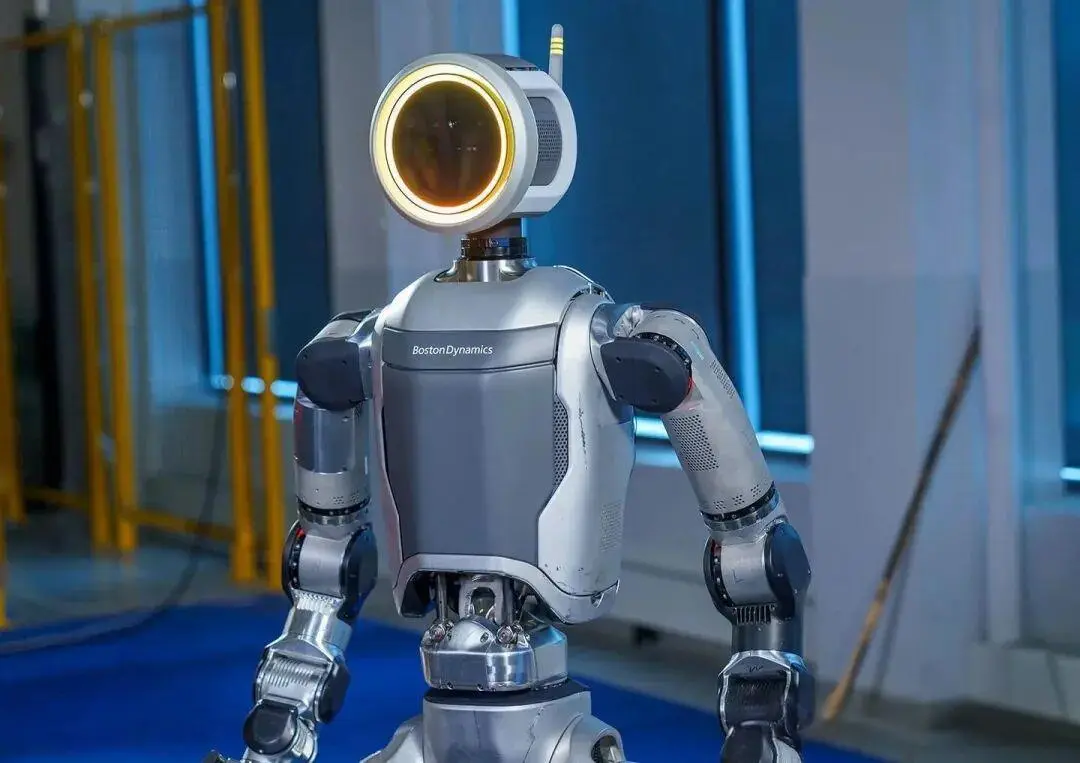
Boston Dynamics' Atlas robot excels in this area, with a center of mass control algorithm that can rapidly adjust posture in response to external pushes, maintaining balance.
2. Gait Planning and Generation
Decomposition of Gait Phases
The walking process of humanoid robots can be divided into the following phases:
Double Support Phase: Both feet are in contact with the ground, providing the most stable system.
Single Support Phase: One foot supports the entire weight while the other swings.
Heel Strike: The heel of the swinging foot first touches the ground.
Full Foot Contact: The foot is fully flat on the ground.
Toe Off: The toe of the support foot lifts off the ground last.
The core goal of gait planning is to determine the timing and trajectory of these phases to ensure both fast walking and stability.
Trajectory Generation Methods
Central Pattern Generator (CPG): Inspired by biological neural systems, CPG generates periodic gaits through coupled oscillators. CPG-based methods are highly robust and adaptive, smoothing gait transitions. Japan's HRP series robots widely use CPG.
Model Predictive Control (MPC): Uses the system’s dynamic model to optimize control sequences over a finite time horizon. MPC handles constraints explicitly and is ideal for complex optimization tasks. Tesla’s Optimus robot uses an MPC-based full-body control framework.
Reinforcement Learning: Trains models through extensive simulation to learn an end-to-end mapping from sensory input to joint control. This method excels in walking on rugged terrain and handling dynamic tasks but requires large datasets and significant computational resources.
3. Joint Actuators and Execution Technologies
Actuator Selection
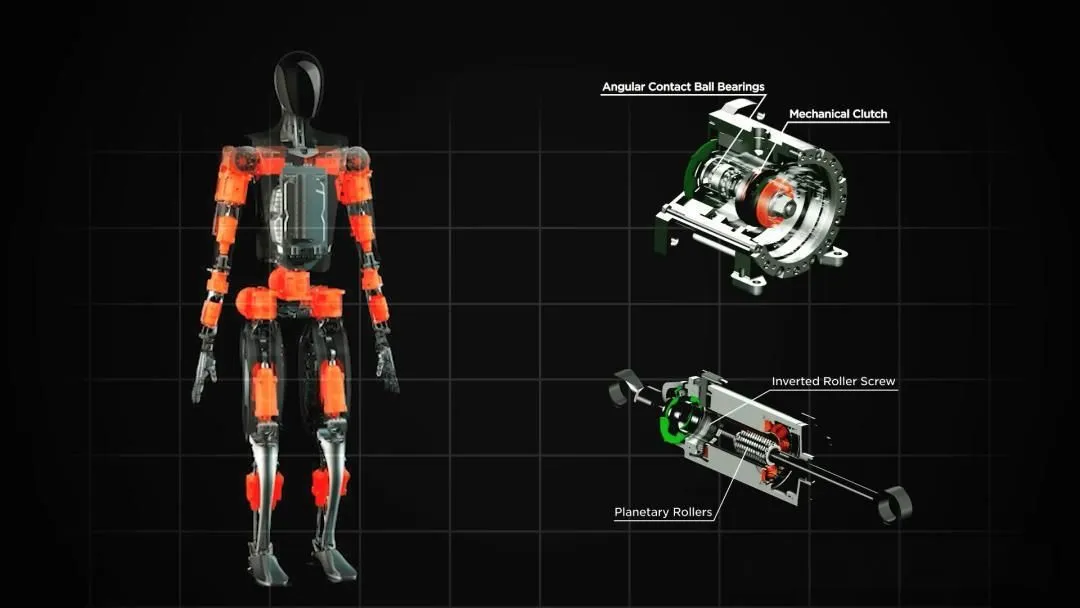
The actuators in humanoid robots’ joints need to balance power density, response speed, and control precision. The current mainstream options include:
Quasi-Direct Drive: Uses low gear ratios (typically less than 6:1) with planetary or harmonic gear reducers, balancing torque output and dynamic response. MIT Cheetah and Unitree H1 both adopt this system, achieving high dynamic performance.
High Gear Ratio Servo Systems: Use gear ratios ranging from 40:1 to 100:1, providing higher torque and position stiffness. These systems are more suitable for heavy loads or applications requiring precise position control, but suffer from mechanical lag at high speeds.
Hydraulic Actuators: Provide the highest power density but come with increased system complexity. Boston Dynamics' early Atlas robot used hydraulic systems before switching to electric drives to reduce maintenance costs.
Drive System Design Considerations
Torque-Speed Matching: The hip joint needs high torque (80-150 Nm) to support the body’s weight, while the knee joint needs moderate torque (60-100 Nm) for flexion and extension, and the ankle joint requires fast response (bandwidth >30 Hz) for balance maintenance.
Mechanical Compliance: Rigid actuators have difficulty absorbing shocks and can damage sensors and mechanical structures. Engineers typically implement:
Series Elastic Actuators (SEA)
Low-damping quasi-direct drive designs
Software-implemented impedance control
Heat Management: During continuous walking, motor power can reach several hundred watts, necessitating effective cooling solutions. Common methods include aluminum alloy casings, heat pipes, and active air cooling.
4. Sensor Fusion and Perception Systems
Body Perception Sensors
Six-Dimensional Force/Torque Sensors: Installed on the feet to measure the ground reaction forces, directly feeding data into the ZMP calculation. Industrial-grade sensors typically offer precision within 0.5-1% of full-scale range, with a sampling rate of 200-1000 Hz.
Inertial Measurement Units (IMUs): Measure the robot’s angular velocity and acceleration for posture estimation and tip-over detection. High-performance IMUs, such as the Xsens MTi series, have an angular velocity resolution as low as 0.01°/s.
Joint Encoders: Absolute encoders provide position information retained during power loss, while incremental encoders offer higher resolution (up to 20 bits). For quasi-direct drive systems, encoder resolution directly impacts torque control accuracy.
Environmental Perception Sensors
Depth Cameras: Devices like Intel RealSense and Azure Kinect provide real-time 3D point clouds for obstacle detection and terrain modeling. Typical configurations offer 30 Hz frame rates with ±2 mm depth accuracy.
LiDAR (Light Detection and Ranging): Provides longer detection ranges (10-30 meters) and higher accuracy but at a higher cost. Solid-state LiDAR sensors like Livox Mid-70 are becoming more popular.
Visual Odometry: Estimates movement trajectories using stereo or RGB-D cameras, compensating for IMU drift. Algorithms like ORB-SLAM and VINS-Fusion are widely used in robotics.
Data Fusion Architecture
Modern humanoid robots typically use Extended Kalman Filters (EKF) or Unscented Kalman Filters (UKF) for state estimation, integrating:
IMU data for high-frequency (200-1000 Hz) posture updates
Visual odometry for lower-frequency (10-30 Hz) but accurate position corrections
Force sensors for contact state detection
Joint encoders for kinematic constraints
Multi-sensor fusion significantly improves state estimation robustness. For example, when a robot slips on a smooth surface, visual odometry can detect discrepancies between actual and expected displacement, triggering a controller adjustment.
5. Full-Body Coordination Control Architecture
Layered Control Structure
In engineering practice, a three-layer control architecture is commonly adopted:
Task Layer: Handles high-level commands (e.g., “walk to a target”), outputting desired COM trajectory and footstep positions.
Planning Layer: Solves full-body inverse kinematics and inverse dynamics to generate desired joint trajectories. This layer must account for:
Kinematic constraints (joint angle limits, collision avoidance)
Dynamic constraints (torque saturation, friction cone constraints)
Optimization objectives (energy minimization, smoothness)
Execution Layer: Implements joint-level PID or torque control to track desired trajectories. Modern robots often use torque control with feedforward compensation to enhance response speed.
Optimization Solving Methods
Quadratic Programming (QP): Converts the full-body control problem into a constrained optimization problem, solving for optimal control inputs in real time. QP solvers like qpOASES and OSQP can provide solutions within milliseconds, meeting real-time control requirements.
Priority Task Control: In cases of task conflict (e.g., COM tracking, posture maintenance, footstep planning), tasks are prioritized sequentially. For instance, preventing a fall takes higher priority than precise trajectory tracking.
6. Robustness and Fault-Tolerant Design
External Disturbance Suppression
Active balance strategies allow the robot to react to external disturbances:
Ankle Strategy: For small disturbances, adjust the ZMP position via the ankle joints.
Hip Strategy: For moderate disturbances, adjust the center of mass through upper body movements.
Stepping Strategy: For large disturbances, take a step to regain balance.
Boston Dynamics' Atlas can withstand up to 70 N of lateral force without falling, relying on a multi-strategy fusion active balance system.
Fall Recovery
Completely avoiding falls is impractical, so humanoid robots are designed with fall detection and self-righting capabilities:
Fall Detection: Monitors body tilt (triggering at >45°) and center of mass acceleration (triggering at >2g).
Protection Actions: Retracts limbs and lands on the back or side to avoid excessive load on joints.
Standing Up Sequence: Predefined recovery movements, including rolling over, limb support,
7. Engineering Challenges and Difficulties
Real-Time Computational Bottlenecks
The computational complexity of full-body control increases non-linearly with the number of degrees of freedom (DOF). For a humanoid robot with 30 degrees of freedom, inverse dynamics calculations involve hundreds of trigonometric functions and matrix operations. To address these challenges, engineers typically use the following methods:
Model Simplification: Ignoring secondary factors such as Coriolis forces and higher-order centrifugal forces.
Parallel Computing: Leveraging GPUs to accelerate matrix operations or using FPGAs to implement fixed pipelines for faster computation.
Precomputed Tables: For periodic motions (such as steady walking), pre-calculating and storing the trajectories in advance can help optimize computation time.
Hardware Reliability
Mechanical wear, sensor drift, and communication delays can all lead to control failures. To improve reliability, engineers adopt the following measures:
Redundancy: Critical sensors (such as IMUs) are often designed with backup units to ensure consistent data availability.
State Monitoring: Continuous monitoring of motor temperatures, battery voltage, and communication quality helps detect and mitigate potential failures.
Safety Protocols: Software and hardware limits are set to prevent joint overloading and ensure safe operation.
Terrain Adaptability
The difference between a flat laboratory floor and real-world environments is vast. Current research focuses on:
Visual-Guided Gait: Using depth cameras to detect obstacles and steps in advance, allowing the robot to adapt its gait accordingly.
Terrain Classification: Using foot pressure sensors to detect different types of terrain (e.g., concrete, grass, gravel) and adjust the walking strategy accordingly.
Online Gait Adjustment: Dynamically modifying stride length, step frequency, and center of mass height based on real-time terrain characteristics.
8. Trends in Commercialization and Technological Outlook
Commercialization Progress
As of 2026, the humanoid robot industry has transitioned from the stage of technical verification to small-scale production. Key developments include:
Boston Dynamics' Atlas: The robot has shifted from a hydraulic system to a fully electric drive, reducing energy consumption and maintenance costs.
Tesla Optimus: Using automotive-grade supply chains, the goal is to reduce the robot's cost to under $20,000.
Xiaomi CyberOne: Featuring a 21-degree-of-freedom design, this robot focuses on emotional interaction and dexterous manipulation.
Technological Evolution
Looking ahead, the key directions for humanoid robot technology are as follows:
AI-Driven Motion Generation: Large-scale reinforcement learning and motion capture data training are enabling robots to learn human-like, natural gaits and movements.
Modular Actuators: Standardized joint modules (e.g., Unitree's B1 actuators) are lowering design barriers and accelerating product iteration.
Energy Efficiency Optimization: Bio-inspired energy recovery mechanisms (such as elastic energy-storing joints) and smart power management are improving battery life, extending operational time to 4-8 hours.
Cloud-Based Collaborative Control: Offloading computationally intensive tasks (such as path planning and scene understanding) to the cloud reduces the local computing burden and enables more efficient operations.
Conclusion
Humanoid robot standing and walking technology is an interdisciplinary system engineering challenge, involving mechanical design, control theory, sensor technology, and computer vision, among others. While current technological capabilities allow for stable walking in controlled lab environments, further breakthroughs are needed in complex terrain adaptability, energy efficiency, and long-term reliability.
With advancements in actuator technology, AI algorithms, and the maturation of the industrial supply chain, humanoid robots are expected to achieve broader commercialization within the next 3-5 years. They will play significant roles in industries such as manufacturing, services, and rescue operations. The experience and methodologies gained by engineers and researchers throughout these technical challenges not only advance robotics but also provide new insights into human movement control mechanisms.